
By Jordan Bimm
Many people know that microplastics pose a global environmental threat and a challenge to remove. If you’ve seen recent news coverage of the growing menace posed by microplastics, you’ve probably learned that these tiny pieces of human-made polymer chains that started their lives as consumer or industrial products have been found everywhere from Antarctica to the deep oceans, to the atmosphere–even the insides of the human body. The problem is the same for plastics of any size; it can take hundreds if not thousands of years for these materials to decompose.
Microplastics are small bits of plastic debris that can range in size from 5 millimeters (the size of a pencil eraser) down to 1 nanometer (the microscopically small scale of one billionth of a meter). Scientists are still working to understand how pervasive they are on Earth and their short and long term ecological impacts on different environments. We don’t know yet if microplastics now pollute extraterrestrial environments that humans have visited or sent robotic spacecraft, like the Moon and Mars, but it is a very real possibility.
As part of the Martian Biology program, Olivia Drayson, a PhD candidate in environmental toxicology at UC Irvine, has been asking this question about Mars analogs. Are there detectable microplastics in the water systems surrounding MDRS and FMARS? Answering this question involves collecting water samples at different field sites nearby and reachable from both of the Mars Society’s analog sites.
Drayson began this microplastics study last summer at FMARS, the Mars Society’s analog station located on Devon Island (Tallurutit in Inuktitut) in Nunavut, a territory of Canada. Drayson was a member of Crew 15 which visited the station for 2 weeks in July 2023 and conducted a weeklong simulated mission. Now at MDRS, as a member of Crew 298, Drayson extends the study she began in the arctic to the desert and sub-alpine environments near Hanksville, Utah.
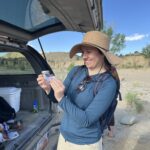
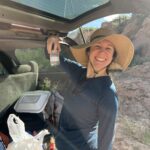
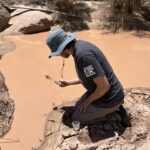
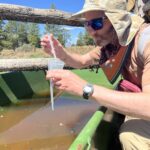
To discover whether microplastics have reached and are present in the water around an analog site, Drayson, who also holds a BA in Physics from the University of Oxford, collects samples from the ocean, lakes, creeks, snow melt, washes, and springs. Whenever she encounters water in the field, Drayson produces a tiny container to transport a sample back for laboratory analysis. The only catch, obvious when you think about it, is that the container cannot be made of any plastic, which could contaminate the sample and confound her search.
The job of selecting a suitable container runs directly into the problem she is studying. Plastics are everywhere and in everything making it difficult to find the right tool for the job. Luckily in the aisles of Grand Junction’s expansive Walmart she was able to locate a set of small glass jars with metal lids free of any plastic.
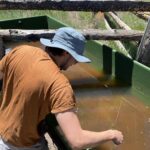
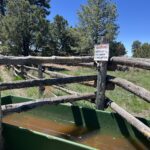
Today, when the crew revisited a field site near the Henry Mountains, Drayson collected two water samples for her microplastics study. The first was at South Creek at the foot of the Henry Mountains where we retrieved a “critter cam” deployed earlier in the week. On account of the dryness we’ve previously noted this season, the scant amount of water present was even less than a few days ago. Still, Drayson succeeded in collecting a good sample for analysis. The second site Drayson collected a small sample of water was Sandy Creek a small but steadily flowing creek that intersects the dirt Henry Mountain Road that leads to Notam Road, our route back home to MDRS.
Later on, Drayson plans to use a special dye called Nile Red which binds to plastic to identify whether microplastics are present in these water samples. This involves adding the dye and then examining the water under a fluorescent microscope. If she detects microplastics, she plans to send samples out for laboratory analysis which can determine which type of plastics it is providing clues to their origin and original intended use.
“How can we understand the current risk microplastics pose?” Drayson asks. “It’s disheartening to see just how far the products of humanity have reached. It shows that everything is connected and we’ve touched everything in a negative way.”
Drayson hopes that determining the presence of microplastics in analog environments can contribute to an understanding of the true reach and risk in the present on Earth, and in our future in space. “I worry that if humans travel to the Moon and Mars how we might contaminate these places as well and whether some places are better left untouched.”
Her study left us looking differently at the plastics all around us. For example, think about the last plastic object you touched. Maybe it was your computer keyboard, a pen, or a plastic water bottle or straw. Try to imagine where this material will be, not in a month or a year, but in 100 years, 500 years, 1000 years. These innocuous objects of everyday life will outlast us all and we owe it to future generations to control their spread and mitigate their impact, on Earth, and eventually on the Moon and Mars.
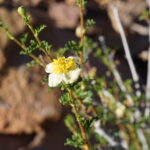
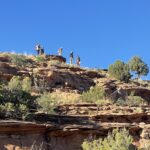
By Jordan Bimm
The Martian Biology program happens in June, at the end of each MDRS season. This means we often contend with the hazard of heat. The planet Mars is cold, but MDRS can get very hot. As seasoned field researchers, we are used to working outdoors when the mercury hits 100 degrees F (38 degrees C). And today was one of those days. Over the years we have developed a few methods to beat the heat while still completing our science goals.
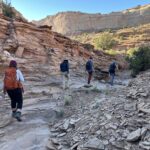
The first is to start early. Very early. This morning our alarms rang out at 4:45 am–over an hour before sunrise. With just a faint purple glow surrounding the science dome, we drank coffee, packed our backpacks, and piled into the Crew Car departing MDRS at 6 am sharp. Our destination? A new field site we had not surveyed before: Temple Mountain Wash, located an hour’s drive north. We arrived on site, ready to work, at 7:15 am. By then the sun was up and already feeling very warm on our skin. In the field, we dress strategically to stay cool. This includes wearing wide brimmed hats, bandanas, loose, long sleeved desert gear, light colors that reflect sunlight, sunglasses, and of course, plenty of water and sunscreen. Still, the early hour meant the heat was tolerable, especially in the small partly shaded canyons we surveyed for vegetation, insects, and animals.
One type of vegetation we’ve long been interested in is lichen. Lichens are everywhere and yet most people don’t know about these complex and fascinating life forms. A surprising fact about lichens is that they are actually a symbiotic partnership between fungi and algae. Fungi provides the structure and algae performs photosynthesis, converting the sun’s rays into energy to sustain the dynamic duo. Another little known fact connects lichens and the planet Mars. In the first half of the twentieth century most astronomers and astrobiologists believed life existed on Mars, but that it took the form of vegetation similar to lichens. This was because lichens are known to survive in low-pressure, low temperature, and low-moisture environments, all aspects of Mars they saw as hurdles for more complex life. Over the past four years we’ve surveyed many sites around MDRS to compile an inventory of the different species of lichen present.
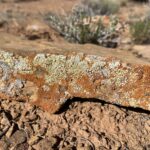
In the early morning light at Temple Mountain Wash we noticed the dominance of a single type of dull blueish-grey lichen called Acarospora strigata. This type is common around the MDRS Hab, and all across southeastern Utah. So much so that some field biologists jokingly call it “Blutah.” But it is often joined by other types of more colorful lichens presenting fiery oranges and vibrant greens. After wrapping up activity at our first stop we continued further down the Temple Mountain Wash road pulling over periodically to investigate sites that appeared promising. It was at our second stop that Olivia Drayson, a PhD candidate at UC Irvine discovered a lone collection of diverse lichens on a single rock outcrop.
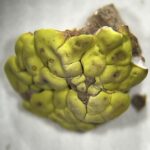
This collage of colorful lichens was a welcome break from the barrage of Blutah we had been noticing so far. Paul Solokoff, an expert in lichens, quickly identified two of the other types present here. The bright orange lichen was Xanthomendoza trachyphylla, also known as desert firedot lichen, and the green lichen was Acarospora stapfiana, also known as parasitic cobblestone lichen for piggybacking on other lichens.
I asked Sokoloff what was behind the dominance of Blutah lichen we had seen all morning at Temple Mountain Wash. He explained that Blutah is known for being especially hardy. “Bluetah is capable of spreading in harsh microenvironments with ease,” he noted, indicating that this gives it a competitive edge over other species when conditions are sub-optimal. At this site he noticed that much of the rock was hard shale, making it a more difficult substrate for lichens to manage.
Next, I wanted to know what might explain this highly localized exception to the uniformity Drayson had discovered. What was it about this place or this rock outcrop that meant other types of lichens also had a chance? Here he noted both the softer type of rock which made for a more favorable platform, as well as the outcrop’s prominence, making it an attractive perch for passing birds that provide extra nutrients for lichens in the form of excrement.
Starting early meant that we returned to MDRS by Noon, avoiding the ever increasing heat-of-day. In the Hab we retrieved some more improvised cool-down tools, water bottles strategically stowed in the fridge to be ice cold upon return, as well as another heat hack. Wet wipes placed in the freezer provide a refreshing and cooling sensation as they remove desert dirt and dust.
Finally, on these hottest of hot days, we take refuge in the MDRS Science Dome, the only part of the analog complex that has air conditioning. Here we set to work processing our samples from the field, writing up notes and findings, and keeping the heat in check. In this way, it is interesting to consider the possibility that MDRS can function not only as a Mars analog but also as an analog of a future Earth, one that is warmer and dryer than it is today. The strategies we use here in the field may become more commonplace as our climate changes and humans worldwide contend with rising temperatures.
By Jordan Bimm
“Is it still there?” “Yes! It survived!” We had our doubts about whether the Critter Cam we deployed at Hog Springs would last six days. Wind and weather can compromise these motion-activated digital cameras used to automatically photograph wildlife. But our biggest fear was the most dangerous critter of all: other humans. Maybe one of the eagle-eyed hikers who make their way along this short trail would spot the camouflaged instrument and out of curiosity or opportunism tamper with or remove the camera. But we were optimistic and our hope was rewarded. Field Biologist Samantha McBeth successfully recovered the camera she deployed on our first evening at MDRS along with its valuable data about what types of local fauna made their way past its lens.
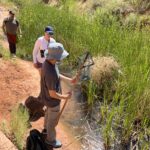
While she was slicing off the zip ties she had used to secure the camera to a long and thin wooden stake, neurobiologist Jacopo Razzauti was making a discovery of his own. Just a few feet away along the edge of a reedy and stagnant part of the marshy creek, something in the water caught his eye. Perched on the red clay trail overlooking the creek, Razzauti had been looking for mosquito larvae but spotted something else. This macroinvertebrate of interest was just hanging out 10 inches or so under the surface of the water. Pivoting his attention to this mysterious water-borne insect, he instinctively reached for his net.
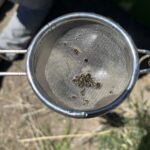
Unfortunately he had left his large butterfly net back in the Crew Car. For scooping mosquito larvae from creeks and ponds his weapon of choice is a small metal mesh strainer, you probably have one in your kitchen utensil drawer. But not to worry, Martian astronauts have long been depicted as creative problem solvers and we lived up to that cultural archetype. We quickly realized we could assemble a makeshift net by combining materials each of us were carrying.
McBeth produced the wooden stake her critter cam had been strapped to, a perfect handle. I reached in my backpack and pulled out my mosquito head net, its role instantly obvious to all. While Razzauti figured out how to attach the net to the handle, Olivia Drayson, an environmental toxicologist, went in search of the finishing touch: a small yet robust dead branch. She used this to prop the mouth of the net open and all of a sudden we were back in business.
Jacopo made a few solid swipes but the underwater critter proved too fast and made quick use of the labyrinth of reeds and resulting smokescreen of mud to evade capture. Still, we felt satisfaction in our quick-thinking and creativity in the field. Angus MacGyver and Mark Watney would be proud. Ingenuity may be a helicopter on Mars, but it also describes this testament to scientific teamwork at Hog Springs.
Our next stop was another attempt to “follow the water” to sites of rich biodiversity. This year’s hot and dry conditions has made employing this foundational principle of astrobiology more challenging than in any of our previous missions. We tried to think of places where we had seen water in the past at sufficient levels to make it likely to still be there this year. One spot came to mind: a tiny canyon site near the MDRS Hab known as Cowboy Corner. We visited this site in our previous missions in 2019, 2022, and 2023 and recalled the Oasis-like pond that usually punctuates the near end of the canyon.
Pulling up to Cowboy Corner we were greeted by a lone pronghorn. A pronghorn is a deer-like mammal with forked horns capable of outrunning every animal on Earth except the cheetah. We’ve seen them before but they’re always a treat to encounter. This one didn’t seem too concerned about us, and headed off in the direction of the pond. We took this as a good indicator that we’d find water hanging on there. After a short hike we peered over into the mini canyon and saw that our pronghorn friend had not led us astray. There was water, but substantially less than in years past. And the water that was there was little more than diluted mud. Our informal characterization was “forbidden milkshake.” But muddy brown water is still water, and where we find water we also find life, so we set to work.
Razzauti unholstered his trusty mesh strainer, knelt down next to the pond, and started fishing for mosquito larvae. He quickly found success, moving them to sample containers for transport back to the MDRS Science Dome. At the same time, McBeth had produced Razzauti’s insect net (there’s no way we’d forget it twice), and dipping it in the pond also hit paydirt. “Something is moving in here!” she called. The dirty, slimy consistency of the water made it difficult to tell exactly what she had found.
Looking over her shoulder at where she had deposited the contents of the net I noticed a mud-covered blob slowly pulsating and twitching. If filmed in close up, the scene could pass as something out of a 1950s creature feature. As McBeth fearlessly used her hands to remove the mud from this wriggling and mysterious lifeform, Razzauti was able to make a positive identification. “It’s a tadpole. But a really big one.” Sure enough, it was a tadpole, but at the size of an adult’s thumb it was larger than any I’d ever seen. We marveled at its large size but returned it to the pond in favor of the mosquito larvae. These two discoveries, the mystery macroinvertebrate at Hog Springs, and the supersized tadpoles at Cowboy Corner remind us of the vast array of life in Utah’s creeks and ponds that often fly under the radar.
After a short drive back to the Hab we unloaded our samples and hunkered down as a brief but intense rainstorm passed over MDRS. Amid the pitter-patter of raindrops and the occasional thunderclap we turned to crafting our final report and planning our fieldwork tomorrow, which will be our final full day of science for this mission.
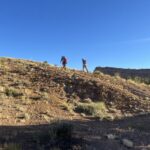

June 03, 2024, by Jordan Bimm
What life is out there? This question unites astrobiology, the field devoted to searching for extraterrestrial life, and our Martian Biology program at MDRS. Founded in 2019 by Dr. Shannon Rupert, an ecologist and Director Emeritus of MDRS, the Martian Biology program conducts non-sim biodiversity surveys of different field sites reachable from the Hab. We do this to establish a scientific understanding of what’s out there. Not on Mars, but around MDRS. What vegetation, insects, and animals exist in the desert south of the San Rafael Swell? What can an inventory of these forms of life tell us about our Station’s surrounding ecosystems and our planet’s environment?
Now beginning our fourth mission at MDRS, the crew (Crew 298) of Martian Biology IV consists of Shannon Rupert, Paul Sokoloff, a botanist at the Canadian Museum of Nature, Samantha McBeth, a field biologist, Jacopo Razzauti, a PhD candidate in neuroscience at Rockefeller University, Olivia Drayson, a PhD candidate in environmental toxicology at UC Irvine, and me, Jordan Bimm, a space historian and professor of science communication at the University of Chicago. Previous missions in 2019 (Crew 210), 2022 (Crew 243), and 2023 (Crew 282) have focussed on sites located close to the Hab accessible by rovers and have expanded progressively outward using the Crew Car to build a robust and comprehensive regional inventory.
We arrived on Station on Monday June 3, and immediately set to work at a new field site called Hog Spring, 64 kilometers south of MDRS and of special interest to McBeth. McBeth’s goal is to deploy the first of six “Critter Cams,” camouflaged motion-activated digital cameras that automatically record images of wildlife. Adopting the astrobiologist’s mantra of “follow the water” we selected Hog Spring due to its flowing H2O, making it a likely destination for all kinds of local life.
McBeth’s focus this time is on macrovertebrates, mostly larger mammals, although some rodents, amphibians, and reptiles may make an appearance as well and will be welcome additions.
“Realistically, we might see racoons, coyotes, foxes, skunks and weasels,” she says. “Amazing would be images of ringtails, a cousin of the raccoon, mountain lions, or even a bobcat. They’re out there!” The idea is to set up concealed Critter Cams and check back on them in a few days, to see what creatures have passed by and been photographed in the process. For bait, (technical term: “attractant”) McBeth uses a small can of Fancy Feast cat food advertised as “Grilled Tuna and Cheddar Cheese Feast.” “The smellier, the better,” she adds. We poked holes in the side of the can, hid it under a nearby rock, and hoped for the best.
Stay tuned for more updates, including from our Critter Cams, as our week-long mission progresses.
By Jordan Bimm.
Whether you’re on Earth or on Mars, if you’re looking for life, you follow the water. But this year, following the water around MDRS has been harder than ever. After visiting five initial field sites a big early takeaway of this mission is that this year is significantly dryer than any we have seen in 2019, 2022, or 2023. Already we have twice had to adjust our science plans on the fly due to arriving at a site only to find a hoped-for river or creek bone dry. We made tongue-in-cheek comparisons to the ancient river delta at Jezero crater that NASA’s Perseverance rover is investigating. In both cases water once flowed, but not currently. In both cases this absence of water poses a serious challenge for the search for life.
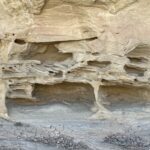
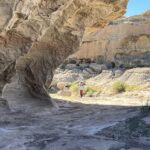
Today, following these setbacks, Shannon Rupert suggested we investigate a new field site she had visited many times in the past, but that our crew had not investigated. Coal Mine Wash is located about a 30 minute drive west of MDRS in the direction of Factory Butte. “If there’s no water at the pool, I’ll really be concerned,” Rupert said. From her description we knew this wasn’t a swimming pool but a prominent pond, a hidden oasis nestled in rock reachable via a short hike through a long-dry riverbed. Stunning rock formations, their rounded edges and oval window-and-arch-like structures, were carved by flowing water millions of years ago and lined the trail, towering over us on either side.
As we hiked in, we paid close attention to any evidence of animal activity. “Scats and tracks,” as Samantha McBeth is fond of putting it. McBeth points out that many types of desert fauna love the plethora of nooks and crannies the rock formations provide. They’re like nature’s condo buildings and perfect for avoiding the sun as well as predators. Walking in we noticed, measured, and cataloged tracks indicating recent pronghorn, mule deer, coyote, red fox, jack rabbit, whiptail lizard, shrew, and ground squirrel activity. Overhead cliff swallows and grey flycatchers flitted past, checking us out. Based on scat patterning, we also identified a likely bat roost in a rock overhang.
As we moved closer to our aqueous destination we noticed an increase in vegetation, which appeared larger and in greater abundance, as well as more bird activity. Strong signals that water lay ahead. Still, we had our doubts, and needed to see the water to believe it.
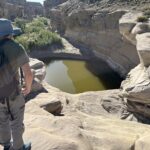
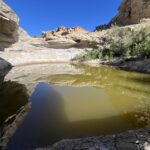
After twists and turns, and scrambling down a large stone ledge which spanned the miniature canyon, we arrived in the vicinity of “the pool.” Peering over a high ledge and onto the landscape below we let out a whoop of celebration and a sigh of relief. Water. We saw the large circular pond surrounded on all sides by stone walls below us. In the early morning sun the surface appeared bright green and the water level looked low based on visible water rings. We found a narrow pathway along one side which took us down to the soft mud next to the pond where we discovered a menagerie of tracks imprinted.
McBeth sprang into action deploying one of her critter cams, and Jacopo Razzauti began checking the pond for mosquitos and their larvae. Once McBeth had her camera deployed and Razzauti had captured several mosquitos using his aspirator, a tool insect scientists use to literally suck tiny bugs into a collection container, we turned to one final task at the Coal Mine Wash pond. McBeth directed the crew to disperse to different areas around the water source. On her signal we all hit record on our phones’ voice memo app, capturing a 2 minute long soundscape of the site. McBeth plans to use these field recordings of ambient sounds to confirm the presence of birds based on their distinctive calls.
Walking back out, and headed to our next site of the day, Salt Wash, we marveled at the natural beauty of the rock formations surrounding us, and celebrated a badly needed win: water where we thought there would be some.
You must be logged in to post a comment.