
June 04, 2024, by Jordan Bimm
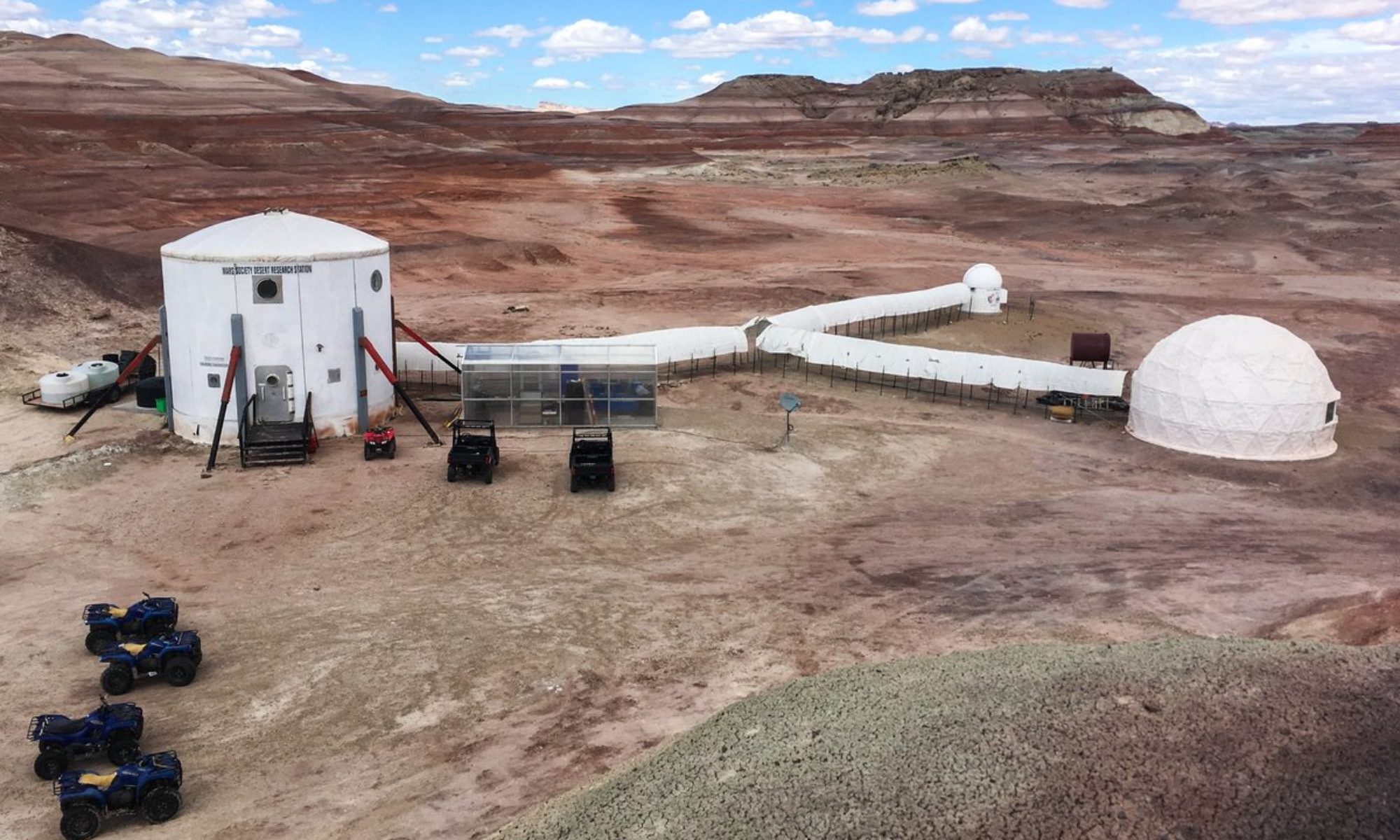
The warning sign read: “Water Not For Human Consumption.” But the greenish liquid we were staring at in a cow trough high in the Henry Mountains was more than fit for scientific research. In fact, for neurobiologist Jacopo Razzauti it is a biological goldmine. The water was teeming with life, wriggling with thousands of tiny wormlike critters. “This is larvae heaven,” exclaimed Razzauti, reaching for plastic pipettes and containers.
On the second day of Martian Biology IV, we decided to return to a field site we investigated last year. The Henry Mountains are a prominent range visible from the Hab, appearing as bluish, snow capped peaks in the distance due south. To reach the site we drove roughly 100 km winding up and down the mesa and eventually ascending from the familiar desert to a biologically rich sub-alpine forest. We parked the Crew Car at a site called McMillan Springs Campground, 8,400 feet above sea level.
When we visited this site last year, Razzauti had stumbled upon a cow trough filled with mosquito larvae, his primary object of study as a PhD candidate in neuroscience at Rockefeller University in New York City. Razzauti studies mosquitos to understand this common pest and infamous disease vector responsible for up to 1 million human deaths per year. This year he was anxious to see if the cow trough was still there, and if it again contained a mosquito motherlode.
As soon as Commander Paul Sokoloff parked the Crew Car we were off. Retracting our steps from last year, as if it had only been yesterday, we quickly spotted the trough just below the collection of campsites with their well-used grills and fire rings. As soon as we looked down into the trough our hopes were confirmed, and we quickly got to work.
Razzauti handed me a plastic pipette, a long plastic tube-shaped tool, like a large eye dropper or a small turkey baster. The goal was to collect as many mosquito larvae as possible. Squeezing the blub end of the pipette primes the device for action. Next you try to place the nozzle as close to a wriggling larvae as possible and then release pressure on the blub to instantly suck these proto-pests up into the pipette. Then it’s a simple process to expel the larvae and accompanying water into a small container for transport. The work became a game, and a simple one at that. Within just a few minutes we had captured hundreds of these critters from our impromptu scientific cistern.
“Some made it back to MDRS, but not all of them,” noted Razzauti referencing the portion of the larvae that died on the journey back. At MDRS Razzauti took the larvae container to the Science Dome where he plans to wait for the hardy survivors to develop into pupae, the stage of insect development between larvae and adult. Then he will isolate them, attempt to identify which species of mosquitos are present in our samples, and then track their activity and circadian rhythms. Do they all work on the same clock? Or do they stagger their activity to better share the space? How will these findings compare to last year’s?
Science is often focused on novelty, but today we noticed the value of recursion. You make new discoveries, leverage local knowledge acquired last time, and gain the ability to compare findings from year to year generating valuable insights. It all contributes to the twin goals of making mosquitos less deadly, and furthering our knowledge of non-desert ecosystems reachable from MDRS.
Martian Biology 4 (MDRS 298) Mission Plan – June 3-10, 2024
This is the fourth non-simulation mission in the Martian Biology program, which seeks to understand the biodiversity of the Mars Desert Research Station (MDRS) operational area, both to better support analog missions and to understand this unique biome. The crew consists of Dr. Shannon Rupert, Dr. Jordan Bimm, Samantha McBeth, Jacopo Razzauti, Olivia Drayson, and Paul Sokoloff.
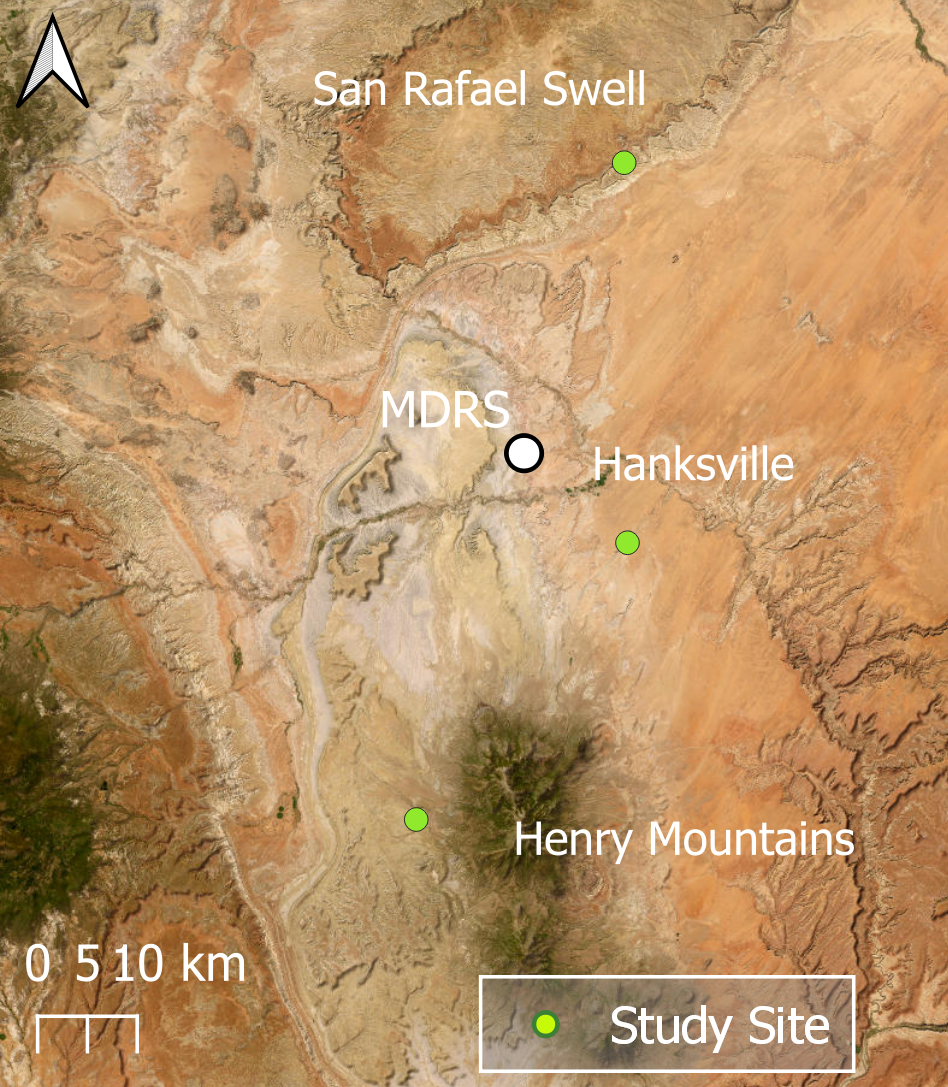
In 2024, we will focus the efforts of our multiple projects at three study sites: Collie Wash (38.32626, -110.67395), the lower slopes of the Henry Mountains (38.07799, -110.91507), and the San Rafael Swell via Temple Mountain Wash (38.66577, -110.67774). Each location would be visited twice – once early in the week to deploy any traps or monitoring devices required, and again at the end of the week to retrieve the samples and/or loggers.
We will continue work on studying the plant and lichen biodiversity of the station through a collections based inventory. We will deploy trail cameras at these locations to better understand the vertebrate diversity at these locations, comparing the data with those available through citizen science platforms (i.e. iNaturalist). We will continue to sample insect diversity with a focus on mosquitos. We will continue to support research into the historical understanding of Martian analogs and astrobiology. We will collect water samples at the study sites to better understand microplastic contamination in the area.
Mission Itinerary:
Monday June 3: Afternoon trip to Collie Wash to collect deposit loggers and traps.
Tuesday, June 4: Science Day on lower slopes of Henry Mountains.
Wednesday, June 5: Science Day at Temple Mountain, San Rafael Swell.
Thursday, June 6: Return to Collie Wash, and collect at waterways along the highway.
Friday, June 7: Return to lower slopes of Henry Mountains.
Saturday, June 8: Return to Temple Mountain, San Rafael Swell.
Sunday, June 9: Flex day.
Monday, June 10: Cleanup at MDRS, mail specimens and gear from Hanksville PO, team leaves MDRS for GJ.
Paul Sokoloff
Title: Testing Approaches to the Analysis and Utilization of
Martian Regolith
Members: Aravind Karthigeyan, Noah Mugan, Prakruti
Raghunarayan
Introduction : Our mission focuses on the detailed analysis of Martian samples to understand the geological history and composition of the Martian surface. This involves the collection, processing, and examination of various samples, including fine Martian soil, White Mound samples, and igneous rocks. By employing a combination of grinding, exfoliation, and microscopic examination techniques, we aim to uncover insights into the mineralogical and geological characteristics of these materials.
Sample Collection and Processing: To date, we have collected a diverse range of samples from various locations around the Mars Desert Research Station (MDRS). These samples include:
Methodology: Our analytical process involves several key steps:
Key Findings:
Discussion: Our findings thus far indicate promising directions for further research:
Applications and Future Work: The techniques and findings from our current research have several practical applications:
Conclusion: Our end-of-mission analysis has yielded significant insights into the mineralogical and geological characteristics of Martian samples. The presence of bilayers in soil and mound samples, along with the ongoing study of igneous rocks, offers promising directions for further research. These findings not only enhance our understanding of Martian geology but also pave the way for future exploration and analysis techniques on Mars.
Introduction : One of the critical aspects of ensuring the safety and well-being of a crew in a Martian environment is the ability to detect and respond to radiation threats in their immediate surroundings. Due to Mars’s lack of a substantial magnetosphere and atmosphere, the planet is exposed to higher levels of ultraviolet radiation and cosmic rays compared to Earth. These factors contribute to increased radiation exposure, posing significant risks to human health.
Objective : The primary objective of this research was to monitor radiation levels in various locations and conditions on Mars using a Geiger counter. By doing so, we aimed to identify areas and situations with elevated radiation exposure and develop strategies for quick response and mitigation.
Methodology: We utilized a Geiger counter to measure radiation levels, recorded in counts per minute (CPM), at different sites around the Mars Desert Research Station. Specific attention was given to areas with potential radiation sources and during environmental conditions that could influence radiation flux.
Key Findings :
Petrified Wood Samples : One significant finding was the detection of increased radiation levels in petrified wood samples. These samples exhibited higher CPM readings, likely due to the absorption of heavy metals during the petrification process. This discovery underscores the importance of analyzing geological samples for radiation content before handling or transporting them.
Windy Periods and Dust Storms : Another notable observation was the increase in radiation flux during windy periods, which are analogous to Martian dust storms. These conditions stirred up dust particles that could carry radioactive elements, leading to higher radiation readings. Understanding the correlation between wind activity and radiation levels is crucial for planning safe EVAs and ensuring crew protection during adverse weather conditions.
Discussion : The ability to quickly detect and respond to increased radiation exposure is vital for crew safety on Mars. The Geiger counter proved to be an effective tool for real-time monitoring, allowing the crew to take immediate action when necessary. The findings from this study highlight the need for continuous radiation monitoring and the development of protocols to mitigate radiation risks.
Conclusion: This research underscores the importance of radiation monitoring in a Martian environment. By identifying and understanding the sources and conditions that lead to increased radiation exposure, we can better protect the crew and ensure their safety during missions on Mars. Future studies should focus on refining monitoring techniques and developing advanced protective measures to mitigate the risks associated with radiation exposure.
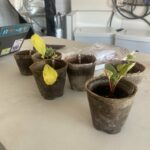
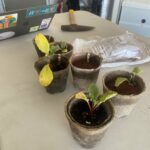
Throughout our mission, we grew a collection of 12 radishes in three separate soil types:
The last two samples are very accurate replications of the soil rovers have analyzed on Mars. Our soil was only supplemented with vermicompost, and we hoped to analyze the nutritional differences between the plants following the conclusion of our mission.
These radishes were planted three weeks before the start of our mission, and by the time we arrived every pot had healthy sprouts. There were already two radish bulbs from our potting soil samples and we could see a radish root widening in one pot with analog Martian soil, indicating the possibility that Martian soil could potentially sustain life with some supplements.
Unfortunately, problems arrived when we “landed” at MDRS. Upon arrival, we placed the radishes in the Science Dome’s grow tent. However, after several days, we observed that many plants were exhibiting drooping leaves with black spots. We suspected that this may be a problem with the grow tent, given that the problems emerged so soon after the change in environment. As such, we moved the radish samples onto a table in the science dome and placed a desk lamp above to provide wherever light we could.
After moving the samples out of the grow tent we observed each plant become healthier again, with leaves standing tall again and stems growing thicker. We also cut off the leaves with black spots to prevent the spread of any disease. However, while this change did save the plants from dying, it also seemed to halt their growth. We believe that the desk lamp did noy provide adequate light to the radishes, and as such they were not able to grow beyond their state from when we arrived. We tried moving several samples back to the grow tent while leaving the flap open, in case the stale air was what caused the problem before. However, almost immediately we noticed that the tent plants grew sick again and the black spots reappeared, leading us to move all plants back under the desk lamp. Our findings indicate that some aspect of the grow tent is harming the radishes, and we could not find a way to change any settings on the light or fan.
By the end of our mission, the radishes had not grown beyond their state from when we arrived. While our experiment did not prove that supplemented Martian soil can sustain life, we do suspect that a replication of this experiment could be successful due to the fact that many of our samples were healthily growing prior to MDRS, under a sufficient lamp and without the harmful grow tent.
Despite the problems we encountered, we do still have some qualitative findings.
Results:
The MMS-2 Enhanced Mars Simulant is the more accurate recreation of Martian soil, which hints that true Martian soil may be a poor soil for crops. However, soil supplements may fix whatever deficiencies there are. Our radishes still produced leaves despite all the roadblocks, and we plan on sending these leaves to a lab for nutritional analysis. If our samples are of sufficient size, we can expect to see detailed reports of the nutrients in radishes from each sample, which will allow us to plan what ways astronauts may need to supplement soil for actual agriculture on Mars. This work shows promise for future advancements in testing Martian agriculture, and future experiments with a more thoroughly-tested environment and a larger sample size will hopefully provide even firmer results.
Project : Environmental Mapping and Pathfinding using
Drone-captured Data
Team Member : Rishabh Pandey
The primary goal of this project was to develop accurate 3D models of the HAB’s surrounding environment using drone-captured footage and photogrammetry software, aiming to support the development of an AI-based pathfinding algorithm for safe and efficient navigation during extravehicular activities (EVAs). Throughout the mission, significant progress was made in capturing and processing video footage of the target environments around the HAB, including paths along Cow Dung Road and more remote walking EVA locations. The footage was processed with photogrammetry software, generating detailed 3D models which were then verified for accuracy against existing topological maps and self-measurements. Multiple drone flights successfully captured comprehensive video footage of these environments, and 3D models were produced by stitching together video frames. These models were verified for accuracy through comparison with topological maps and direct measurements, and efforts were made to ensure they were free from incorrect artifacts and inconsistencies. Preliminary pathfinding algorithm development was undertaken, applying algorithms like Dijkstra’s to identify possible paths in sandbox environments. This phase demonstrated initial success in controlled settings, establishing a foundation for real-world application.
Despite these successes, the pathfinding algorithm encountered significant challenges when applied to the real-world environment. The environment exhibited abrupt changes from hard-packed soil to loose sand, causing large variations that impacted algorithm performance, leading to inaccuracies in pathfinding predictions as the algorithm struggled to adapt to the inconsistent terrain. Additionally, the rovers’ operational range and power capabilities were not adequately accounted for in the algorithm, resulting in impractical path suggestions. The combined walking and climbing ability of the crew further complicated route planning, as the algorithm failed to balance these factors effectively. Unexpected road compositions and build complexities introduced additional variables that the algorithm could not predict or accommodate, collectively hindering its reliability and accuracy in real-world applications. While the AI pathfinding algorithm did not perform as expected in the mission’s final phase, valuable insights were gained regarding environmental mapping and the complexities of real-world navigation. Future efforts should focus on enhancing the algorithm’s adaptability to diverse and changing terrains, incorporating comprehensive data on rover capabilities and crew mobility to improve route planning accuracy, and developing more sophisticated models to better predict and account for unforeseen environmental factors. The work completed during this mission provides a strong foundation for further development and refinement of environmental mapping and pathfinding technologies, with the potential for significant improvements in future missions.
Title: Photometric Study of White Dwarf BD-07 3632
Crew Members: Avery Abramson and Kristina Mannix
Introduction : We intend to continue capturing and analyzing the light curves of BD-07 3632, a WD with limited data. This star is notable for its bright magnitude and location in a binary system with an RD. With the light curves obtained from this project, more insight into its properties can be revealed. BD-07 3632 is an excellent candidate with a bright magnitude at 11.90 V. Its stellar coordinates are 13 30 13.6370112733, -08 34 29.46. It also has minimal research; on NASA ADS, no papers have been published on this WD, nor is there research from AAVSO.
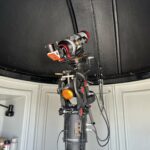
Objective and Methodology : As this star is under-researched, we plan to deduce if it is pulsating. Discovering its pulsation mode can help us understand the star’s composition, density, temperature, and layering. To do this, we will continue using a telescope with assistance from its tracking software to produce data. Then, we will continue removing noise from the data caused by factors such as atmospheric clouds by using the comparison stars. The three comparison stars we are using include HIP 65856 (Mag 8.8, 13h 29m 58.42s, -14 deg 0′ 5.4″), Tycho 5551:631 (Mag 9.9, 13h 29m 48.75s, -13 deg 40′ 37.4″), and Tycho 5551:421 (Mag 9.86, 13h 29m 35.62s,
-13 deg 55′ 35.5″). These images are taken with a primary focus on the photometric V filter at a 240-second exposure. With this data, we are using an in-house tool developed in Python and its appropriate modules to generate the light curves of the WDs with time vs. intensity plots. To clear up the data, we are then doing a Fourier analysis of the time series light curve through the power spectrum. Following this, we are finding the amplitudes and try to deduce the pulsation mode and the intensity.
Key Findings : This project is still in progress and will continue on Earth. Once concluded, findings will be presented in the future.
Discussion : The data from this project may confirm or refine findings from other related works. It may also influence future studies on BD-07 3632 and other related WDs. Additionally, we may be able to deduce other characteristics of these WDs that were previously undiscovered. Overall, our research has the potential to increase our understanding of WDs.
Mission Summary
Mission: 299
Dates: 05-12-2024 – 05-24-2024
Author: Prakruti "Pari" Raghunarayan, Mission Commander
We were merely freshmen in college when we began working towards this. Our now Executive Officer, Avery Abramson, came to me with a great idea to get us ambitious undergraduates to work on making progress towards sustainability and space exploration. Knowing other incredible people with similar interests, we assembled the group of people at the University of Texas at Austin that you know as the Bevonauts.
We had many meetings and brainstorm sessions before finally settling on and working towards what became our proposal: "The Frontiers of Martian Geology and Spectroscopy." The goal of this project was to essentially be able to bring back spacecrafts sent to Mars making for sustainable space travel. The sustainability aspect increased when we decided if we want to get to Mars, we should also be able to inhabit it and make use of the natural resources. The three subprojects were born there: Aravind, Noah, and I would work on making use of natural materials and complementing it with what we know and use to grow and sustain life on Mars, Rishabh would work on drone mapping that can be purposed for search and rescue, and Avery and Kristina would make progress on the space weather and solar physics front.
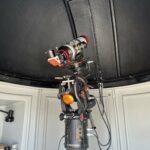
Towards the end of the mission, despite a few technical hiccups, Kristina and Avery made great progress conducting research on Mars. They learned about solar and robotic imaging, as well as image processing. After the conclusion of this mission, the scientific research will continue, as there is extra time saved on the SkyNet account for additional observations via the Robotic Observatory in New Mexico. There are also two more images to process from the Musk Observatory. Avery and Kristina enjoyed their time at MDRS and look forward to finishing their research projects on Earth.
Anomalies were not just present in the GreenHab. As expected of any space station, maintenance was a primary responsibility of the Crew Engineer – a duty at which they excelled at. During the 12-sol mission, the Crew Engineer repaired and replaced Hab Tunnel zip ties, and the astronomy laptop boot drive. Apart from corrective maintenance, the engineer made sure that the Hab was functioning nominally by monitoring and emptying the toilet, calculating water levels, and inspecting the entirety of the station’s facilities in the midst of uncertain power supply.
Lastly, on the materials front, Noah, Aravind, and I made significant progress–but are not yet done. We have determined the mock grade Martian soil would actually be alright to sustain life as we know it if complemented with whatever nutrient they are missing. We tested this on radishes. Usually, this can be done with cardboard, organic matter, or something like clay, silt, or sand (depending on the deficiencies). We were also able to exfoliate the materials to the point where they can take some samples from MDRS and get them to spectroscopy labs and have them measured, We will learn the uses of natural material from this and be able to take these principles and studies to Mars!
As I write this, I am aware of the great progress my great crew has made. I am grateful to have such a young, ambitious crew. It gives me great hope for the future of space exploration. We have ventured off to Mars and started this journey when we were literally children (like genuinely) and as we arrive back to Earth we come back as adults, knowing that the responsibility of sustainable space travel lies in the hands of our generation. We are grateful to have contributed to something bigger and hope to do more.
Mission complete. Mission successful. Thank you.
Crew 299 Sol Summary 05-24-2024
Sol: 12
Summary Title: The End
Author’s Name: Prakruti Raghunarayan
Mission Status: Complete
Sol Activity Summary:
Avery and Kristina:
For Sol 12, the last sol, it was a productive day! Avery and Kristina used the morning to get final imaging done at the Musk Observatory, which yielded two sets of images. Afterwards, they closed the observatory for the final time. Following this, everyone got to work cleaning the Hab before their journey back to Earth. For example, Avery, Rishabh, Pari, and Kristina helped take inventory of the food and cleaning items of the Hab. Avery also helped sort and take out the trash, as well as put away dishes and vacuum.
Rishabh:
For the last day here, Rishabh assisted in cleaning the lower level of the hab as well as cleaning up the RAM. He finished his project up and the videos are done processing. After this, he worked to film a thank you video for donors with Pari. He later did food inventory with Avery, Kristina, and Pari. Now he is doing his research summary.
Noah, Aravind, and Pari:
Today, Pari, Noah, and Aravind cleaned out the science dome and finished up their experiments there. They’ve picked out some samples to send out for spectroscopy analysis–including 3 materials found at MDRS during EVAs. They cleaned out the radishes and cleared out the entire area. Then, they finished their research analysis for the samples. Lastly, they also filmed a thank you video for donors. Pari worked with Avery, Kristina and Rishabh to do food inventory as well.
To MDRS: thank you so much for having us.
Best,
Prakruti "Pari" Raghunarayan
Mission Commander
Hello Mission Control,
It’s officially the end of our stay. The Bevonauts are officially analog astronauts and we couldn’t be prouder.
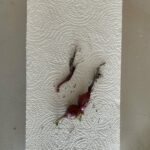
Today we had a lot of last day chores to do and that was mainly it. We concluded the experiments in the science dome and are having a few samples sent out to an external lab for spectroscopic analysis! We cleaned up the area and dumped out all the samples we no longer need. We also took the leaves from the radishes and the plants for further lab analysis. However, our measurements are done and we have some good news (see research summary :D).
The astronomy team processed two images today! They also wrapped up their project. Rishabh finished up his map as well. We had a lot of good and complete results!
We also filmed a video for our donors and sponsors today.
MDRS, thank you for welcoming us. We have enjoyed our stay and learning and growing here as scientists and engineers.
Bevonauts out <3
Thank you!
Best Regards,
Prakruti "Pari" Raghunarayan & the Bevonauts
Crew 299 Operations Report 5-24-2024
SOL: 12
Name of person filing report: Rishabh Pandey (Engineer)
Non-Nominal Systems: Suit 9 (broken visor), Suit 11 (fan issue)
Notes on non-nominal systems: Issues with both suits were noted before our mission, both will not be used during our mission.
ROVERS
Rovers Used: None
General notes on rovers: None
Summary of Hab operations:
WATER USE: 41 Gallons
Water (static tank): 178.3 (using effective value from spreadsheet) (was also refilled today)
Static tank pipe heater: off
Static tank heater: off
Toilet tank emptied: yes
Summary of internet usage: Catch up on Earthly news, email responses, code development, entertainment
Summary of suits and radios: No suits or radios used.
Summary of GreenHab operations: NA, GreenHab out of operation
Summary of ScienceDome operations: Final soil analysis was conducted.
Summary of RAM operations: Measuring tape used.
Summary of observatory issues: NA
Hello Mission Control,
Crew 299 EVA 10 Report 5-21-2024
EVA #12
Author: Kristina Mannix
Purpose of EVA: Collect final samples from Marble Ritutal.
Start Time: 2:00 PM
End Time: 2:45 PM
Narrative: The crew drove to marble ritual, then took samples and drone footage at marble ritual.
Destination: Marble Ritual
Coordinates:
518750, 5251000 (Marble Ritual)
EVA Participants: Kristina (HSO), Pari (Commander), and Rishab (Engineer)
Road(s) and routes per MDRS Map: Cow Dung Road
Mode of travel: Driving
You must be logged in to post a comment.