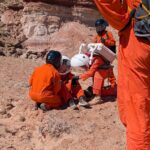
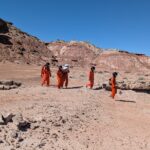
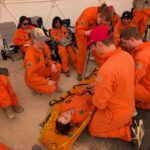
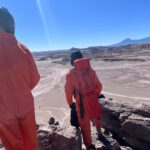
Report title: Photos of the Day
Crew #: 331
Position: Medical Lead
Report prepared by: Arian Anderson
Date: 19-03-2026
Sol: 4
Journalist Report – March 18th
Journalist Report
Crew #331
Position: Medical Lead
Report prepared by: Arian Anderson
Date: 18-03-2026
Sol: 3
Journalist Report Title: Sol 3
Today’s sol continued with a combination of lectures and field-based exercises. Lectures focused on toxicity and environmental exposures, as well as behavioral health and cognitive performance factors in long-duration spaceflight. These topics highlighted the complex and often subtle risks crews may face, reinforcing the importance of early recognition, sound judgment, and sustained physical and psychological performance in isolated environments.
During EVAs, the crew deployed in three teams to test prototype automated medical decision-making assistants in the field. Each system was tasked with helping identify and guide responses to unexpected medical scenarios. All three tools performed successfully, supporting crews in recognizing emergent conditions, guiding interventions, and stabilizing affected crewmates. The exercise demonstrated the potential for decision-support technologies to enhance safety and responsiveness during exploration missions, underscoring our mission’s focus on integrating medicine, engineering, and operations into a unified system for exploring the complex environment of Mars.
Crew Photos – March 18th
Report title: Photos of the Day
Crew #: 331
Position: Medical Lead
Report prepared by: Arian Anderson
Date: 18-03-2026
Sol: 3
Journalist Report – March 17th
Journalist Report
Crew #331
Position: Medical Lead
Report prepared by: Arian Anderson
Date: 17-03-2026
Sol: 2
Journalist Report Title: Sol 2
Today’s sol blended focused classroom instruction with field-based operational training, emphasizing both human factors and mission execution in our Mars analog environment. Morning lectures covered teamwork in high-risk settings, women’s health considerations in spaceflight, research in analog environments, and principles of search and rescue operations. Together, these sessions reinforced the importance of communication, adaptability, and inclusive team planning as we prepare for the demands of long-duration exploration.
In the field, the crew conducted an EVA in two teams to establish a communications relay between remote locations and the habitat. One team ascended to the summit of Tim’s Peak, working to transmit messages from multiple positions to a ground team, which then attempted to relay those communications back to the hab. The terrain proved challenging, and during descent, a crewmember suffered a fall resulting in a femur fracture. The situation quickly shifted from routine operations to emergency response, but the crew acted with focus and precision, stabilizing the injured crewmember and coordinating a safe return to the habitat using the medical and evacuation techniques they had practiced. All crewmembers are now safe, in good spirits, and ready to take on the next sol.
Crew Photos – March 17th
Report title: Photos of the Day
Crew #: 331
Position: Medical Lead
Report prepared by: Arian Anderson
Date: 17-03-2026
Sol: 2
Crew Photos – March 16th
Report title: Photos of the Day
Crew #: 331
Position: Medical Lead
Report prepared by: Arian Anderson
Date: 16-03-2026
Sol: 1
Journalist Report – March 16th
Journalist Report
Crew #331
Position: Medical Lead
Report prepared by: Arian Anderson
Date: 16-03-2026
Sol: 1
Journalist Report Title: Sol 1
Today’s sol at the Mars Desert Research Station blended rigorous medical training with high-stakes field operations. The morning began with an in-depth exploration of the challenges of Mars exploration and the physiological effects on the human body of prolonged exposure to spaceflight. Additional briefings included a comprehensive introduction to decompression sickness, which is a critical risk in an environment with operational pressure changes. Crew members engaged with the physiological mechanisms behind the condition, learning how inert gases can form bubbles in the bloodstream and tissues during rapid depressurization. Particular emphasis was placed on recognizing symptoms such as joint pain, dizziness, and neurological deficits, as well as implementing appropriate treatment protocols, including oxygen therapy and recompression strategies. At the time, these lessons were approached as theoretical preparation, but they would later take on immediate practical significance.
The crew then transitioned into a session focused on the vestibular system and its role in maintaining balance and spatial orientation. Through a combination of lecture and hands-on activities, we explored how altered gravity environments disrupt normal sensory processing, leading to space motion sickness and disorientation. These exercises highlighted how even minor impairments in orientation can significantly affect performance during mission-critical tasks.
In the afternoon, the crew embarked on two EVAs designed to advance both engineering and scientific objectives. Teams set out to locate a simulated crashed satellite, attempt repairs on a communications relay, and collect geological samples from the surrounding terrain. The Martian landscape presented both opportunities and challenges, requiring careful navigation and constant situational awareness.
During the EVAs, an unexpected incident tested the crew’s preparedness. While traversing uneven ground, a crew member tripped and sustained a minor knee injury accompanied by an abrasion. More critically, the fall resulted in damage to their spacesuit, leading to a depressurization and the onset of decompression sickness. The situation escalated quickly, transforming a routine EVA into a complex medical emergency.
The crew responded with professionalism and efficiency. Drawing directly on the morning’s training, team members rapidly identified the signs of decompression sickness and initiated appropriate treatment procedures. The injured crew member was stabilized in the field, carefully transported back to the habitat, and treated and monitored closely upon return. The coordinated response demonstrated the crew’s ability to translate theoretical knowledge into effective action under pressure.
Following the EVAs, training continued with instruction on SKED stretcher use, where crew members practiced safely packaging and transporting a simulated patient across uneven terrain. This exercise emphasized coordination, communication, and the physical demands of emergency response in a remote environment.
By the end of the sol, the injured crew member had fully recovered, and all team members were safe and accounted for. The incident served as a powerful reminder of the unpredictable nature of exploration and the importance of comprehensive preparation. It also reinforced the value of interdisciplinary training, where medical knowledge, operational skills, and teamwork converge to ensure mission success.
Despite the challenges encountered, morale remains high. The crew is encouraged by their ability to respond effectively to an emergency and is motivated to continue building on today’s experiences. As we look ahead to the next sol, we carry forward not only new knowledge, but also a renewed sense of confidence in our collective capability to meet the demands of life and work on Mars.
Mission Plan – March 15th
Mission Plan
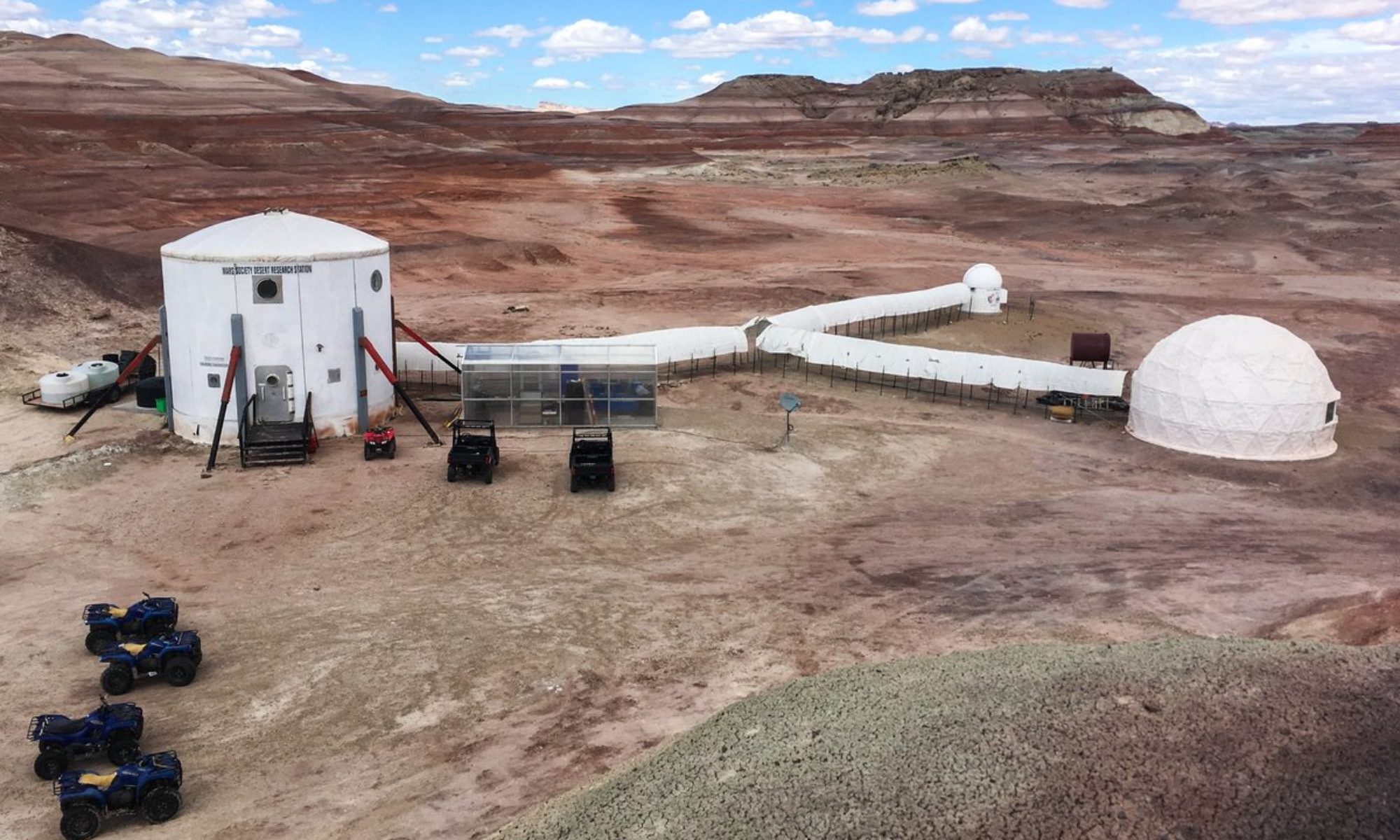
Mars Desert Research Station
Crew 331
University of Colorado MiSSE Team
The goal of our teams’ mission at the Mars Desert Research Station is to integrate medical training, engineering, and space exploration operations within a Mars mission framework. The primary objectives for today are to develop practical competencies in the recognition and management of decompression sickness, to deepen our understanding of the physiological and operational challenges posed by altered vestibular function in extraterrestrial environments, and to successfully complete our first surface EVAs.
The day will begin with a series of instructional sessions. Crew members will review the challenges of Mars operations, including the physiological effects of prolonged spaceflight and the impacts of pressure changes on the human body. Particular emphasis will be placed on identifying the key clinical signs of decompression sickness, such as joint pain, neurological impairment, and fatigue. Treatment strategies, including oxygen administration and recompression protocols, will be discussed to ensure readiness for simulated or real medical contingencies.
Following this, the crew will participate in a briefing and hands-on training session focused on the vestibular system. This session is designed to deepen understanding of how balance and spatial orientation are affected in reduced-gravity environments and how these changes can lead to space motion sickness and disorientation. Through experiential activities, crew members will examine how sensory conflict can impair performance and decision-making during mission operations.
Operational readiness will be reinforced through a comprehensive orientation to MDRS facilities. Crew members will review habitat systems, EVA preparation procedures, communication protocols, and safety guidelines to support safe and efficient mission execution. In addition, the crew will receive training in SKED stretcher use and will practice patient extrication techniques in preparation for potential field emergencies.
The afternoon will be dedicated to two planned EVAs. During these excursions, the crew will attempt to locate a simulated crashed satellite, conduct repairs on a communications relay system, and perform geological sampling in the vicinity of the habitat. These activities are intended to highlight the challenges of integrating scientific objectives with operational constraints in a Mars analog environment.
Throughout all activities, the crew will emphasize safety, teamwork, and strict adherence to protocols. Any anomalies encountered during EVAs will be treated as realistic mission events, with appropriate medical and operational responses. By the conclusion of the sol, the crew aims to strengthen both technical proficiency and its ability to respond effectively to complex, interdisciplinary challenges on Mars.
Supplemental Operations Report – March 14th
Date: 3/14/2026
Name of person filing report: Brett Bennett
Reason for Report: Routine
Off-Nominal Systems: Hab outer shell.
Power system: Nominal.
Current generator hours: 1444.0
Last 200 hr generator service ocurred 01/08/26 at 1325 hr. Next service will occur at 1525 hr.
Note that with extended daylight hours, the power system has been dropping to a minimum of ~20% SOC around 7:30 am.
Propane:
Station Tank: 45%
Director Tank: 38%
Intern Tank: 55%
Generator Tank: 68%
Propane was not refilled this week.
Water:
Hab Static Tank: 480 gallons (full). Hab static tank sensor recently replaced with pressure sensor, returning volume estimation data. An additional sensor diagnostic was conducted, and is described below.
GreenHab: 111 gallons
Outpost tank: 480 gallons (full)
Septic Tanks emptied: No
Tank deicers removed from Hab and Outpost static tanks based on seasonal temperature increases. Stored in the Outpost shed.
Rovers:
Sojourner rover used: No (except to service).
Hours: 223.5
Beginning Charge: 100%
Ending Charge: 100%
Currently Charging: Yes
Pad replacement for Perseverance e-brake completed March 11. Monthly service completed for all five rovers on March 13.
Cars:
Hab Car used and why, where: Multiple trips to Hanksville for supplies.
Crew Car used and why, where: During the trip on March 14 to Grand Junction for crew 330-331 turnover, the crew car experienced a catastrophic fire. Crew 330 gear and the vehicle were lost. All crew exited safely.
General notes and comments: The station will be operating with the only hab car until crew car function is replaced.
Internet: Nominal.
EVA suits and radios: Nominal.
Suits: Nominal.
Comms: Nominal.
T-Echo EVA-link: Nominal.
Campus wide inspection, if action taken, what and why: The data stream from the Hab water tank sensor dropped out unexpectedly on March 12. The issue was resolved with the following process: Remove sensor control board cover next to main tank, press reset button (opposite the "boot" button) on control board, confirm "online" status of Hab main water tank level sensor YAML in Home Assistant dashboard ESPHome Builder, run "logs" function in that YAML, allow to complete log process, confirm restored data stream in dashboard (approx 3-5 min) timeline.
Hab outer shell shows ongoing wear.
Summary of Hab Operations: Nominal.
Summary of GreenHab Operations: Nominal.
Summary of SciDome Operations: Nominal.
Summary of Observatories Operations: Nominal.
Summary of RAM Operations: Nominal.
Summary of Outpost Operations:
Director trailer: Nominal.
Intern trailer: Nominal.
Summary of Health and Safety Issues: Nominal.
Sol Summary – March 13th
Report title: Sol Summary Report
Crew #: 330
Position: Crew Commander
Report prepared by: Gaspard THIEULIN
Date: 13/03/2026
Sol: 26
Summary Title: Last sol on Mars
Mission Status: The mission is a success, ending at 17:30
Sol Activity Summary: These are the last hours we will spend on our simulated Mars as MDRS Crew 330. Last evening was full of emotion, and we went to bed a bit tired. Nevertheless, we woke up early this morning, ready to tackle Adèle’s last physical activity session. After a frugal breakfast with the last remains of our food supply, we tackled the deep cleaning of the station, to prepare it for the next crew. We finished most of it in the morning, just a few small tasks remain for this evening and tomorrow morning.
We finished writing the reports for the last sol and the end of the mission, and are getting ready to step foot back on Earth.
Look Ahead Plan: While our stay in the MDRS is ending, we will have a lot to do with the data we collected, and will continue to make the assessment of our mission. But before that, we are going on a well earned road trip away from work!
Anomalies in work: See mission summary
Weather: Sunny
Crew Physical Status: Physically fit and well
EVA: N/A
Reports to be filed:
Journalist report
Greenhab report
Operations report
Astronomy report
Mission Summary
End of mission Science Report
Support Requested: N/A


You must be logged in to post a comment.