
Sol: 4
Summary Title: Expanding the Search
Author’s name: Andrew Wheeler
Mission Status: Nominal
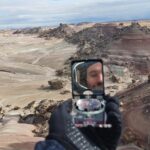
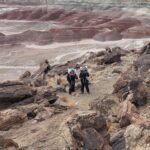
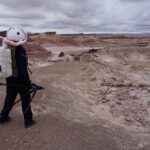
Sol Activity Summary: Sol 4 had the potential of denying us EVAs based on the weather forecast. Fortunately, the rain held off and we were able to get away on time. Clare had us at Kissing Camel Ridge West in search of concretions (a source of carbonates) and petrified wood (an analogue of organic remains). Previous crews had reported this location and, after some climbing around outcrops and mudstone domes, we located the stratigraphic layer that contains the concretions. GPS coordinates were taken and samples collected. The petrified wood remained elusive as only fragments in the stream wash were observed. The second EVA saw an excursion towards the north along Cow Dung Road past Cowboy Corner en route to the largest stream draining the Tharsis Montes. Operational constraints (Point of No Return is rover power levels at 55%) pulled the team up short of the proposed destination. Nevertheless, Steve was able to have the push broom spectrometer up and recording the many and varied lithologies of the nearby geology. Finally, the commander joined a livestream event for Igniting The Space Down Under timed for transmission for Australia Day 26th January back on Earth.
Look Ahead Plan: Weather dependent as always, tomorrow will see an EVA return to the Tharsis Montes area for the next stage in collecting spectroscopic data. The remaining time will be spent continuing the troubleshooting of the stubborn sensor station and collating previously collected data.
Anomalies in work: Nothing to report.
Weather: Overcast morning and remained so during the day. No precipitation. Temperature increasing from 0 Celsius in the morning to high single digits in the afternoon. Humidity fluctuated between 80% and 50%. Faint to no wind.
Crew Physical Status: nominal
EVA: EVA 7 with Clare, Andrew and Scott to Kissing Camel Ridge West. EVA 8 with Steve, Alex and Rob to the Tharsis Montes area north of Cowboy Corner.
Reports to be filed: Sol Summary, Journalist Report, Greenhab Report, Operations Report, EVA report, EVA Request(s). No Astronomer report (too cloudy for telescopic observations).
Support Requested: Nothing to request.
SOL: 4
Name of person filing report: Scott Dorrington
Non-nominal systems: None
Notes on non-nominal systems: None
ROVERS EVA #7
Spirit rover used:
Hours: 242.6
Beginning charge: 100%
Ending charge: 56%
Currently charging: No
Opportunity rover used:
Hours: 156.8
Beginning charge: 100%
Ending charge: 58%
Currently charging: No
ROVERS EVA #8
Curiosity rover used:
Hours: 264.5
Beginning charge: 100%
Ending charge: 46%
Currently charging: No
Perseverance rover used:
Hours: 282.4
Beginning charge: 99%
Ending charge: 38%
Currently charging: No
General notes on rovers: Mirrors removed previous night.
Summary of Hab operations:
WATER USE: 13.1 gallons
Water (static tank): 380.1 gallons (depth 13 inches)
Static tank pipe heater (on or off): on
Static tank heater (On or off): on
Toilet tank emptied: yes (indicator light has not changed from 2/3 full – visually monitoring)
Summary of internet: Nominal
Summary of suits and radios: Suit #8 was not used today, as it was noted to have two screws loose at the charging port. These came out when one of the crew attempted to remove the power plug. (See pictures before and after repair). I screwed them both back in, but found the top screw would not tighten, just keeps turning. The plug is secured, and can function for plugging and unplugging, but may need extra care and monitoring when plugging/unplugging. We are prepared to stand suit #8 down for now until further advice from mission support.
Summary of GreenHab operations: put notes here
WATER USE: 5 gallons
Heater: Space heater on overnight
Supplemental light: light on all day
Harvest: None
Summary of Science Dome operations: Crew visited Science Dome in search of vinegar and hydrochloric acid for use in rock sampling in the field. Identified chemicals, but not used (could be part of ongoing experiments).
Dual split: Nominal
Summary of RAM operations: Not used
Summary of any observatory issues: None
Summary of health and safety issues: Medical forehead thermometer was tested but shown to be not accurate to expected body temperatures – out by 4 to 5 C.
Questions, concerns and requests to Mission Support:
Crew were interested in the vinegar or hydrochloric acid (10% HCl) in the Science Dome for rock testing of returned samples. Inquiring if this is from an ongoing experiment, or if we are allowed to use it. Acknowledge that handbook requires crew to bring their own chemicals for testing, so ok if not allowable.
Rocks Rock
Sol 4 began with fritters and cereal. It was tenuous as to whether we’d be able to proceed with planned EVAs due to weather, but luckily the rain subsided and the ground remained roverable.
The sky was still overcast, and with the hab’s solar panels struggling we were instructed to conserve energy – which meant a switch to gas. Later in the evening this spawned a discussion regarding the role(s) of hydrogen on Mars. Water will be electrolysed for oxygen, which as a byproduct will also produce hydrogen – this hydrogen will likely be reacted with exhaled carbon dioxide to form methane, for use as rocket fuel (or perhaps other things)… but what else could hydrogen potentially power on Mars as it becomes a more prevalent fuel source on Earth? Assuming that any early human population on Mars will need to continue obtaining at least some of their oxygen from electrolysis, in addition to various other methods currently employed aboard the ISS (or ideally photosynthesis), what will become of any excess hydrogen once those humans have enough methane? Commandrew says it gets vented. I say (with zero expertise on the matter) that they double down on Mars’ ice supplies and turn it into a green (in multiple ways) hydrogen utopia. Hopefully someone more knowledgeable than me can reach out for my edification.
ANYWAY, the EVAs. This morning’s EVA took three of our crew out to Kissing Camels Ridge to look for calcium carbonates – which once reacted with various acids would serve as a source of carbon dioxide on Mars, which in turn could be reacted with hydrogen to generate methane (see hydrogen rant above). The team found some good deposits and sent back coordinates. It’s been too cold so far to reach the gypsum deposit approximately 4km north of the MDRS (the rovers’ batteries deplete too quickly in the cold), but multiple members of the crew would benefit from gypsum samples and so we’ll launch an EVA to that site if that becomes possible. Today I learned that gypsum is a hydrate material that when processed via heat or other techniques can yield water (literal water from rocks!). For the geologists in the room, this is all pretty ordinary fare, but for myself (with a biology background) it’s fascinating.
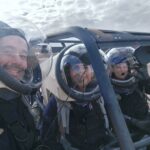
The afternoon’s EVA set out to Cowboy Corner. It was supposed to extend further, to the area north-west of Tharsis Montes, but Opportunity hit the 55% power threshold and the team was forced to disembark… where we discovered an adjacent ‘target-rich’ site anyway. This site was stunning, with the geomorphology of the long-dried stream-bed proving spectacular against the rocky mounds (“hills”?) and distant mesas. Steve was able to get several gigabytes of spectrophotometer data, from multiple types of material.
Highlights of the day: Steve’s taste in music, EVAs being greenlit, incredible geomorphology (like the stream-bed) near Cowboy Corner, Commandrew’s minerology lessons.
Lowlights of the day: More extraterrestrials (this time we also observed a symbiotic quadrupedal species).
– Alexander Tobal, Crew 291.
GreenHab Officer: Scott Dorrington
Environmental control: heater off (space heater on overnight), fan on in afternoon, door closed
Average temperatures:
08:01: 47.8 F, 62%
09:30: 57.0 F, 56% heater off
11:00: 85.6 F, 36% fan on
12:48: 83.8 F, 24%
12:56: 79.5 F, 27%
14:12: 63.3 F, 34% fan off
14:43: 67.8 F, 37%
15:16: 67.8 F, 45%
16:00: 65.3 F, 49%
18:36: 48.6 F, 66% heater on
19:11: 48.9 F, 67%
Hours of supplemental light: 24 hrs (lights on all)
Daily water usage for crops: 5 gallons
Daily water usage for research and/or other purposes: 0 gallons
Water in Blue Tank (200 gallon capacity): 142.5 gallons
Time(s) of watering for crops: 9:30 mist, 12:45pm mist, 2:43pm water + mist, 4pm mist
Changes to crops: None
Narrative:
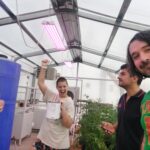
This morning I woke to a commotion in the hab. Apparently Clare had faced her arachnophobia, capturing another spider from the hab and relocating it to the greenhab (along with another one captured the night before). I headed over to the greenhab to get a temperature reading. I returned to the greenhab at 9:30am just prior to our EVA to turn off the heater and give the plants a nice misting. Following yestersol’s high midday temperatures, I asked Rob to check in on the plants while we were out on EVA. The temperature was picking up through the day, so the fan was turned on for an hour or so. Following the EVA, I returned to check in on the plants, give them a watering, and perform a rotation of the tomatoes. The tunes for the afternoon watering consisted of Spiderbait (for the greenhab spiders) and David Bowie. I also noticed a fly in the greenhab. Hoping the greenhab spiders will sort it out to earn their keep. Over the last few sols, I’ve been experimenting with collecting and re-using some of the water that drains from the tomatoes onto the floor during watering. I figured water conservation would be very important on Mars. I experimented with using the dustpan and broom to scoop up some water – this was working, but not practical to use to collect a good amount of it. Today, I experimented with positioning some empty food cans from the hab kitchen underneath the pallet to catch some dripping water. This was effective, and I was able to pour the collected water back onto the tomatoes. Although, I’m not sure how practical this solution will be applying to all tomatoes towards the back of the pallet. I will keep experimenting. I returned a few times in the afternoon to check temperatures and mist. I also noticed a few tomato leaves that were wilting (likely from the cold), which I pruned. The tomatoes on #9 are looking red and juicy. I think they may be ready for harvesting in a day or two. The challenge will be dividing two baby tomatoes between 6 crew members. Space heater turned on at 6:36. Hopeful that the greenhab heater will be getting repairs sometime soon.
Crew 291 EVA Report 25-01-2024
EVA # 7
Author: Clare Fletcher
Purpose of EVA: Went to Kissing Camel Ridge West to identify concretions and possible fossils, as signs of life on Mars. Attempted to reach the Hab Ridge via Kissing Camel Ridge. Dual purpose of this EVA was to get bearings to locations identified during EVA 5 that we are considering using as wayfinding points.
Start time: 1000
End time: 1230
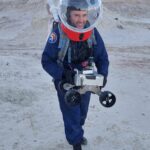
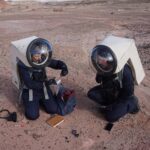
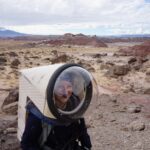
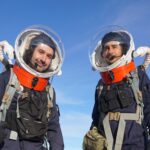
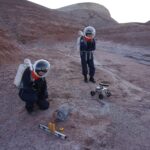
Narrative: Kissing Camel Ridge has proven to be a site of great success for Crew 291. After a steep hike up the ridge, and a lot of disappointing conglomerate, we found the unit with the concretions. We could follow the unit for a little way, but the slight dip angle of the unit meant that we couldn’t find too many, and we would have done better on the North side of the ridge. However, the North side of the ridge was much steeper, so we weren’t able to investigate. While up near the concretions we also took a few bearings to several different peaks that we could see as part of our wayfinding research. We are yet to come to any conclusions about which peak we are seeing is which on the map, and if our crew will develop colloquial names for them that we might use amongst ourselves. We had planned to attempt to reach Hab Ridge via Kissing Camel Ridge, but we determined the path to be too treacherous in our EVA suits. With that and the lack of time, we decided to downclimb and look around the road cutting for anything interesting that had washed down the talus slopes from the top of the ridge. We found several interesting pieces of chert and jasper, as well as a few samples of interesting staining patterns, perhaps by iron oxide and copper, and desert varnish (manganese oxide).
Destination: Kissing Camel Ridge West. Walked within 700m of the rover. Parking rover at 518271, 4249560, walked to 517664, 4249650.
Coordinates (use UTM WGS 84): Parked rover at 518271, 4249560, walked to 517664, 4249650.
Participants: Andrew Wheeler, Clare Fletcher, Scott Dorrington
Road(s) and routes per MDRS Map: Exit Hab via main airlock. Drive down driveway to Cow Dung Rd 0110. Drive South on Cow Dung Rd 0110 to Kissing Camel Ridge. Walk up and along Kissing Camel Ridge to Hab Ridge.
Mode of travel: Driving and walking.
Sol: 3
Summary Title: Testing the limits
Author’s name: Andrew Wheeler
Mission Status: Nominal
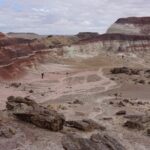
Sol Activity Summary: Sol 3 saw us preparing to see how far Martians are able to push themselves encumbered with the means of our survival on the red planet. Traverses to a number of distinctive topographic features were made both for navigation and endurance testing. Results are pending though the EVA members were very pleased with their efforts. The second EVA saw continued traction testing of the robot rover and deployment of a wheel mounted regolith sampler for evaluation. Within the hab, maintenance inspections of the backpack and helmet combinations were undertaken and further troubleshooting of the recalcitrant environmental sensor system proved fruitless. Finally, an invitation to join a livestream event for Igniting The Space Down Under was previewed and has been set for Australia Day 26th January, which is of course, Thursday 25th January at MDRS here on Mars.
Look Ahead Plan: Weather dependent, tomorrow will see an EVA to the Kissing Camel Ridge in search of carbonate concretions and an EVA north to the gully draining west from the Tharsis Montes in search of spectrometric targets.
Anomalies in work: Nothing to report.
Weather: Clear morning clouding over during the morning. Temperature increasing from -2 Celsius in the morning to double digits in the afternoon. Humidity fluctuated between 80% and 50%. No precipitation. Faint to no wind.
Crew Physical Status: nominal
EVA: EVA 5 with Scott, Clare and Alex . EVA 6 with Steve, Alex and Scott
Reports to be filed: Sol Summary, Journalist Report, Greenhab Report, Operations Report, EVA report, EVA Request(s). No Astronomer report (too cloudy for telescopic observations).
Support Requested: See operations report.
SOL: 3
Name of person filing report: Rob Hunt + Scott Dorrington
Non-nominal systems: None
Notes on non-nominal systems: None
ROVERS
Spirit rover used: Scott EVA #5
Hours: 242.4 (start) – 242.6 (end)
Beginning charge: 100%
Ending charge: 66%
Currently charging: No
Opportunity rover used: Alex and Claire EVA #5
Hours: 156.5 (start) – 156.8 (end)
Beginning charge: 100%
Ending charge: 69%
Currently charging: No
Curiosity rover used: N/A not used
Hours:
Beginning charge:
Ending charge:
Currently charging:
Perseverance rover used: N/A not used
Hours:
Beginning charge:
Ending charge:
Currently charging:
General notes on rovers:
Opportunity – nominal
Spirit – nominal
Summary of Hab operations:
WATER USE: 427.5 gal.
Water (static tank): 393.2 gal.
Static tank pipe heater (on or off): On
Static tank heater (On or off): On
Toilet tank emptied: no
Summary of internet: Nominal
Summary of suits and radios:
Donning area negligibly re-arranged for better circulation space during donning and doffing,
Calico ‘head’ covers for suits vary in circumference so they were sorted and number-matched to ensure best fit,
Battery voltage on all suits is now recorded before and after EVAs. This has revealed at least two that lose approx 2V during an EVA. i.e. approx 13.5V to 11.5V.
Two-piece suits
Suits #1 – #6 were checked for structural integrity. Some minor repairs made e.g. loose screws tightened (not overtightened)
Suits #1 – #6 chargers labelled/placed according to suit numbers,
Charger with label #3 missing and charger with label #12 was relabelled.
One-piece suits
Suit #10 – strap-ends tidied with zip-ties to make donning less confusing. This is planned for the other suits,
Suit #11 (small size) – power issue resolved. Problem was the toggle switch which has a ‘neutral’ setting between ‘Off’ and ‘On’. It is the only one of the 11 suits with this type of switch. Best solution is to swap out with same type switch as others. Other solutions might be general team awareness and/or a check list for donning area.
Summary of GreenHab operations: put notes here
WATER USE: 6.5 gallons
Heater: Off (broken). Space heater on overnight
Supplemental light: On
Harvest: 14g basil, 21g dill, 38g kale, 57g red cabbage,
Summary of ScienceDome operations: put notes here
Dual split: nominal
Summary of RAM operations:
Collated and photographed existing stock of ‘tape’,
Collated and photographed existing stock of cable ties,
Used 2 x 3” screws to repair door striker on Room 4
Summary of any observatory issues: Observatory not used.
Summary of health and safety issues:
Hazards identified:
Questions, concerns and requests to Mission Support:
Rolls of fabric tape, insulation tape, clear packing tape please (see pic of current stock),
Large cable ties please (for the walkway tarp)
Bread knife
2L plastic drink jug
Silicon baking spatula
Crew 290 GreenHab Report 19-01-2024 (Sol 12)
Greenhab Officer: Ben Kazimer
Heater off (not by choice), fan off, door closed
Average temperatures: 1128: 92.3⁰F, 11%, 1310: 79.4⁰F, 30%, 1956: 52.2⁰F, 18%
Hours of supplemental light: nominal 4 hours overnight
Daily water usage for crops: 11.25 gallons
Daily water usage for research and/or other purposes: N/A
Water in Blue Tank 114.05 gallons
Time(s) of watering for crops:
1128: 11 gallons watering, ¼ gallon misting
Changes to crops: Trimming, watering, and organization of all plants. Light harvests in some herbs
Narrative:
A bittersweet last chapter in Funk’s Martian Greenhab operations. For my last sol in sim and as acting greenhab officer, I closely inspected every plant to trim off dead leaves, give a healthy watering, thorough misting, and thoughtful repositioning within the greenhouse layout. The music choice was soft alternative/folky music, fitting for the last sol mood. All the plants were doing pretty well, aside from the cucumbers… The cuke in the back blue planter didn’t do too well with the thermal cycling overnight due to the faulty heater, but the 2 plants in the front of the greenhab faired a bit better. I figured an in-depth tomato fruit inventory was worthwhile for all those following along at home and the results are in for the most fruitful plant… Tomato Number 4 with 45 fruit showing!!! Don’t worry, I’m as surprised as you are! For context this was solely based on the number of fruit, not combined size. While more difficult to measure in these facilities, I would eyeball that victory to (unsurprisingly) Tomato Number 9 To be fair, Tomato No. 4 did bear the 3 orange tomatoes our crew shared tonight before dinner (out of this world flavor). Side note: the heater is currently not functioning properly, but I have faith that Roots, Mission Support and myself can return it to nominal status tonight.
The plants are happy and the greenhab is clean! Everything should be in order for 291 to come in and continue the MDRS Greenhab legacy!
Harvest: 2 grams Sage, >1 gram chives, 6 grams basil, 23 g tomatoes (!)
Support/supplies needed: Heater is on the fritz again
You must be logged in to post a comment.