Journalist Report February 1st

Journalist Report

1-FEB-2022

Author: Pierre Fabre

Today was the day. The day we have been waiting for and working those past two years for.

This morning when we woke up, we were on Mars. This morning we left our beds when the sun was rising. We were not afraid of the strong radiations of the sun. Even if the atmosphere of Earth doesn’t protect us anymore, the walls of the Hab act like a shield against these radiations so we have nothing to be afraid of.

Today will be a great day, a day to remember our whole life. Today every member of the crew will perform their first EVA (Extra Vehicular Activity). What does that mean? We are going to leave our shield, our home, to go outside, on Mars. We are not going to go outside without being protected, we would die from it! We are going to wear our spacesuits to protect us from those lethal radiations! In addition to prevent us from dying, which is good, they look super cool!

So we start the morning with this feeling of excitement and nervousness ! But first our HSO is waiting for us for our morning workout

! We had no problem to endure it because we were only thinking of that incoming EVA.

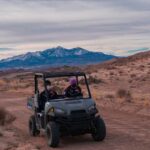
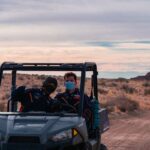
There will be two EVAs today. For the first one, the plan is to go to the Marble Ritual area. This is the classic EVA that every crew does as a ritual. The aim is just to do a short EVA to feel more comfortable with wearing a spacesuit and driving a rover. The second one will have a scientific interest. We will go to North Ridge to map the area thanks to a drone. I will definitely talk to you in more details about this experiment later but for now I will try to describe as well as I can how you feel when you do an EVA on Mars.

9:30 : I am seated at the upper deck’s table. The crew’s commander, Clement Plagne, will do the briefing for the first EVA of the day. There is a huge map of the surroundings of the station on the table. My hands are becoming damp and I can feel the excitement growing inside of me. He puts his finger on a point on the Map : Marble Ritual, this is our destination.

For this EVA, I will be teamed up with Julie, the HSO. The other buddies will be Clement and Francois, our Engineer. Maxime, the astronomer will be our Hab Com. He is the man inside who communicates with us and makes sure everything is going well. The last member of the crew, Marion, will be in charge of taking care of the Green Hab while we are out. Marion and Maxime will participate in the second EVA of the day with Clement and myself.

9:45 : The excitement is still growing in me while I’m putting on my spacesuit with the kind help of my crew mates! I still have to test my radio and be ready to enter in the airlock at 10:00. The air conditioning system starts in my helmet and I can hear nothing but voices from the radio in my ear.

10:00 : I step into the airlock with my crew mates who are waiting for me. Maxime closes the door and we start the depressurisation. We have to stay 5 minutes in the airlock while the pressure is passing from the Earth pressure to the Mars pressure, which is 1000 times lighter.

10:04 : « one minute left » says the Hab Com in the radio. My breathing is fastening. I look to my crew mates and I can tell just by their face that they feel just like me.

10:04:50 : « ten, nine, eight, seven, six, five, four, three, two, one… » the door opens and the light comes in. After a flash that blinds me for a moment my eyes start to accommodate to the light and I can see the red colour of the sand and the rocky mountains in the background through the open door. « Welcome on Mars » says the Hab Com. The goosebumps get me. At this moment, I can’t contain a smile. This is the first result of two years of hard work that were truly worth it. A little thought to Raphael our botanist who would have loved that view and we step out of the station and land our first foot on the red soil of Mars. We dreamt so many times of this moment and now it’s real. But now we have to focus on our destination, the reason for this EVA. Marble Ritual is waiting for us!

Operations Report February 1st

Crew 240 Operations Report 01-02-2022

SOL: 1

Name of person filing report: François Vinet

Non-nominal systems: NA

Notes on non-nominal systems: NA

ROVERS

Spirit rover used: yes

Hours: 153.9

Beginning charge: 100%

Ending charge: 98%

Currently charging: yes

Opportunity rover used: yes

Hours: 83.2

Beginning charge: 100%

Ending charge: 98%

Currently charging: yes

Curiosity rover used: no

Hours: NA

Beginning charge: NA

Ending charge: NA

Currently charging: yes

Perseverance rover used: no

Hours: NA

Beginning charge: NA

Ending charge: NA

Currently charging: yes

General notes and comments: NA

Summary of Hab operations:

WATER USE: 24 gallons

Water (static tank): 440 gallons

Water (loft tank): 30 gallons

Water Meter: 0155347.8 units

Static to Loft Pump used – yes

Static tank pipe heater (on or off): on

Static tank heater (On or off): on

Toilet tank emptied: yes

Summary of internet: NA

Summary of suits and radios: Suit n°7: ventilation system stopped working intermittently during the EVA. It seems that the problem is a short circuit at the fan switch (at the bottom of the suit). Fixing it will require to open the ventilation grid. Please advise.

Summary of GreenHab operations:

WATER USE: 15 gallons

Heater: On

Supplemental light: On

Harvest: None

Watered with 10 gallons at 8am and topped it off with 5 gallons at 6pm.

Summary of ScienceDome operations:

Dual split: off

SOC: 71% (at 06:07pm)

Summary of RAM operations: NA

Summary of any observatory issues: NA

Summary of health and safety issues: NA

Questions, concerns and requests to Mission Support:

– A microphone used during the EVA works very badly with lots of crackling when it is used. Is it possible to get a replacement ?

– Is it ok to plug rovers at the end of the morning EVA or is there a special procedure to save energy (plug only in the evening…) ? There was a mention of charging procedure during training that we think we missed.

EVA Report February 1st

Crew 240 EVA Report 02-01-2022

EVA #2

Author: Clément Plagne

Purpose of EVA: Acquiring EVA experience, performing capture of the first 3D maps from a drone.

Start time: 14:36

End time: 16:24

Narrative: Pre-EVA briefing went smoothly, and we walked on northbound to reach the bottom of the North Ridge. Unfortunately, the head band that held Pierre’s headset in place started falling over his eyes. He still could see, and we organized with the rest of the EVA group to lead him back to the Hab, where he successfully set up his headset correctly and got back out, with enough time remaining on the EVA to reach the objective. We arrived at the spot where Pierre could carry out his observations, where he sadly once again lost some ability to listen out of his earphone but could still successfully communicate. He successfully performed a flyover with his drone and acquired good quality 3D mapping of the area. The return went on without a hitch. My spacesuit turned off its ventilation intermittently across the EVA, but never for more than a second or two, which led me to continue as planned and assess the suit post-EVA with the Engineer.

Destination: North Ridge

Coordinates (use UTM NAD27 CONUS): 518500 4251500

Participants: Clément Plagne, Maxime Jalabert, Pierre Fabre, Marion Burnichon

Road(s) and routes per MDRS Map: Entrance Road

Mode of travel: foot.

EVA Report February 1st

[category EVA-report]

Crew 240 EVA Report 02-01-2022

EVA #1

Author: Clément Plagne

Purpose of EVA: First in-sim EVA experience, acquaintance with procedures

Start time: 10:03

End time: 11:00

Narrative: Pre-EVA briefing went smoothly, and we drove to the spot safely and slowly. Finding my bearings with the map and getting my confidence back took a smidge more time than I expected, but we arrived at Marble Ritual without any delay. We walked on Marble Ritual, and a little bit around its rocky formation to get some bearings in the suits. Pierre felt confident enough in the suit to try and take out his drone, which I approved for a quick flight and a picture. A crew member mentioned that they were beginning to feel some back pain, and we therefore decided to call it for the walk and drive back to MDRS, which went well too. We were pleased to see that the batteries for both rovers stayed very high, as they had depleted fairly quickly on training day.

Destination: Marble Ritual

Coordinates (use UTM NAD27 CONUS): 518800 4250700

Participants: Clément Plagne, François Vinet, Pierre Fabre, Julie Levita

Road(s) and routes per MDRS Map: Entrance Road, Cow Dung Road

Mode of travel: Rovers Spirit and Opportunity, foot.

Journalist Report February 1st

Crew 240 Sol Summary Report 02-01-2022

Sol: 1

Summary Title: Putting ourselves out there, somewhat

Author’s name: Clément Plagne

Mission Status: All is well!

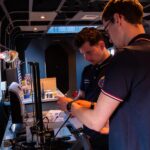
Sol Activity Summary: Big day for EVAs, with two occurring in the same day. Morning EVA went on nominally, with crew members getting well acquainted with the procedures and the material at hand. Afternoon EVA had a few issues and required us to get back to the Hab once to fix a headset issue, but we still managed to achieve the objectives set. Meanwhile inside, work continued (with success!) on our 3D printer and for water conservation experiments.

Look Ahead Plan: We have a big EVA tomorrow for setting up our atmospheric experiments, which may take a while if we’re not all well prepared.

Anomalies in work: Crew members have been reporting discomfort with the headsets during EVA, with one microphone working poorly. We’ve put in a request for a new mic, and comfort issues we’ll try to alleviate ourselves. Spacesuit Seven has been spotty and turned off for a few seconds many times over an EVA. François has details of the issue in his Ops report

Weather: Cloudy but (relatively speaking) warm.

Crew Physical Status: Sore from our daily exercise, but no worse for wear

EVA: Two performed (EVA 1: 10:05 to 11:00, EVA 2: 14:41 to 16:25)

Reports to be filed: Operations Report, HSO report (with temperatures), Pictures, Journalist’s report, Sol Summary, EVA Request, EVA Reports (2)

Support Requested: Information about whether or not we can attempt a fix on spacesuit 7 during the coming day, or if Scott thinks it’s a bad idea. Request to use another suit for the next EVA.

We assumed there was a precision scale at the Science Dome but haven’t been able to find it. We read that in a fairly old version of the Science Dome inventory. Is it still there somewhere?

Operations Report – January 31st

Crew 240 Operations Report 31-01-2022

SOL: 0

Name of person filing report: François Vinet

Non-nominal systems: Heater

Notes on non-nominal systems: The temperature has dropped a lot from the night in the upper desk (3am : 61°F, 6am : 57°F). Atila checked the thermostat and switched to FAN:AUTO (it wasn’t the case during the night). Filter was also replaced.

ROVERS

Spirit rover used: yes

Hours: 153.7

Beginning charge: 100%

Ending charge: 76%

Currently charging: yes

Opportunity rover used: yes

Hours: 82.9

Beginning charge: 100%

Ending charge: 70%

Currently charging: yes

Curiosity rover used: yes

Hours: 165.4

Beginning charge: 100%

Ending charge: 70%

Currently charging: yes

Perseverance rover used: No

Hours: 226.5

Beginning charge: NA

Ending charge: 100%

Currently charging: NA

General notes and comments: NA

Summary of Hab operations: Some crew members felt discomfort during the night because of dusty air. The air filter has been changed. Water filter next to the loft tank has also been changed.

WATER USE: 11 gallons

Water (static tank): 470 gallons

Water (loft tank): 24 gallons

Water Meter: 0155318.2 units

Static to Loft Pump used : yes

Static tank pipe heater (on or off): on

Static tank heater (On or off): on

Toilet tank emptied: no

Summary of internet: NA

Summary of suits and radios: NA

Summary of GreenHab operations:

WATER USE: 10 gallons

Heater: Off

Supplemental light: Off

Harvest: Cherry tomatoes (150g)

Questions:

– Should the supplemental light be turned on during our weeks at the MDRS considering the sun sets early?

– If the GreenHab is at 80°F at 7PM should the heater be turned on considering the temperature will likely drop even lower overnight?

Summary of ScienceDome operations:

Dual split: Off

SOC : 41% at 6.45pm

Summary of RAM operations: The batteries of the Combustible Gas Meter have been changed (3 AAA batteries).

Summary of any observatory issues: The computer in the observatory is not working (problem at startup). Peter Detterline has been contacted by the crew astronomer on his personal gmail address. The main computer mouse is also broken (there is no left key anymore).

Summary of health and safety issues: There is a problem in the insulation of the commander bedroom: the glass wool above the headboard is apparent. Photos can be provided.

Questions, concerns and requests to Mission Support: one non-burnable trash is waiting for pickup in the rear airlock. Thank you!

– I am not sure what is the dual split in the Science Dome. Is it the white fan to the right of the battery management device ? Where can I check its state ?

Journalist Report – January 31st

Crew 240 Journalist Report 31Jan2022

Author : Pierre Fabre

This day surely was a particular day, both confusing and exciting.

First, let me introduce myself briefly – don’t worry, my crewmates will be introduced properly later on. I’m Pierre, Crew 240’s Journalist, and for three weeks I will keep you updated on our mission on Mars.

Yes, you read that well, for three weeks we will perform a Martian mission. But let’s start by the beginning of that incredible day.

This morning we woke up in the Mars Desert Research Station, in the middle of nowhere, in an environment that looks like Mars, but in reality, is still on Earth. We will only be on Mars in the afternoon after our training is complete and the airlocks are locked.

First, it is 6:45 in the morning and we need to meet our Health and Safety Officer Julie at the lower deck to do our first workout as a crew – those morning workouts will be our routine during those three weeks. This first bit of exercise was hard for some members of the crew but it was fun and good for team building.

After our breakfast, Atila, the Assistant Director, came to visit us in order to finish up our training which started yesterday. We talked about the philosophy of the simulation, the history of MDRS, and how everything in the station works.

We tried on our spacesuit and went for a walk around the station to test them. It surely was exciting to walk in a place that looks so much like Mars, in a spacesuit, communicating only by radio with the noise of the air conditioning system in the helmet. But in reality, it is just a taste of what would be our first real EVA on Sol 1, on Mars. We can’t wait to do it!

Atila showed us how to properly drive the rovers at MDRS. Fun fact: they’re named after real rovers that went to Mars: Perseverance, Opportunity, Spirit, Curiosity… How cool is that? We went to Galileo Road in the cold of the Utah Desert. Driving a rover is not complicated, but with a spacesuit it will surely be a challenge, which we will discover tomorrow!

Our trainer Atila then left us and we had our last lunch on Earth, which was actually confusing since we already started to eat Martian food – more about Martian food in another report. After this lunch we went out of the station through the front airlock and we took the classic picture every crew takes before beginning the sim. This was the last time we were outside of the station without a spacesuit, the last time feeling the fresh air on our skin and in our lungs. With a lot of emotion we stepped into the front airlock and closed the door. The sim had begun.

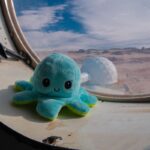
This moment was all the more emotional because our botanist, and friend, Raphaël Dehont, spent two years of hard work preparing this mission with us, but couldn’t make it to the USA due to visa issues. This was a heart-breaking event and we miss him a lot on this Sol 0. In order to have him somehow with us during those three weeks, we took a small plushie as a mascot for him.

Now that the sim had begun, we all started to work on the tasks defined by our roles and on our experiments. Some stayed at the Hab and others started to fill the other buildings of the station: Science Dome, GreenHab, RAM (the names are cool, but not even as much as the rooms themselves).

Everyone starts to feel more and more at home in the station. At the time of writing this, we are all writing our reports for Mission Support. We’ll then have dinner, the first on Mars, and we’ll be off to bed. This can be seen as a very earthly routine, except we are on Mars, and tomorrow we will perform our first EVA and step for the first time on Martian soil.

Sol Summary – January 31st

Sol Activity Summary: Morning was spent with Atila, finalizing the steps required for us to safely and confidently perform EVAs. Following a very substantial lunch, we took our final pictures outside and entered sim mid-afternoon. During the following time, we continued setting up various science experiments and began getting used to life in sim.

Look Ahead Plan: Planning for and performing our first EVAs in order to get our footing outside.

Anomalies in work: Nothing of note.

Weather: Slightly overcast, biting cold in the morning.

Crew Physical Status: No health issues, a little fatigue for some

EVA: None performed besides outside training with Atila

Reports to be filed: Operations Report, Health and Safety Officer’s report (with temperatures), Pictures, Journalist’s report, Sol Summary, EVA requests (2 if possible)

Support Requested: We have taken pictures of the visible insulation mentioned previously and can supply them if need be.

Final Mission Summary – Crew 226

Mission Summary Crew 226- Team Colombia

Description

From January 16th to the 30th, 2022, the second Colombian Mars Simulation Analog Mission took place in the MDRS. The team got integrated by Colombian students, researchers, and professionals in the areas of Science, Engineering, and Technology strongly related to the aerospace field. Among others, some challenges the mission crew encountered were to go through confinement and isolation in this habitat for 15 days, on a diet based on dehydrated food, and limitations on the use of water and communications.

The Colombian main crew, Crew 226, includes:

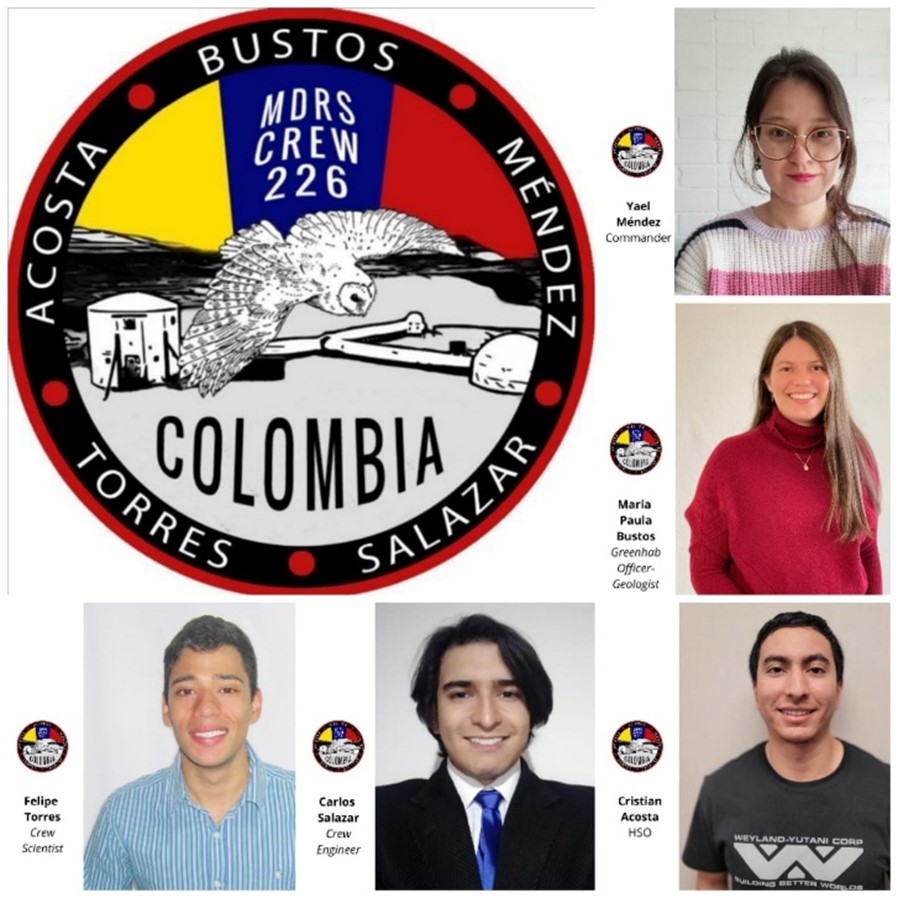
  • Felipe Torres, Mechanical Engineer from Universidad Nacional de Colombiawith the position of Crew Scientist.
  • Carlos Salazar, Mechatronic Engineer candidate for a master’s degree in Engineering– with the position of Crew Engineer, both from the Universidad Nacional de Colombia.
  • Cristian Acosta, Aerospace engineer for Blue Origin, with the role of Health and Security Officer.
  • Maria Paula Bustos, Geologist and Master’s student in Geodesy and Geoinformation Science -Technische Universität Berlin, with the position of Greenhab Officer and Crew Geologist.
  • Yael Méndez, Microbiologist, from Universidad de los Andes and Master’s student in Geosciences from Universidad Nacional de Colombia with the position of commander.

The Crew Organizer is David Mateus, a Mechatronic Engineer and Master’s student in Space Studies at the University of North Dakota.

The main line of work is related specifically to the areas of expertise of the crewmembers, developing projects following years of studies and preparation, and, as it usually happens in space exploration, collaboration with teams left back on Earth. The second line is about the interest in developing outreach projects in Colombia. Our country does not have a well-developed space field, and these kinds of opportunities provide a platform to develop several types of outreach activities, from general to specialized public.


Mission patch and personal photos
EVA Summary

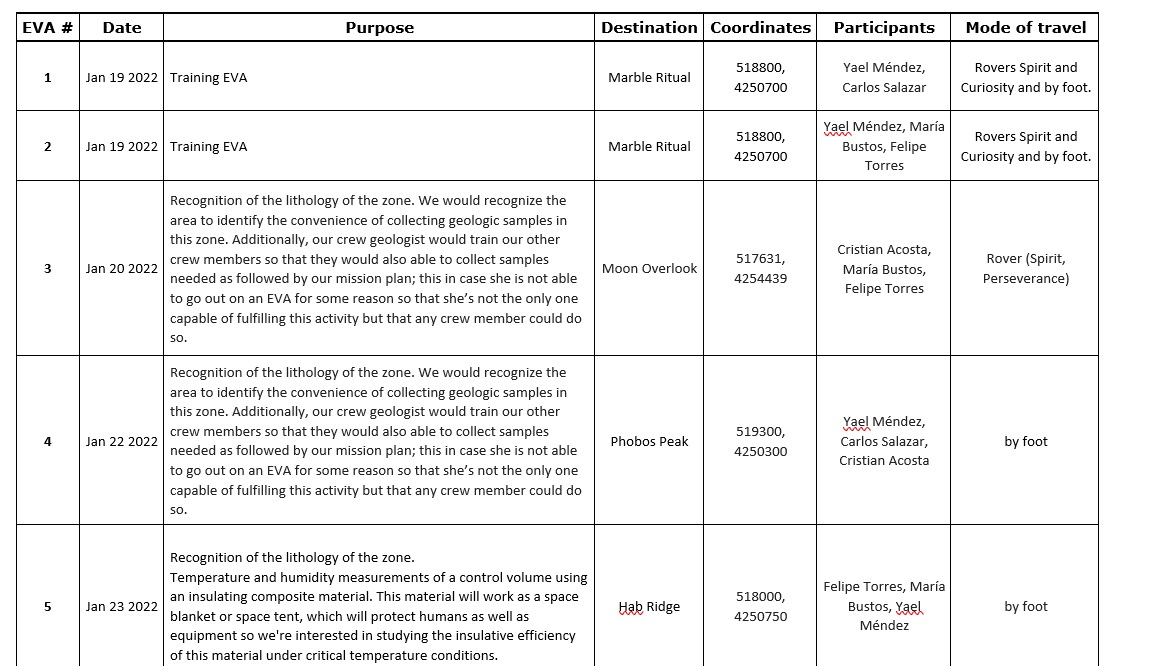
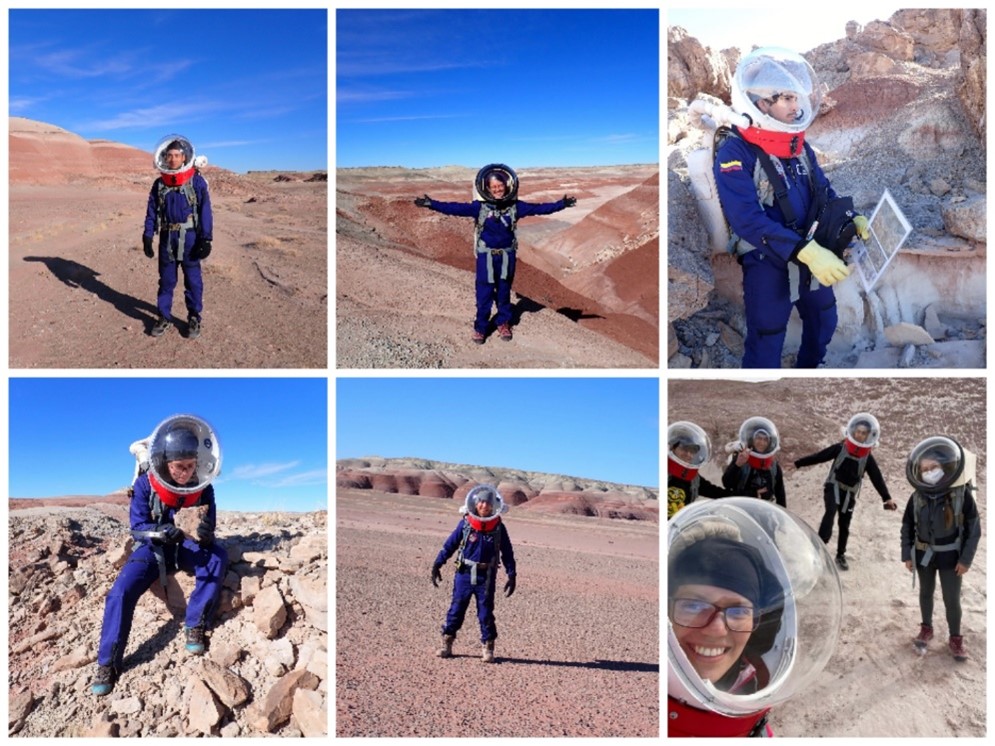
The crew executed a total of 8 EVAs during the 2 weeks period at the MDRS. Appendix 1
Operations Summary

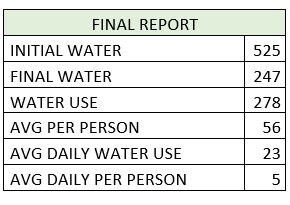
Water consumption was monitored daily as well as the status of charge of batteries powered by the solar panel system. All mechanisms functioned nominally throughout our mission except for the energy system which controllers failed one day before ending simulation.
Health and Safety Summary

The overall health for crew 226 during the mission was good. No one developed any severe illness or injuries while at MDRS which was always great to see. Nonetheless, the following symptoms developed among the majority of the crew members at different times: coughing, sneezing, headaches, chills, sore throats, and acid reflux. Aside from the acid reflux, these symptoms were manageable with specific vitamins and medicines and never worsened after appearing. The only minor injury sustained by a crew member was that of the rolled ankle which saw inflammation. But with rest, pills, and creams, both the inflammation and pain went away and recovery was speedy. Another note was that of personal hygiene and although the crew has not taken a shower in 12 days, they have been very good with using facial wipes and other personal hygiene products to stay relatively clean throughout the mission.

Green Hab Summary

The green-hab was received on the 18th of January 2022. Several kinds of plants such as cherry tomatoes, herbs, carrots, lettuce, micro-greens, peppers, and cucumbers were already planted on our arrival. During the two-week rotation we harvested the following:
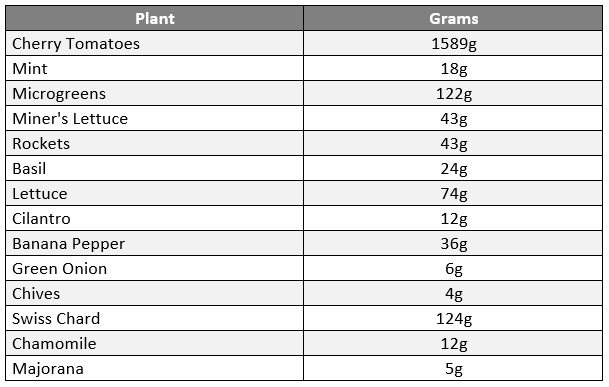
Additionally, the following was planted: lettuce, microgreens, chives, lemon balm, cilantro, and red bunching onion. Some of them are already growing and are expected to be harvested in the following weeks.


Research results

Carlos SALAZAR (Crew Engineer)

Project Title: 3D Mapping for rovers using point cloud stitching and Kinect

Description: Build a system that gets point clouds taken with a 3D camera on an element like the Kinect sensor and joins them together to make a 3D map of the environment and locate itself in it. The following tasks have been defined:

  • Get the points clouds using Kinect and point cloud library
  • Process the point clouds taken
  • Check and validate point cloud stitching algorithms
  • Check and validate point cloud matching algorithms
  • Integrate the developed modules


Methodology: The method of research selected for this project is going to be experimental, the samples taken with the sensor will be taken mainly in indoor areas or in a controlled environment, a portion of the solution will use methods from the point cloud library PCL using example point clouds. The idea is to check if those methods work with our samples and how a correct integration of all the modules can be made, identifying its weak points to propose and evaluate ways to improve them.

Preliminary Results:  A lot of pictures for structure from motion were taken during an EVA, some processing is needed to turn them into point clouds. The Kinect was used in the hab and the samples will be used to test the algorithms that will be developed later.


Maria Paula BUSTOS (Crew Green Hab Officer)

Project Title: Classical music and the growth of plants at MDRS


Description: Evaluate the growth of cherry tomatoes and mint plants in the station under the sound of the classical music of Johan Sebastian Bach by exposing these plants daily to Bach’s songs and comparing them to a control group that is not going to be exposed to this music, and determine if Bach songs have an impact in the rate of growth of these plants in the MDRS Green-hab.


Methodology: 1) Select two cherry plants and two mint plants that were cultivated at the same time and exposed to the same conditions during the last weeks and measure the size of its leaves and the number of fruits and flowers they have. 2) Expose daily for three hours one mint plant and one cherry plant to Bach songs. 3) Measure daily the size of the leaves and the number of fruits and flowers of each of the plants exposed to classical music and the ones not exposed (control group). 4) compare results and determine if the exposure to Bach classical music affects the growth of tomato cherry and mint plants in the research station.


Results: We performed experiments in which we daily exposed two cherry tomato plants to Bach’s classical music for three hours. We exposed one of the two plants (Plant A) to the music at a distance of 1cm, while the other one (Plant B) was exposed to the music 7 meters away. After two weeks we found out that plant A, grew less in terms of new fruits and flowers compared to plant B. We cannot conclude that music was the only factor that could have influenced the growth of the plant since there were also a lot of insects that infested plant A. Further research with more controlled parameters should be performed in order to have concluding remarks regarding music exposure and plant growth.


Felipe TORRES (Crew Scientist)

Project Title: Feasibility of using bo-PET films to build an emergency Space Tent.

Description: Analysis of the insulating efficiency of a biaxially oriented polyethylene terephthalate (bo-PET) film in order to determine the feasibility of building an emergency space tent for EVAs in Mars and other aerospace applications using this material.

Methodology: Take measurements of Humidity and Temperature using a DHT11 sensor and Arduino. These measurements will be taken on different control volumes outdoors both with and without the thermal insulation provided by our material. To consider meteorological factors, these measurements will be taken at different times of the day and at different locations around the station. The insulative material will then be tested on different crew members, by providing a protective layer with the material and the body temperature will be measured with and without this insulative layer.

Results: Bo-Pet films provide considerable protection against critical temperature conditions. At high temperatures, the material is able to reduce temperature inside the control volume due to its high light reflectivity, avoiding temperature to rise considerably. In contrast, at low temperatures, the material maintains heat inside the control volume; while it doesn’t increase temperature, it prevents that the volume reaches extremely low temperatures in the absence of sunlight. In terms of relative humidity, bo-PET film increases the relative humidity inside the control volume, which is convenient for the dry environments found on Mars. Figure 1
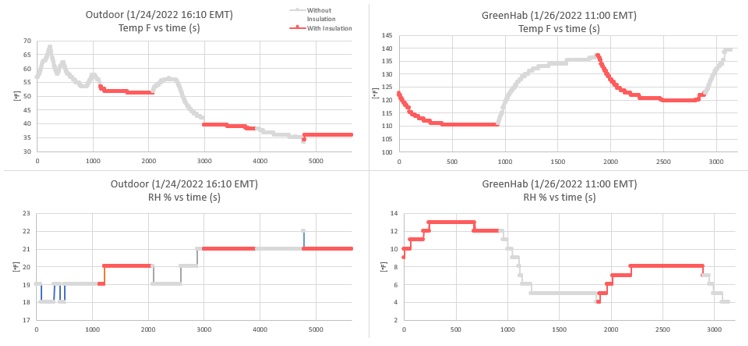
Figure 1. Temperature and Relative Humidity measurements with and without insulation.


Yael Natalia MÉNDEZ (Commander)

Project Title: Clays identification through reflectance spectrometry and Raman spectroscopy.

Description: This project seeks to use Mars Desert Research Station (MDRS) to analyze the impact that clay variations have, and recognize their mineralogy through laboratory techniques (reflectance spectrometry and Raman spectroscopy), and compare that with the instruments applied in the perseverance rover.

Methodology: Collect samples of different types of clays found in the MDRS and they will be process in Colombia by Grupo de Caracterización Tecnológica de Minerales at Universidad Nacional de Colombia.

Preliminary Results: Zones’ geological description and lithology recognition, Clay samples collection to be processed in Colombia.
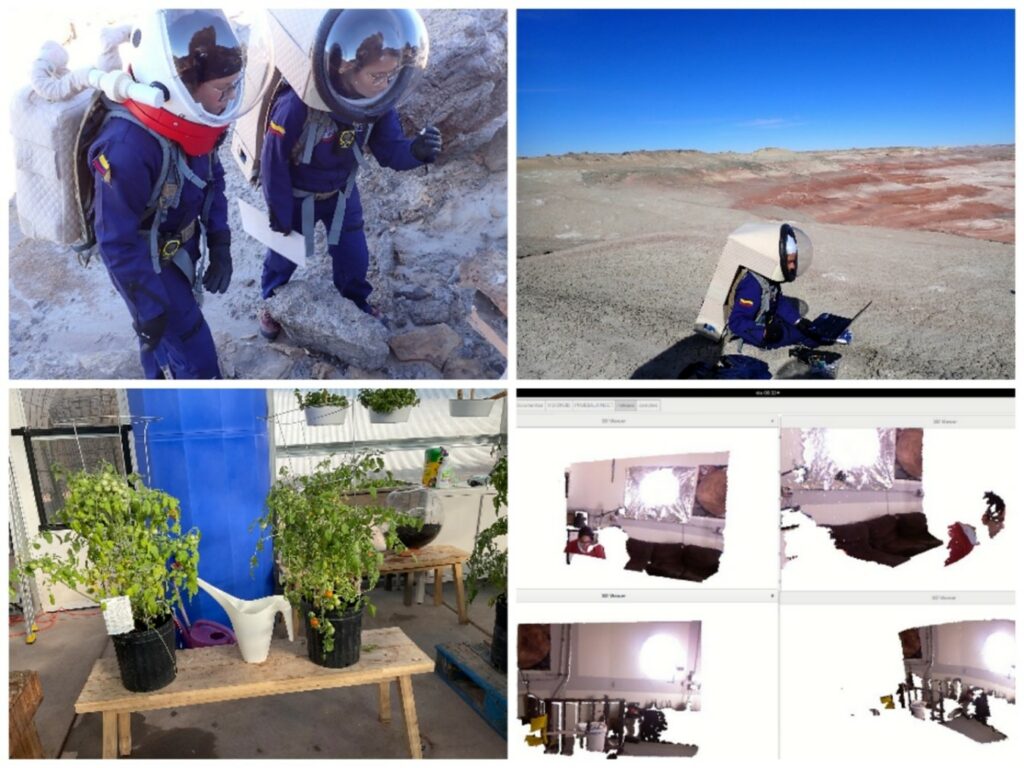
Figure 2. Upper left: Recognition of zone’s lithology. Upper right: Temperature and Humidity measurements. Lower left: Green Hab and music experiments. Lower right: Hab 3D imaging.


Acknowledgments

MDRS Crew 226 wants to acknowledge and thank all the people and institutions that made this possible. It’s been a two-year-long process that required a significant amount of effort from several people. We would like to start by thanking The Mars society, in the head of its president, Dr. Robert Zubrin, as well as Director Dr. Shannon Rupert, and Atila Meszaros, who made us feel safe and welcomed. We would also like to thank all the Capcom officers who were ready to take our reports and comments. And also, all the people behind the scenes working actively to make this possible, but surely helped us make our mission smoother and wonderful.

Appendix 1