[category science-report]
End of Mission Science Report
I. Project Phantom Virtual Reality/Augmented Reality Demonstration
PI/Crew Lead: Trevor Jahn, M.S. Aeronautical/Astronautical Engineering
· Objective: Create 3D models of the aera surrounding MDRS, and show its effectiveness in mission planning in tandem with Aerospace’s unique Augmented Reality Software
· Accomplishments:
Demonstrated using Remote Control (RC) rover/robot to collect imaging data to be used for photogrammetry during a spacewalk on Mars
Demonstrated using Aerial Drone to collect imaging data to be used in photogrammetry to create 3D models, and maps, to be used for mission planning during a spacewalk on Mars
Demonstrated stitching together 3D models produced from Aerial Drone images, and 3D models from satellite imaging to create a 3D model of the operational environment that can be updated with new stitched in models
Demonstrated using Aerospace’s Augmented reality software for mission planning and execution
· Relevance: Photogrammetry is now becoming more common place and has already been used in limited capacity on Mars to create 3D models of the planet’s surface. There are also public documents outlining the use of Augmented Reality hardware in NASA’s next generation space suit. This research will lay the groundwork for ways to use 3D models from photogrammetry, and the augmented reality spacesuit capability, together on future space walks and missions on the Moon and Mars.
II. Mirror Coating Experiment
PI: Chelsea Appleget, Ph.D. Aerospace Engineering
Crew Lead: Ashley Kowalski, M.S. Aerospace Engineering
· Objective: Monitor and characterize mirror surface degradation under a simulated, accelerated environmental exposure over the two-week period at MDRS
· Accomplishments: The crew deployed four different mirror samples close to Marble Ritual on Sol 1. On Sol 5 and Sol 8, the mirror samples were brought in by a morning EVA crew and inspected in the Science Dome under The Aerospace Corporation microscope by Crew Engineer. During the inspections, the locations of abnormalities on the mirrors were noted and images of those anomalous areas were saved and delivered to the PI on Earth. Upon completion of each inspection, the mirror samples were redeployed to the Martian environment on an afternoon EVA the same day. Originally, one final mirror inspection was to be performed on Sol 12; however, upon receiving feedback from the PI on Earth, it was determined that an unexpected anomaly occurred during this experiment. Thus, an EVA was performed on Sol 10 to adjust the mirrors in the field. Additional mirror inspections were completed on Sol 11 with additional exposure time on Sol 12. Therefore, while the original procedures for this experiment needed to be modified, the crew was able to make necessary adjustments to the payload and successfully utilize the unique Martian environment to obtain an abbreviated data set to characterize the mirror surface degradation.
· Relevance: Highly reflective silver mirrors are used in many space applications, but exposure to environmental contaminants can rapidly degrade optical performance. The results of exposure to a simulated Martian environment with dust, variable temperatures, and harsh conditions will be compared to traditional laboratory accelerated environmental testing, allowing researchers to correlate laboratory testing to harsh desert conditions.
III. Ham Radio Demonstration
PI/Crew Lead: Matthew Eby, M.S. Aerospace Engineering
· Objectives: Demonstrate deployment of a ham radio field antenna in a Mars analog environment while wearing analog space suits; Conduct handheld ham radio range test on EVA
· Accomplishments: While at MDRS, the three ham radio operators on the crew (Eby KJ6ZCL, Ferrone KI5AMM, Braun N1VNJ) completed activation and checkout of the new MDRS ham radio station and two of their own handheld ham radios. The crew also deployed the whip antenna with vertical extension while on EVA. Subsequently, crew received transmissions on the ham radio station from as far away as Lithuania and Luxembourg, but the crew did not yet receive confirmation their own transmissions were received. Using the handheld radios, the crew conducted EVA communications tests at several locations around MDRS and determined that the handheld ham radios would make excellent alternative or backup communications to the MDRS EVA radios.
· Relevance: Pending improved understanding of the Martian ionosphere, ham radio communications may be employed to supplement traditional radio communications on the surface of Mars.
IV. EVA Tools Demonstration and Regolith Sample Collection
PI/Crew Lead: Allison Taylor, M.S. Space Studies
· Objective: Evaluate the operational use of the selected commercial-off-the-shelf (COTS) tools in accomplishing regolith sampling during planetary surface EVAs
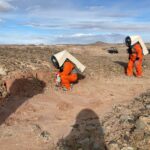
· Accomplishments: The COTS EVA tool suite included a rake and scoop, handheld battery-powered sifter with 75-micron mesh, and special sample collection bags. The crew successfully collected 10 regolith samples from sites near the Hab and known traverse routes in the Tharsis Montes quadrant, the Special Region in the Valles Marineris quadrant, and the Barrainca Butte region in the Charitum Montes quadrant. Sifted regolith is the first step in the beneficiation of material for in situ resource utilization (ISRU), as ISRU requires smaller grain sizes for processing. The regolith samples will be sent to a laboratory at The Aerospace Corporation for analysis to determine if any of the sampled regions near MDRS have compositions suitable for ISRU processing, such as creating building materials.
· Relevance: It is likely that similarly collected samples from the Moon and Mars will be analyzed for purposes such as future site construction with the goal to maximize the use of in situ material.
V. Weather Balloon Release
PI/Crew Lead: Matthew Eby, M.S. Aerospace Engineering
· Objective: Prepare and launch a high-altitude weather balloon in an analog Martian environment and in analog space suits; Measure dust in the atmosphere from ground level to 90,000 ft
· Accomplishments: This experiment leveraged existing Aerospace assets from prior high-altitude flights, including radio, telemetry, and tracking equipment, parawings, and spare weather balloons. To the existing sensor package, a dust sensor was added, requiring modifications to the flight code to add a two-wire serial data interface. An epoxy fiberglass cone was fabricated to house the experiment package. Upon arrival at MDRS, the experiment was unpacked and prepared for flight by loading the flight batteries and assembling the quarter-wave ground plane telemetry antenna. A dress-rehearsal launch was conducted with the team, activating the payload, and checking out the ground station. On flight day, the balloon was filled with 150 cubic feet of Helium. The balloon train (balloon-parachute-experiment) was assembled and in calm air near the ground, then the balloon was sent aloft. Measuring dust in the air, the balloon caught the Jetstream, and the crew tracked the balloon as it rose to the target altitude and then as it descended over the Colorado Rockies.
· Relevance: Balloons on Mars would enable in situ atmospheric measurements that are not feasible with other platforms such as satellites and rovers. Applications for human Mars missions include dust storm monitoring, atmospheric sounding, on-demand or rapid response science missions, and tethered communication relays.
VI. Exercise and Fitness Protocols
PI: Sylvia Kohn-Rich, Ph.D. Aerospace/Aeronautical/Astronautical Engineering
Crew Lead: Barbara Braun, USAF Lt. Col. (ret.), M.S. Aerospace Engineering
· Objective: Evaluate Hygear compact fitness equipment and other exercise protocols in space-like living environments
· Accomplishments: Five of the six analog crew members used the Hygear fitness bands and jump rope equipment in circuit-style workout plans, as supplements to other regimens, and in conjunction with videos and other exercises. Crew discussed their voluntary fitness activities and provided feedback on the equipment if used. The fitness bands have a simple and flexible attachment mechanism, ideal for an environment with limited fixed mounts. The bands are very compact and use elasticity rather than weight to provide resistance, as appropriate for a low-gravity environment, but require a moderate amount of free linear space to stretch to their full length. Crew members are finding the jump rope and rope-free weighted handles surprisingly effective; the weighted handles are particularly good for confined spaces. The crew is having difficulty fitting the recommended three 15-minute workouts into their day and recommend fewer, longer workouts as a more suitable regimen.
· Relevance: Maintaining astronaut fitness in low-gravity and limited-space environments is critical to successful space exploration. Evaluating exercise equipment and approaches in an analog environment allows a better understanding of their suitability for interplanetary habitat and space station use.
VII. Radiation Environment Monitoring and Mapping
PI/Crew Lead: Kristine Ferrone, Ph.D. Radiation Physics
· Objective: Demonstrate the use of a handheld portable radiation dosimeter to collect GPS-tagged radiation dose rate data to create a dose rate map of a designated area on Mars or another planetary surface
· Accomplishments: With assistance from other EVA crew members, Commander collected GPS-tagged environmental radiation dose rate measurements at regular intervals using the handheld Radex RD1212-BT radiation dosimeter. This dosimeter records the GPS-tagged radiation dose rate in preset intervals and submits data to a public database (https://quartarad.com/radexweb/#/ViewChart; zoom in to MDRS location on map). The data collected on this mission was also used to create a radiation dose rate map of the area around MDRS.
· Relevance: Crews could use a radiation dose rate map to aid in EVA planning to identify exposed or protected solar radiation areas or to locate radioisotopes on the surface. The GPS-tagged radiation dose rate data could also be integrated into VR/AR models in the future.
VIII. Discord Crew Communication Demonstration
PI: Elias Braun, 10th Grade Student
Crew Lead: Barbara Braun, USAF Lt. Col. (ret.), M.S. Aerospace Engineering
· Objective: Evaluate low-bandwidth, high-latency messaging (similar to texting) as a way for interplanetary astronauts to stay in touch
· Accomplishments: PI developed a special Discord text-only messaging server that simulated the light-time delay between Earth and Mars (currently five minutes each way). In addition to all-crew channels for talking to Aerospace mission support, each crew member had a set of private channels for talking to family and friends. Early bugs in the server were resolved by Sol 2. During the mission, the crew sent and received over 2000 messages across all channels. Crew members used Discord to stay in touch, conduct STEM outreach, consult with subject-matter experts, text with each other, and even to ask friends to look up information from “Earth” internet. The Discord server was highly effective with the relatively short five-minute light-time delay; future efforts might explore its effectiveness as the light-time delay grows to its maximum of about 20 minutes.
· Relevance: Crew morale will be a significant concern on long-duration interplanetary missions where communication is severely bandwidth-limited and time-delayed; this project demonstrates that the simple ability to text might provide an easy way to mitigate these concerns.
IX. EVA Planning
PI/Crew Lead: Allison Taylor, M.S. Space Studies
· Objective: Investigate how well a crew can manage experiment objectives and execution of daily tasks
· Accomplishments: Pre-mission, the crew created a high-level map of major activities showing allocation of the ~24-hour Sol. This was useful in evaluating the durations of major activities throughout the day and how much working time would be available. The second level plan was a Sol-by-Sol map of EVA and IVA activities. This was created with color-coded activity blocks in Excel, which made it easy to manipulate based on changes or adjustments to the plan while allowing all the objectives to remain on the plan. The third level plan included example timelines in 15-minute increments for each Sol. During the mission, the crew understood what they needed to accomplish each day and did not utilize the 15-minute increment schedules, which would have been too restrictive and labor-intensive to create without a mission control flight planning team in place. The 15-minute increment planning would be more appropriate for space station style missions and was not conducive to a more autonomous crew with long communications delays and planetary EVA traverses. Ultimately, the crew heavily used the second level Sol-by-Sol map of EVA and IVA activities as the master plan, which allowed for crew autonomy in management/decision-making. XO managed the schedule and EVA requests and marked major disruptions to the plan. Utilizing the color-coded EVA spreadsheet, the crew was able to ensure enough EVAs were completed to cover the objectives for each of the major experiments.
· Relevance: This mission planning methodology can be compared to existing NASA human spaceflight mission management/planning capabilities, as well as other analog planning approaches. Data on how planetary crews operate, with multiple EVA traverses in the mission plan, is relevant now as NASA is proceeding toward recurring lunar surface missions.

You must be logged in to post a comment.