Operations Report – February 22nd

Crew 293 Operations Report 22-02-2024

SOL:4

Name of person filing report: Leo Tokaryev

Non-nominal systems: Suit n°2 and Suit n°6

Notes on non-nominal systems:

Suit n°2: one of two attachments that is supposed to hold the red circle that is holding the helmet is broken, we suppose that it broke during yesterday’s EVA.

Suit n°6: the suit has a serious problem with power. After 3 hours of EVA, the suit was on 9V, which made the ventilation system inefficient and caused a medical event right at the end of the EVA. The suit loses energy too fast, and still is too dangerous to use even though the battery was replaced by the previous crew.

ROVERS

Spirit rover used: No

Hours: (before EVA)

Beginning charge: (Before EVA)

Ending charge: (On return from EVA, before recharging)

Currently charging:

Opportunity rover used:Yes

Hours: 164.2

Beginning charge:100

Ending charge:72

Currently charging:Yes

Curiosity rover used: No

Hours:

Beginning charge:

Ending charge:

Currently charging:

Perseverance rover used:Yes

Hours:284.4

Beginning charge:95

Ending charge:61

Currently charging:Yes

General notes on rovers:

Summary of Hab operations: put notes here

WATER USE: 9.8 gallons

Water (static tank): 407.9 gallons

Static tank pipe heater (on or off):On

Static tank heater (On or off)On

Toilet tank emptied: yes

Summary of internet: none

Summary of suits and radios: The radios were functioning well.

Summary of GreenHab operations: put notes here

WATER USE: 6 gallons

Heater: On

Supplemental light: 22h-2h on automatic

Harvest: nothing

Summary of ScienceDome operations: put notes here

Dual split: Heat or AC, On

Summary of RAM operations: RAM wasn’t used today

Summary of any observatory issues: none

Summary of health and safety issues: see the HSO report about the medical event that was caused by the malfunction of one of the EVA suits.

Questions, concerns and requests to Mission Support:

1) We decided to test all the suits’ battery usage, we will inform you after we have our results. Our protocol is to put all the suits on maximum ventilation mode and take voltage and air flow measurements every 30 minutes to test their battery usage. We will conduct this testing for 4 hours since it is the maximum time of an EVA. I believe that previous tests that were made on suit N°6 were conducted only for one hour, that is why the problem wasn’t detected. We will send you the full results, but for the moment we already identified some problems in suits 4 and 6.

We had an issue with toilets today: the odors were too strong not only in the restroom, but in the whole lower deck and even in some rooms in the upper deck. We emptied the toilets hoping that it would solve the problem, but the sensor only indicated that the tank was 1/3 full. I don’t know what is the source of the problem: the ventilation, the toilets or the sensor that wasn’t indicating the right value.

Crew 293 Crew biographies, photos and mission patch – 18Feb2024

[title Crew biographies, photos and mission patch – February 18th]

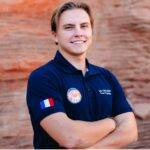
Yves Bejach

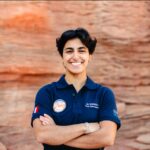
Yves Bejach joined ISAE Supaero to pursue his passion for space. With this in mind, and to get closer to the world of research, he joined the crew as Crew Scientist, responsible for ensuring that experiments run smoothly and protocols are respected. Together with his crew, he hopes to continue extending the scientific scope of the project, and to take advantage of this mission to popularize science.

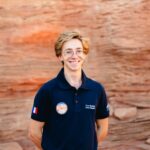
Léa Bourgély

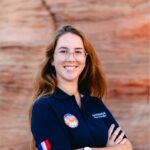
Léa Bourgély joined ISAE-Supaéro after completing a degree in physics in Paris, with a major in astrophysics. In line with her passion for astronomy and astrophysics, she has taken on the role of Astronomer for Crew 293. She will be in charge of the station’s two telescopes, and her astronomy project will involve studying Coronal Mass Ejections and sunspots, in order to assess their speed and direction.

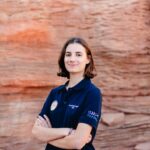
Lise Lefauconnier

Lise Lefauconnier, a 2nd year student at ISAE and originally from Normandy, has long been interested in space exploration, and more particularly in the physiological impact of manned flight on human beings. This interest in the study of human reactions and behavior, her natural sensitivity and attentiveness to others, and her experience as a gymnast are what motivate her in her role: she will be a health and safety officer, in charge of the moral and physical well-being of the crew, through daily sports sessions in the station and moments of team-building.

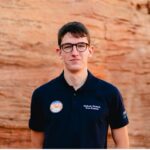
Leo Tokaryev

A long-standing space enthusiast, Leo Tokaryev has joined crew 293 as a flight engineer to conduct experiments that will advance scientific research in space. During this mission, he will be responsible for keeping the station and its scientific instruments in good working order. Leo is particularly interested in space hardware test experiments, which will help develop tools for astronauts.

Marie Delaroche

Marie Delaroche is a student at ISAE Supaero. Having grown up in New York in a multicultural environment, she decided to return to France to study space engineering and manned flight. After a first mission at MDRS as Crew Journalist, she joined Crew 293 to serve as Commander, with the aim of continuing to extend the scientific and educational reach of Supaero’s MDRS project.
Her experience and kindness will be major assets to the success of crew 293’s mission in 2024!

Erin Pougheon

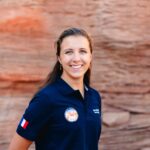
Erin Pougheon is a second-year student at ISAE-SUPAERO. Having heard about the MDRS project, she decided to join the school to study space and manned flight, a field she’s been passionate about since childhood. MDRS is an opportunity to realize her dream of contributing to space exploration efforts. An avid writer, she will be the crew’s journalist, reporting on the mission and sharing her experiences with the spacefaring community.

Mathurin Franck

After completing preparatory classes at the Lycée Pierre de Fermat, Mathurin Franck went on to pursue his dreams of space exploration and piloting at ISAE SUPAERO. With his heart set on collaborating as closely as possible with the major entities in the space sector, he wants to participate and bring his conviction, values, seriousness and skills to space exploration, to contribute to technological evolution and to be a stakeholder in this formidable human adventure that breaks down all frontiers. So it’s with great pleasure that he takes part in this mission in the role of botanist, and is ready to take science to the next level!

Mission Plan – February 19th

Crew 293 Mission plan 19Feb2024

Name of person filing report: Yves Bejach

Our Crew is as follows:

Commander: Marie Delaroche

Executive Officer / GreenHab Officer: Mathurin Franck

Astronomer: Lea Bourgély

Engineer: Leo Tokaryev

HSO: Lise Lefauconnier

Journalist: Erin Pougheon

Scientist: Yves Bejach

Crew 293, gathering 7 students of ISAE-Supaero (Toulouse, France) is planning to perform a range of scientific experiments that articulates around two main axes: human factors experiment and technology demonstrations. It is the 10th consecutive mission from Supaero students and the second one to last 4 weeks.

Physics

Two experiments from the French National Center of Scientific Research (CNRS) have been performed at the MDRS for several years already. We are planning to gather additional data for this season as well. These activities will require EVAs.

· LOAC (Light Optical Aerosol Counter): LOAC is an optical aerosol counter, measuring the concentrations of different particles in the air and classifying them by size.
Related EVAs: Two EVAs planned for the first week to install the device. Every two days, the batteries will have to be changed and the data will have to be collected. The latter procedures can be part of other EVAs.
External points of contact: Jean-Pierre Lebreton and Jean-Baptiste Renard, CNRS.
Point of contact within the crew: Lea Bourgely.

· Mega-Ares: Mega-Ares is a sensor precisely measuring the electric field and the conductivity of the air. It is the little brother of Micro-Ares, the only payload of the Schiaparelli lander (ExoMars 2016). This year we’ll also install a wind-mill that will give us aditionnal data.
Related EVAs: Performed simultaneously with the EVAs planned for LOAC. Two EVAs planned for the first week to install the device. Every two days, the batteries will have to be changed and the data will have to be collected. The latter procedures can be part of other EVAs.
External points of contact: Jean-Pierre Lebreton and Jean-Baptiste Renard, CNRS.
Point of contact within the crew: Lea Bourgely.

Technology

Technology demonstrations are planned, one of them being the continuation of the two last missions of ISAE-Supaero (Crew 263 and 275). They are based on technologies developed by the French Space Agency (CNES) and its health subsidiary (MEDES).

· AI4U: AI4U is an AI tool designed to help and assist astronauts in their daily tasks (environmental measurements, voice recognition). The aim is to test this AI assistant in real or close-to-real scenarios.
Related EVAs: None.
External points of contact: Gregory Navarro and Laure Boyer, CNES.
Point of contact within the crew: Mathurin Franck.

· Echofinder: Onboard the ISS, ultrasound scanners are teleoperated by trained specialists. As we travel further away from Earth, communication delays will increase and teleoperated devices will no longer be usable. The goal of Echofinder is to enable autonomous ultrasound acquisition sessions without any knowledge in medicine and any communication link with an experienced sonographer. The Echofinder tool uses augmented reality and an AI to help the operator capture usable imagery of the subject’s organs.
Related EVAs: None.
External point of contact: Aristée Thévenon, MEDES.
Point of contact within the crew: Yves Bejach.

· Photogrammetry: Re-conducting an experiment started by last year’s crew (Crew 275) which aims to determine how a 3D map created thanks to drone photogrammetry could improve an EVA crew’s performance during an outing.

Related EVAs: Three EVAs per week, starting the second week. The first one’s goal is to create the 3D map and decide where to position checkpoints on a designated area (one area per week). For the 2nd and 3rd ones, the EVA team will go to each checkpoint, having prepared the EVA using the standard 2D and 3D map respectively.

External point of contact: Alice Chapiron, ISAE Supaero student (Crew275)

Point of contact within the crew: Yves Bejach

· Neuroergonomy: Experiment aiming to evaluate the importance of vision compared to other senses in our perception of space.

Related EVAs: None

External point of contact: Maelis Lefebvre, ISAE-Supaero

Point of contact within the crew: Leo Tokaryev

Human factors

Human factors experiments are arguably the ones that benefit the most from taking place during an analogous mission.

· KTHitecture: Measure of the stress of analog astronauts and of the influence of environmental parameters on the stress using Polar bands bracelets, sleep monitoring using Dreem headbands, questionnaires, evaluation of the position of the analog astronauts in the station, and environmental measurement (temperature, humidity, etc.).
Related EVAs: None.
External point of contact: Michail Magkos, KTH.
Point of contact within the crew: Lise Lefauconnier.

· MELiSSA: The MELiSSA project (Micro-Ecological Life Support System Alternative) is a European project led by the European Space Agency (ESA) aiming at developing a highly circular and regenerative life support system for space missions. The ALiSSE methodology (Advanced Life Support System Alternative) was developed as part of the project to provide an impartial evaluation tool of each technology system, including mass, energy and power, efficiency, crew time, crew risk, reliability, and durability. The proposed activity within the MELiSSA project focuses on the operational aspects of preparing recipes from higher plants and aims for a preliminary evaluation of the "crew time" criterion.

Related EVAs: None

External point of contact: Blandine Gorce, ESA

Point of contact within the crew: Mathurin Franck

· Trace Lab: The purpose of this research is to better understand the role that emotion and coping strategies have on team dynamics within ICE (Isolated, Confined, Extreme) teams. The findings from this study will aid in the understanding of the role of affect within teams operating in ICE conditions – something that has been highlighted as being important by researchers, Antarctic expeditioners, and astronauts. Experiment conducted in collaboration with Trace Lab, University of Florida.

Related EVAs: None

External point of contact: Andres Kaosaar

Point of contact within the crew: Marie Delaroche

· AMI – Anomalies Monitoring Interface: Software allowing random anomalies to occur within the station to simulate problems that could happen in a real environment and see how we could react. The main goal is to improve the simulation.

Related EVAs: Potentially emergency EVAs in case of depressurization of ammoniac leak. It is worth noting that such emergencies cannot be mistaken for real ones as it is not a problem that can occur within our earthly MDRS.

External point of contact: Quentin Royer, ISAE Supaero student (Crew275)

Point of contact within the crew: Marie Delaroche

· Timepercept: Subjective time perception in confined environments, such as isolation or imprisonment, often leads to a distortion of time experience. The phenomenon is significant in understanding the psychological effects of confinement and has implications for mental health management in isolated or controlled settings like space missions or solitary confinement. Experiment conducted with the University of Krakow.

Related EVAs: None

External point of contact: Mateusz Daniol

Point of contact within the crew: Erin Pougheon

Outreach

· Media: Several articles and interviews in French newspaper and on radio

· Scientific mediation: We, like all Supaero Crews that came before us, try to share our passion for space and science in general by engaging in intervention in middle and high school. This year, we developed with high-schoolers a 3-step project around growing food on Mars.

Related EVAs: One as early as possible to retrieve some martian soil in which to plant radish seeds.

External point of contact: None

Point of contact within the crew: Mathurin Franck
Crew 293 HSO Beginning Of Mission Checklist 18Feb2024

[title HSO Beginning Of Mission Checklist – February 18th]

HSO BEGINNING OF MISSION CHECKLIST 2022-2023

Submitted by: Lise Lefauconnier

Crew: 293

Date: 02/18/2024

Part 1: Using the attached Safety Equipment Inventory, locate, test and confirm operation of all safety equipment. List any equipment not found and/or missing:

Did not find the intercom in lower deck. This has been discussed with the site manager, Ben.You will find below the Safety Equipment Inventory completed.

Part 2: Locate and confirm the emergency escape routes in the Hab are functional and clear:

1. Stairs: all clear

2. Emergency window: all clear

3. Commander’s window: all clear

Part Three:

Inventory First Aid kit and note what needs to be refilled:

In the EVA bag:

– Marker

– Scissors

– Emergency thermal blanket

– Compressed gauze Z-folded

– Dressing

– Alcohol prep pads

– Antiseptic Towelette

– Adhesive bandage

– Sterile gauze swab

– Tourniquet

– Emergency compression bandage

– Triangular bandage

– Elastic bandage

– Adhesive tape

– Examination gloves

– Splint

In the little locker:

– Instant cold compresses

– Eyewash, eye pads and tape

– Burn dressing

– Plastic bandages

– Antibiotic ointment

– First aid/ Burn cream

– Hand sanitizer

– Nitrile exam gloves

– BZK Antiseptic towelettes

– Triangular bandage & CPR face shield

– Adhesive tape

– Trauma pad

– First aid guide

– Gauze dressing pads

– Scissors

– Tweezers

In the large locker:

– Ibuprofen

– Hydrogen peroxide

– Fingertip pulse oximeter

– Isopropyl alcohol

– First aid antiseptic

– Infrared thermometer

– Electronic blood pressure monitor

– Earloop face masks

– Cotton swabs

– Athletic tape

– Stretch gauze bandage rolls

– Pen

– Self adhering wrap

– Band-aid pack

– Thermal blankets

– Elastic bandage

– Adhesive tape

– Dramamine

– Clip

– Triangular bandage

Note any safety issues: Nominal

Note any health/environmental issues: Nominal

Note any missing or recommended health and safety supplies: None

Safety Equipment Inventory 2022-2023

HAB Upper deck HAB Lower deck RAM GreenHab ScienceDome Rovers
CO monitor Tested, works Tested, works Tested, works Tested, works Tested, works
Escape ladder ok
Eyewash ok
Fire blanket ok ok ok
Fire extinguisher ok ok ok ok ok
First Aid X
Intercom ok Not found ok ok ok
Nightlight ok ok
Propane alarm Tested, works Tested, works
Radios (Channels 10 and 22) ok ok ok ok ok
Small fire extinguisher Not found
Smoke alarm Tested, works Tested, works Tested, works Tested, works Tested, works
Tow rope ok

Journalist Report – February 18th

SOL 0: Into familiar unknowns

“This wasn’t a strange place; it was a new one.” – The Alchemist, Paulo Coelho

Finally, Crew 293 has landed on Mars! The seven of us have arrived on the Red Planet. After an entire year of preparation and challenges, our interstellar space shuttle driven by Mathurin our Botanist and Lise our HSO made us step on our new habitat for the next four weeks. The travel was joyful and sunny in empty space!

As we arrived at the Mars Desert Research Station, we were truly amazed to finally see the station that we had dreamt of. We had a strong emotion upon seeing our future home, and we met Ben Stanley, the site manager. We spent the rest of the day being taught about how the station works. Ben explained to us details about the Upper Deck, where our rooms and kitchen are. No fight for the rooms, they are all small and look the same… Marie, our commander, has the privilege to have a window in her room, with a unique view on Mars! Then, we visited the Lower Deck, and the different station’s modules: the RAM, that Leo began to tame as our Crew Engineer; the GreenHab, realm of Mathurin; the Science Dome for out Crew Scientist Yves, and finally the Observatory, in which Léa will perform her Astronomy project! We finished off the day by preparing the EVA training, to learn how to use our EVA equipment. We will use it tomorrow for our two first training EVAs!

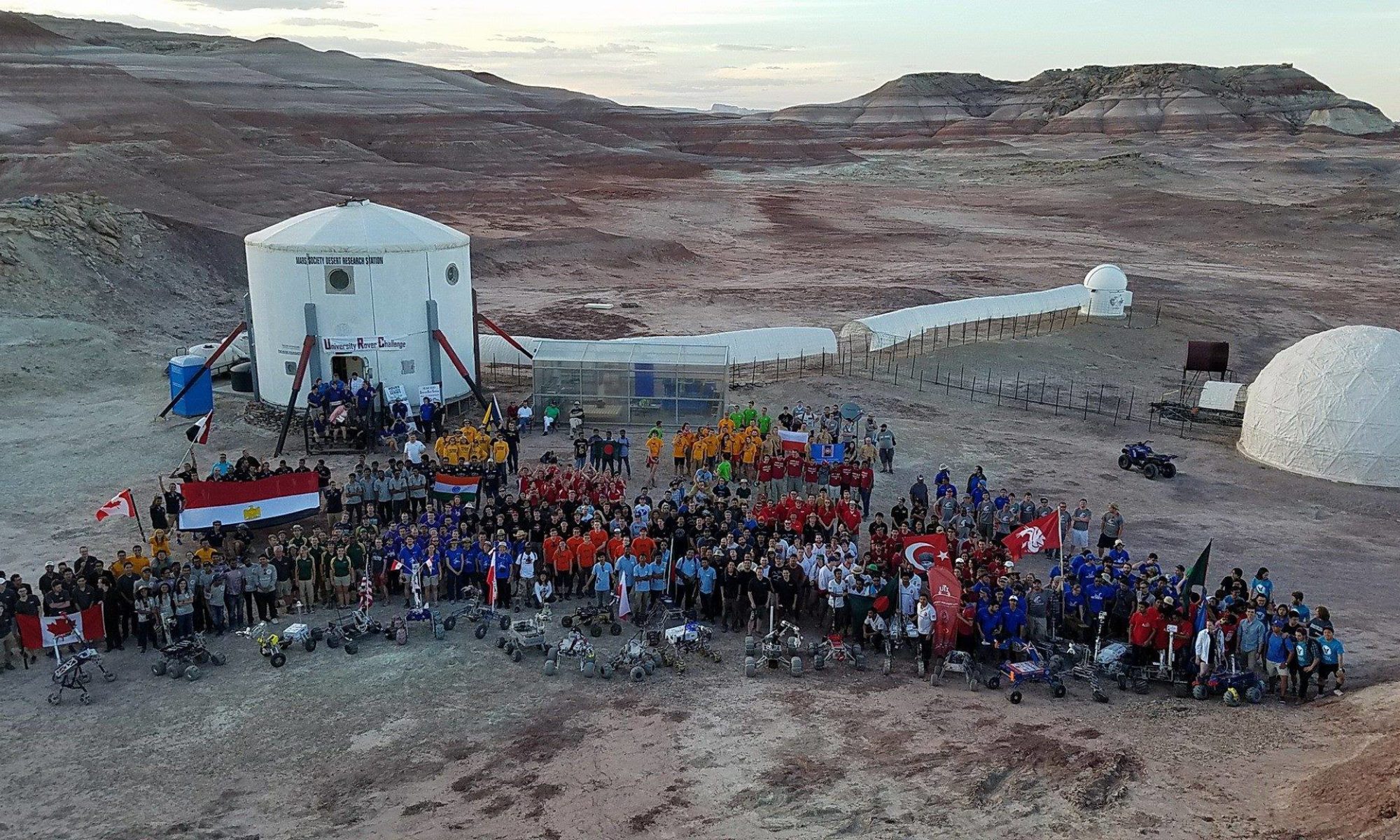
Despite all the hard work, we could benefit from the hot Martian sun rays, and we took some photos outside as we have not entered the simulation yet. Indeed, tomorrow we’ll close the station’s door and officially enter the Martian life simulation. Then, we’ll be authorized to go out with spacesuits and equipment only!

Supplemental Operations Report – February 18th

Date: 2/18/2024
Name of person filing report: Ben Stanley
Reason for Report: Routine
Non-Nominal Systems: Hab wall heater, solar observatory, perseverance parking brake

Power system:
Solar: Nominal.
SOC Last 24 hours: Max 98%; Min 39%; Avg 69.1%.
VDC Last 24 hours: Max 59.52V; Min 38.52; Avg 49.53V.
Generator run time: 5134.2 hours. Serviced on 02/18/2024, oil changed

Propane Readings:
Station Tank: 79%
Director Tank: 81%
Intern Tank: 83%
Generator Tank: 76%

Water:
Hab Static Tank – 550 gallons
GreenHab – 200 gallons
Outpost tank – 480 gallons
Science Dome – 0 gallons
Septic Tanks emptied: No

Rovers:
Sojourner rover used: No
Hours: 196.6
Beginning Charge: 100 %
Ending Charge: 100 %
Currently Charging: Yes
Notes on Rovers: Perseverance is back to normal.

ATV:
ATV’s Used: None. Nothing to report.

Cars:
Hab Car used and why, where: To Hanksville for supplies. Serviced on 2/12/24 – oil, oil filter, air filter, tires rotated, tire leak repaired, Mechanic note: looks like P/S cooler lines starting to leak
Crew Car used and why, where: In GJ with incoming crew
General notes and comments: N/A

Summary of Internet: All nominal.

EVA suits and radios:
Suits: All nominal
Comms: All nominal

Campus wide inspection, if action taken, what and why:
Sergii’s notes: remaining three fire extinguishers were serviced on 02/13/2024

Summary of Hab Operations: Wall heater is not functioning. Diagnostic is pending.
Summary of GreenHab Operations: All nominal
Summary of SciDome Operations: All nominal

Summary of Observatories Operations: Solar observatory telescope diagonal has two snapped screws. Repairs pending.

Summary of RAM Operations: All nominal
Summary of Outpost Operations: All nominal.
Summary of Health and Safety Issues: All nominal.

GreenHab Report – February 16th

Crew 292 GreenHab Report 16-02-2024 (Sol 12)

GreenHab Officer: Mehnaz Jabeen

Environmental control: heater on , fan off , door close

Average temperature

6:25: 70.2F, 20% (heater on, fan off)

10:23: 90.5 F, 32% (heater off, fan on)

11:00: 90.5 F, 32% (heater off, fan off)

Hours of supplemental light: 22:00 – 02:00

Daily water usage for crops: 6 gallons

Daily water usage for research and/or other purposes: 0 gallon

Water in Blue Tank (200 gallon capacity): 114.6 gallons

Time(s) of watering for crops: 10:30 water (heater off)

Changes to crops: No Change.

Narrative:

Sol 12 started with a sleepy early morning and a bittersweet feeling. It’s the last day here at MDRS for our crew and I’m already missing the plants and the GreenHab. I must say that I learned a lot practicing simulation. I realized it’s not really hard to live using less resources and staying in a small space collaborating with crew mates, being disciplined. I have learned that space is just a state of mind. If all the humans practiced living the same way outside of simulation the same way we live in, earth would be a better place than how it is now, and going to mars is a different story. We are breaking the sim by mid-day and I will continue to be the same human as I am now than who I was when I entered MDRS , only the spirit for going to mars will keep accelerating . I cleaned up the GreenHab with some help from Bharti, our crew geologist and watered the plants. Emptied the trash can and went to hab. Best wishes to all the GreenHab officers and their mission.

Harvest:None

Support/supplies needed: None

Journalist Report – February 16th

Sol 12: Life on Mars

Well, it’s the final sol for Crew Mangalyatri, and my goodness did Mars put on a gorgeous sunrise for us today! Today, all our sadness about leaving has been replaced with panic about cleaning the research station for the incoming Crew 293. But we didn’t bother worrying until after breakfast. It was another day for pancakes, and Daniel wisely suggested putting choc-chips in them. Good idea!

Once breakfast was complete, the cleaning began. First with the Science Dome, GreenHab, and RAM, and then the Hab itself. I have to say, the place is looking great! We blast off from Mars and back to Earth at 1200. That is to say, we break sim and can go about our lives as we normally would on Earth, e.g., not worrying about airlocks, being able to go outside without our EVA suits on, and being able to access the phone/internet outside of comms hours. Our plan once we break sim is to have lunch and then play tourist in the area and look at some more geology (woohoo, rocks!), before coming back for the night and doing our final cleaning tomorrow.

In lieu of anything particularly interesting happening today, I’m going to ask all the Mangalyatris what their favourite moment of this mission has been and to include their favourite photo from our time at MDRS.

Annalea (Commander): She has two! Which I guess I’ll allow as she’s the Commander. Her first is when she saw the dehydrated mango in the kitchen cupboard, which she then proceeded to eat most of. Annalea’s next favourite moment was decompressing in the airlock, wearing the EVA suit for the first EVA.

Aditya (XO & Crew Astronomer): Playing cards, specifically the first UNO game, which went on for AT LEAST 10 rounds and got sillier and sillier each round, resulting in a lot of laughter and a lot more of us saying “just one more round” and “I just want to win ONE game”.

Bharti (Crew Geologist): As a geologist, I have come across benchmarks many a time, but I don’t know why this feels certainly emotional as I was saying I am not that emotional currently when the mission is getting over but on the last EVA looking at the benchmark reminded me that someone before us put it there and this land has been explored many a time which may be or may not be the case for Mars. Either I’ll be one of the few geologists who will map and survey the Martian land, and maybe we will put it there. Or maybe we will go out after some people and see a similar benchmark on Mars. I don’t know if that makes sense at all, or I was just emotional for a very brief period of time. But yeah, here it is, the benchmark.

Mehnaz (GreenHab Officer): When we went to Candor Chasma, and we hiked there inside the canyon and the rough driving on the rover. Also, she said when I (Clare) make nice pancakes in the morning, and every time in the morning she wants something sweet, she wakes up to the smell of me making pancakes. How sweet of her to say!

Rajvi (Crew Engineer): The drive back from Candor Chasma in the EVA suit and the view of the Henry Mountains on that drive back. They were so beautiful covered in snow, and appeared so big and close, but at the same time, they were so different from our immediate surrounding landscape. Rajvi thought it might be a bumpy ride on the way back, but it wasn’t, instead, it was just a breathtaking moment. She said that it was really hard to pick a favourite moment, because everything was so good, and she loved it here. She also has a last-minute add of working on the space suits.

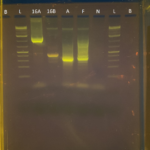
Daniel (Crew Biologist): Daniel’s favourite moment was the first time that DNA was successfully extracted from a collected sample, with attached annotated gel image to see. This was from the first sampling EVA, and while DNA was only obtained from one other soil sample out of 9 other samples, this was a great start and allowed the project to move forward.

Me, Clare (Crew Journalist): My time in the Science Dome. I painted in there with Annalea while Daniel did microbiology experiments. I taught Rajvi about testing for carbonates with vinegar and about breaking rocks while Daniel did his microbiology experiments and Annalea painted. I learned about said microbiology experiments from Daniel and learned how to pipette, pour a gel for gel electrophoresis, learned to prepare a DNA ladder, and learned that I was bad a shaking the tubes which contained samples and small beads to break the cells and extract DNA in lieu of a vortex. The Science Dome was a meeting of minds and a confluence of disciplines that I’ll miss in my everyday life.

So long, and thanks for all the fish,

Clare Fletcher (292 Mangalyatri Journalist)

Sol Summary – February 16th

Crew 292 Sol Summary Report 16-02-2024
Sol: Sol 12
Summary Title: Mangalyatri Crew 292 finishes its rotation at MDRS
Author’s name: Annalea Beattie
Mission Status: Nominal
Sol Summary Activity: We finish our simulation today so we are very busy. Clare cooked pancakes and we all were up early(ish). This morning we cleaned and cleaned every corner of the station. We scrubbed everything even under the cupboards in the kitchen. The Science Dome and The Green Hab are spotless. Downstairs the equipment and the area are sparkling. It is incredible really what teamwork can do. Again, we debated where to put biodegradable wipes. Should they be burnt or ? In the end that decision belongs to our engineer who says biodegradable wipes are not paper and are No Burn. That word ‘biodegradable’ is deceptive. Further research and more action needed on this. This morning (after midnight) I also finished our End of Mission Report. We all worked so hard for days to write this and my bad as I missed seeing the word limit on the mission support email. In fact, our actual report with everyone’s research in it is more than twenty pages. So I had to summarise to the short report. We are all happy with the long report however. We decided to turn it into a conference paper as we have really nailed in writing the conceptual breadth and depth of our research here, as well as a real sense of our time together in a simulated Mars environment. What a stunning crew and brilliant work. After lunch we will drive past Skyline Rim to the Valley of the Stars and to the box canyon quarry at White Cliffs, to see at close range authigenic gypsum in the Sommerville.
Look Ahead Plan: Across disciplines we have lots of plans for the Ladakh station to process and a conference paper to submit. We will meet in a few weeks. Mangalyatri Crew 292 will continue to work together. On to Mars Mangalyatri!
Anomalies in work: None
Weather: Early, 51% cloud cover, 30F and high humidity. There was a 5% chance of precipitation. This afternoon the maximum is 51F with 39% humidity.
Crew Physical Status: Nominal
EVA: none
Reports to be filed: Sol Summary, Journalist Report, Green Hab Report, Operations Report, End-of-Mission Report.
Support Requested: None