[category science-report]
Crew 335 Projects:
Title: Journey Through the Outer Darkness
Investigators: Elisa Strinna, Matteo Calore
Objective: "Journey Through the Outer Darkness" is an experimental documentary that explores the motivations, beliefs, expectations, and lived experiences surrounding the possibility of future life on Mars. These elements are examined as they emerge through daily routines, collective practices, and interactions within Mars-analog environments.
Description: The project begins during an analog Mars mission at the Mars Desert Research Station (MDRS), where audiovisual material is being collected as the foundation for a future 60-minute film. Following the mission, the project will expand through additional filming in the Netherlands, including rover experiments at the ESTEC Mars Yard in Noordwijk. There, the film will engage with simulation environments and existing Mars-related documentation. The project is expected to be completed in 2027.
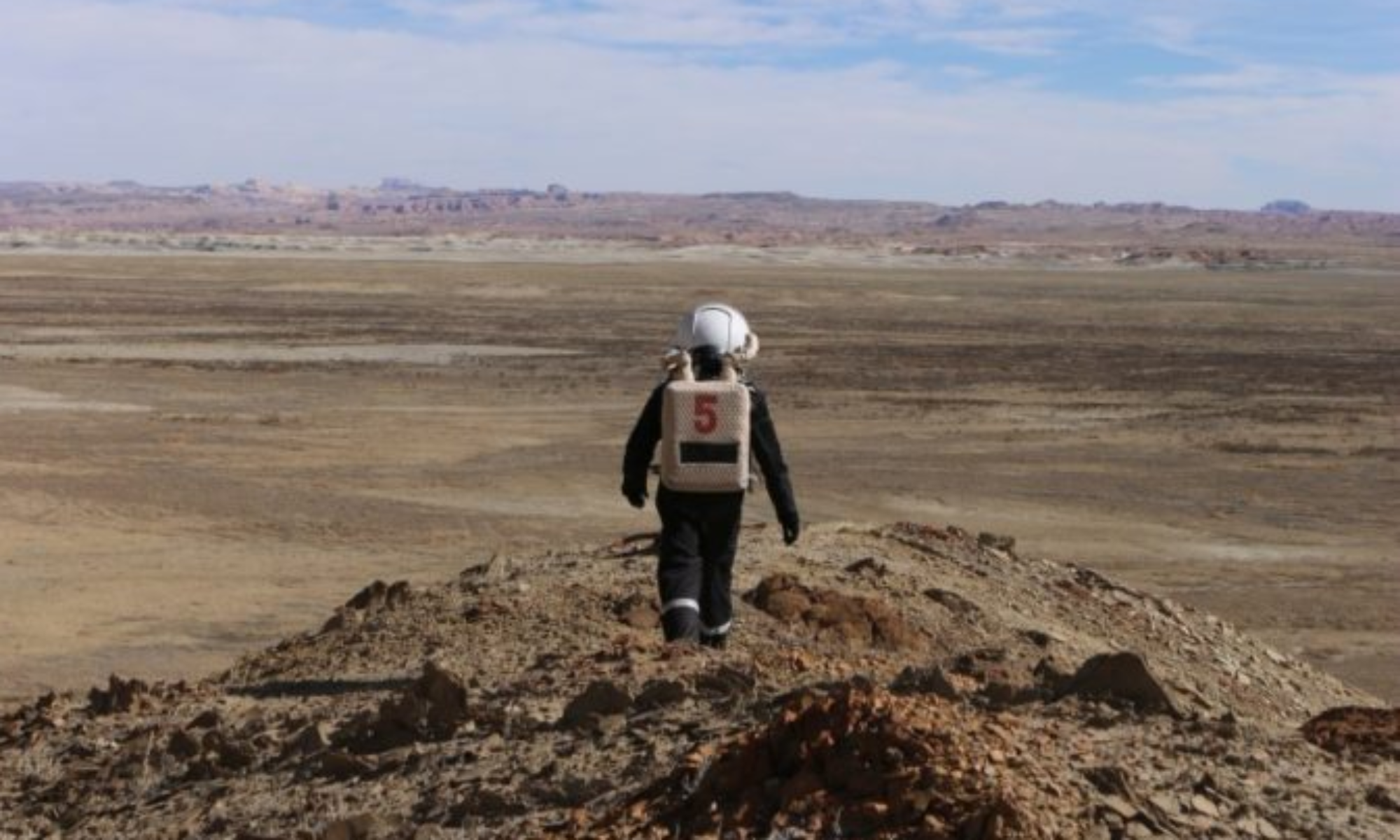
Development of the Project: Over the past week, we have been documenting life inside the habitat, focusing on daily operations, shared routines, and moments of gathering among the crew. We have followed participants in both individual and collective activities, including their research projects and EVAs. In parallel, we have initiated collective sessions designed to foster reflection and discussion around themes related to space exploration and life on Mars. These moments include shared readings and open conversations, aimed at activating a deeper engagement with the conditions and imaginaries of extraterrestrial living.
We have also documented specific crew activities: Charlotte’s clay collection, David’s panoramic photography project, and Kat’s drone operations, alongside broader EVA-based research practices.
Pending / Missing Material
Several key elements are still to be completed:
1. Additional documentation of daily life within the habitat, focusing on experiences of confinement, including morning briefings, routine check-ins, and shared meals (lunch and dinner).
2. Further EVAs to capture Mars-analog landscapes and environmental conditions, including the Sea of Shells and, if time allows, one additional location.
3. Documentation of Charlotte’s clay workshop (scheduled for Tuesday afternoon), using locally sourced materials to create objects that reflect the lived experience and speculate on their potential use in a future Mars settlement.
4. Footage of Kat testing the rover, documenting both technical operations and embodied interaction with the vehicle.
5. Individual interviews with each crew member (planned between Monday and Thursday), focusing on personal motivations, experiences, and reflections on life in the analog environment.
6. Additional landscape footage in the surrounding area (planned for Thursday afternoon), to further contextualize the environment and expand the visual narrative
Title: Operational Impact of Pre-Traverse Aerial Reconnaissance on Surface Route Planning Efficiency
Investigator: Katherine (Kat) Berry
Objective: To evaluate whether pre-traverse aerial reconnaissance improves rover route planning efficiency, hazard avoidance, and overall navigation performance in an analog Mars environment.
Description: This study investigates the operational benefit of using a manually piloted aerial drone to inform rover navigation decisions. The experiment compares two conditions: (1) rover traversal based solely on ground-level observation and (2) rover traversal informed by pre-traverse aerial reconnaissance. The study focuses on human-in-the-loop decision-making and aims to quantify how additional situational awareness impacts traversal outcomes. Results will contribute to analog astronaut operations research and surface mission planning strategies relevant to planetary exploration.
Progress Made: While the aerial drone has been successfully piloted both in and not in EVA suit and the rover is functioning, there is a rover problem in its range presently being investigated.
Title: Panoramic Landscape Photo Survey
Investigator: David Laude
Objective: To provide future crews with photos from locations of potential interest for EVA planning to improve EVA efficiency and help ensure field research project success.
Description: This is a panoramic landscape photo survey for use by future crews with locations of interest based upon my previous experiences at MDRS.
Progress Made: There has been three locations completed so far with two more planned.
Title: Evaluating Drone Piloting Performance During Simulated EVA Operations in a Mars Analog Environment
Investigators: Katherine Berry, Dave Laude
Objective: To assess how simulated EVA conditions impact human drone piloting performance and identify operational constraints relevant to future Mars exploration.
Description: This study evaluates differences in drone piloting performance between standard conditions and simulated EVA conditions. As aerial systems become more integrated into planetary exploration, understanding how EVA limitations (such as restricted mobility, reduced dexterity, and limited visibility) affect human control is critical. Results will help inform operational strategies and human-in-the-loop drone use during surface missions.
Progress Made: Both Kat and Dave have successfully completed practicing both in and out of EVA suit. They are running somewhat behind on the formal project, but with time to complete it remaining.
Title: Foraging Wild Clay
Investigator: Lot Brugge
Objective: Sourcing local clay provides a more sustainable approach to living on Mars while contributing to art and culture, which is an essential part of human history and expression.
Description: This project explores the process of locating, processing, and working with wild clay. I will experiment with treatment methods and investigate how the material behaves when shaped into different forms and objects.
Progress Made: I’ve gone on three EVAs to find clay. I’ve been lucky enough to find three different types, each with its own color. It feels kind of magical to experience every step, from collecting the clay to sculpting it. After collecting it, I started processing the clay and separating it from debris. I used sieves of different sizes to isolate the clay from the silt, trying both wet and dry filtering. Later, I put the clay into a bucket, waited a minute, and poured the cloudy water into another bucket, separating the last bit of clay from the rest. I then let it dry in the greenhouse, pouring off a layer of clear water the next day to help it dry faster. I’ve started making figurines that represent our time here and the conversations we’ve had about starting a new society on Mars. Later, I’ll do a clay workshop where we all create something together as a crew.