
Report title: Mission Summary
Crew #: 330
Position: Crew Commander
Report prepared by: Gaspard Thieulin
Date: 13-03-2026
Sol: 26
Overview:
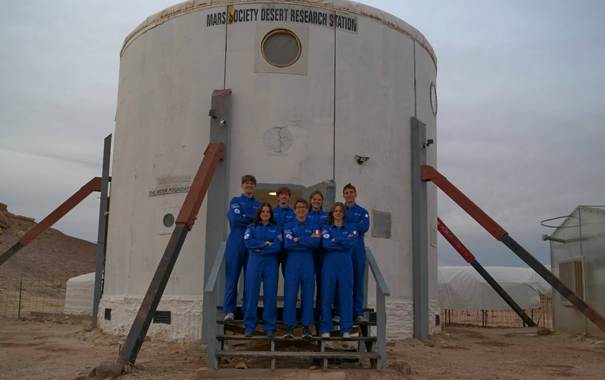
Crew 330 was composed of 6 students from ISAE-SUPAERO (an engineering school in Toulouse, France) and their commander, research engineer for the Spaceflight Institute.
From the 16th of February 2026 to the 13th of March 2026, we lived in isolation for 26 Sols in the MDRS, working 6 Sols and resting during Saturdays. We conducted 15 scientific experiments on diverse subjects.
Our mission is a success on our primary mission objectives, and we bring back as much scientific data as possible from our experimentations, to be analyzed when we return to France with the researchers who support us.
Crew:
Adèle LADAGNOUS (Health and Safety Officer), Aerospace engineering student at ISAE-SUPAERO (Toulouse, FRANCE)
Célia PARNAUD–AMY (Astronomer), Aerospace engineering student at ISAE-SUPAERO (Toulouse, FRANCE)
Lou GOIFFON (Engineer), Aerospace engineering student at ISAE-SUPAERO (Toulouse, FRANCE)
Adrien SAUGNAC (Journalist), Aerospace engineering student at ISAE-SUPAERO (Toulouse, FRANCE)
Félix MARGUET (GreenHab Officer), Aerospace engineering student at ISAE-SUPAERO (Toulouse, FRANCE)
Julien BESSON (Mission Scientist), Mechanical Engineer (McGill University, CANADA), Master student in Aerospace engineering at ISAE-SUPAERO (Toulouse, FRANCE)
Gaspard THIEULIN (Commander), Aerospace Engineer (ISAE-SUPAERO, FRANCE), Research Engineer at the Spaceflight Institute (Toulouse, FRANCE)
Mission Narrative:
One main objective of our mission was to ensure the social cohesion of the crew, and the well-being of every member during the whole duration. Particularly from the work of the HSO, we implemented specific methods and tools to avoid conflicts and solve them quickly, efficiently and sustainably. The Commander paid special attention to balance the workload throughout the mission, between achieving the very ambitious scientific goals and managing the tiring effects of the mission itself. This specific goal was achieved with spectacular results, as we suffered extremely few internal conflicts and solved them in depth when they arose. Despite the long duration of our mission (double the usual in the MDRS), we kept the social cohesion of our crew at its highest point during the whole mission, and the dynamics of the group evolved toward a sustainable equilibrium during this last month. While everyone in the crew faced various difficulties, we stood together in the harder times, supporting each other to overcome every issue.
The addition of Yoga and Meditation sessions during the mission had a positive impact on the morale and the sleep quality of the crew. We also noticed the positive impact of an afternoon nap on the most tiresome days of the mission.
No medical incident arose during the mission, and everyone stayed fit and healthy for the whole duration. The physical activity sessions were followed by everyone almost every day, with each crew member exceptionally skipping one or two sessions because they felt too tired.
Water Usage (average): 14 L / CM / day
We ate a diversified menu every day, utilizing fully the food supplies we were given and the kitchen appliances available at the MDRS.
Documentary and Outreach
One other objective of our mission was public outreach, giving our followers a better look at what we do inside the MDRS. The whole crew contributed to this effort, by giving conferences and animating workshops in French schools and in New York before we left for Utah. While we were in isolation, we also filmed content for the schools we have a partnership with, answering their questions about space exploration and our simulation. The Crew Journalist, Adrien, had an even more ambitious project for outreach: filming a documentary, which is going to be shown in “La Cité de l’Espace” in Toulouse. Shooting a 90 minute documentary is not an easy task, and we tried to include as many moments from the mission as possible. The documentary is going to show “behind the scenes” of our usual external communication, alternating between the “every sol” life in the station, our scientific activities and filmed explanations of what is a Martian analog mission. The documentary will also display the preparation of the mission, as well as the outcome when we get back to France.
EVA Summary:
The Crew 330 performed 21 EVAs in total, including two training EVAs to Marble Ritual on Sol 1. Taking full advantage of the human presence on the ground, we conducted many experiments outside and conducted plain exploration whenever we had the time. Using the MDRS rovers, and the wonderful agility of the human body, we could explore on a larger surface than all robotic explorers could, improvise our route and access places that could seem inaccessible to most wheel-based rovers. Here is the distribution of each EVA’s purpose:
| Training | Exploration | Atmospheric experiments | Photo-grammetry | Stratigraphy | SupaeroMoon | |
| EVA #01 | X | |||||
| EVA #02 | X | |||||
| EVA #03 | ||||||
| EVA #04 | X | |||||
| EVA #05 | X | X | ||||
| EVA #06 | X | |||||
| EVA #07 | X | X | ||||
| EVA #08 | X | X | ||||
| EVA #09 | X | |||||
| EVA #10 | X | |||||
| EVA #11 | X | X | ||||
| EVA #12 | X | |||||
| EVA #13 | X | X | ||||
| EVA #14 | X | |||||
| EVA #15 | X | X | ||||
| EVA #16 | X | |||||
| EVA #17 | X | |||||
| EVA #18 | X | X | ||||
| EVA #19 | X | |||||
| EVA #20 | X | X | ||||
| EVA #21 | X | |||||
| EVA #22 | X | X | ||||
| TOTAL | 2 | 9 | 9 | 6 | 2 | 2 |
Only the EVA#03 was cancelled, due to strong winds measured before the EVA Team went outside.
All EVAs were successful in their main objective and there wasn’t any incident during EVAs that could have required the early return of the crew to the station. Despite some EVAs starting later than planned, mostly because of delays in the preparation, all EVAs were finished before their planned ending time.
Most EVAs were conducted with a team of three crew members, while the other four stayed working in the station, occasionally a team of four exited the station to support the more complicated EVA tasks. Communication between the EVA teams and the station was always ensured by at least one crew member in the Hab, and this communication worked better than before thanks to the radio relay on North Ridge. Specifically, the communication between the team and the Hab was lost on EVAs where the team lost visual contact with North Ridge, for instance when they entered deep terrain like Candor Chasma or went behind Camel Kissing Ridge. The range of the radios could also be an issue when going as far as the “Special Region”.
Repairs and upgrades to the station:
- The Water heater was removed (seasonal decision)
- We closely monitored the state of the tunnels, threatened by some heavy winds during our stay. We leave the tunnels in great shape, with all necessary zip ties installed and no puncture to report.
- The toilet tank was emptied on Sols xx, xx and xx. The sensor for the level of the tank doesn’t seem to work at all. We did an inspection and we couldn’t see any visible issue with the wiring.
- The clean water feeding white tube for the toilet is leaking from a small puncture, after the valve between the white tube and the blue tube. We have identified the root of the issue:
o Due to a very strong hammer effect in the hard blue tube, it moves “forward” from its intended position (it even seems to have ripped a fixation on the wall before our mission).
o Once the tube has moved too far from its position, it creates a heavy bend on the white tube connected to the toilet. The bend has punctured the white tube over time.
o We managed the issue with a new procedure: we keep the valve before the white tube closed at all times, except when we are pressing the toilet pedal. The very few drops of clean water are wiped with a dry cloth.
o The white tube could be replaced or repaired with a replacement tube fitting.
- The water tank sensors have been repaired
- An inside lock has been placed on the observatory door for the astronomer to close it from the inside, it is a removable addition
- The opening mechanism of the observatory dome has been repaired (the wooden piece used as end of course was falling apart)
- 4 backpack batteries have been replaced
- The GPS battery has been replaced
- The communication kit N°2 is not working (see operation report to see the trouble shooting)
- The bed step for the 3rd room from the right has been screwed back
Summary of GreenHab Activities:
During these four weeks, the plan was to help grow the GreenHab by planting new seeds adapted to the other plants nearby and to take care of the one which was already here.
When we arrived, the coriander and fennel were pretty dehydrated at the bottom and many flowers were growing at the top. At the mid-mission, our botanist decided to cut the top flowers to re-boost the leaves which are our main point of interest. Despite the fact that the flowers contribute to making the GreenHab nice with colors, it was draining too much water and preventing the bottom leaves from growing.
We had various kinds of weather, and some days were really hot. When it was the case, two waterings were mandatory. The sun was pretty aggressive between 11AM and 4PM so the waterings were usually either at 10AM or 4-5PM. On average, our botanist used 4 gallons a day.
Regarding experiments, our botanist continued the space tomatoes in Martian regolith experiment and kept sending photos to the person responsible for the experiment. He watered them several times with distilled water.
Another experiment he wanted to do was the microgreens experiment. He followed the protocol with broccoli and radishes seeds. The broccoli seeds didn’t grow but it was successful regarding the radishes. He managed to harvest 90g the first time and 250g the second time. The micro-green were very tasty and well appreciated by the crew. The crew also harvested several basil and fennel leaves, and he tried to regrow the coriander.
For his botanist project, he didn’t have the attendance result. The cress seeds never saw the light of day during our mission. The experiment is on the shelf just on the left of the entry if the next crew wants to keep monitoring it.
He also planted radishes, cucumbers on the left of the big blue box. The growth of the garden beans and lettuce was particularly remarkable.
Our botanist also had an innovative idea: planting flowers for each member of the crew. The flowers didn’t bloom in time, but the Crew 330 let them to the next crew. They are spread in 7 pots which are named after the 7 members of the crew.
Summary of Scientific activities:
See the dedicated end of mission Science report.
You must be logged in to post a comment.