Crew 335
Apr 19th – May 2nd, 2026
Crew Members:
Commander: David Laude
Crew Engineer: Kat Berry
HSO: Matteo Calore
Crew Artist: Elisa Strinna
Crew Journalist: Matteo Calore
Greenhab Officer: Charlotte Brugge
Crew Projects:
Title: Journey Through the Outer Darkness
Investigator(s): Elisa Strinna, Matteo Calore
Objective: Experimental documentary that explores motivations, beliefs, expectations, and lived experience surrounding future life on Mars, as they emerge through daily routines, collective practices, and interaction with Mars-analog environments.
Description: During an analog Mars mission at the Mars Desert Research Station (MDRS) in the Utah desert, the film will document and collect audiovisual material that will form the basis for a future 60-minute work. Following the mission, the project will expand through further filming in the Netherlands, including rover experiments at the Mars Yard of the European Space Agency’s ESTEC facilities in Noordwijk. There, the film will engage with the Mars Yard simulation environment and existing Mars-related documentation, integrating these materials with the footage gathered during the MDRS mission. The project is expected to be completed in 2027.
Procedure: Over the course of two weeks, we will document daily life inside the simulated habitat, focusing on work routines, collective decision-making, and the dynamics that emerge under conditions of isolation, together with Extra-Vehicular Activities (EVAs). In addition to this documentation, I will propose to the crew a series of simple creative activities integrated into the daily life of the mission.
1. Bonding Sessions
These sessions are informal moments of exchange intended to support connection within the crew during the mission. They consist of simple activities based on storytelling, attentive listening, and small shared actions that encourage participants to get to know one another beyond their technical roles. Through open prompts, crew members are invited—if they wish—to share personal experiences, memories, or thoughts related to travel, exploration, and the idea of living or working in environments such as Mars. The sessions take place in a relaxed setting where participants sit in a circle and speak in turn. These moments offer a space where crew members can exchange stories, reflect on their motivations for exploring Mars, and imagine together what it might mean for humans to live or work in such an environment.
2. EVA — Landscape and Flora Observation
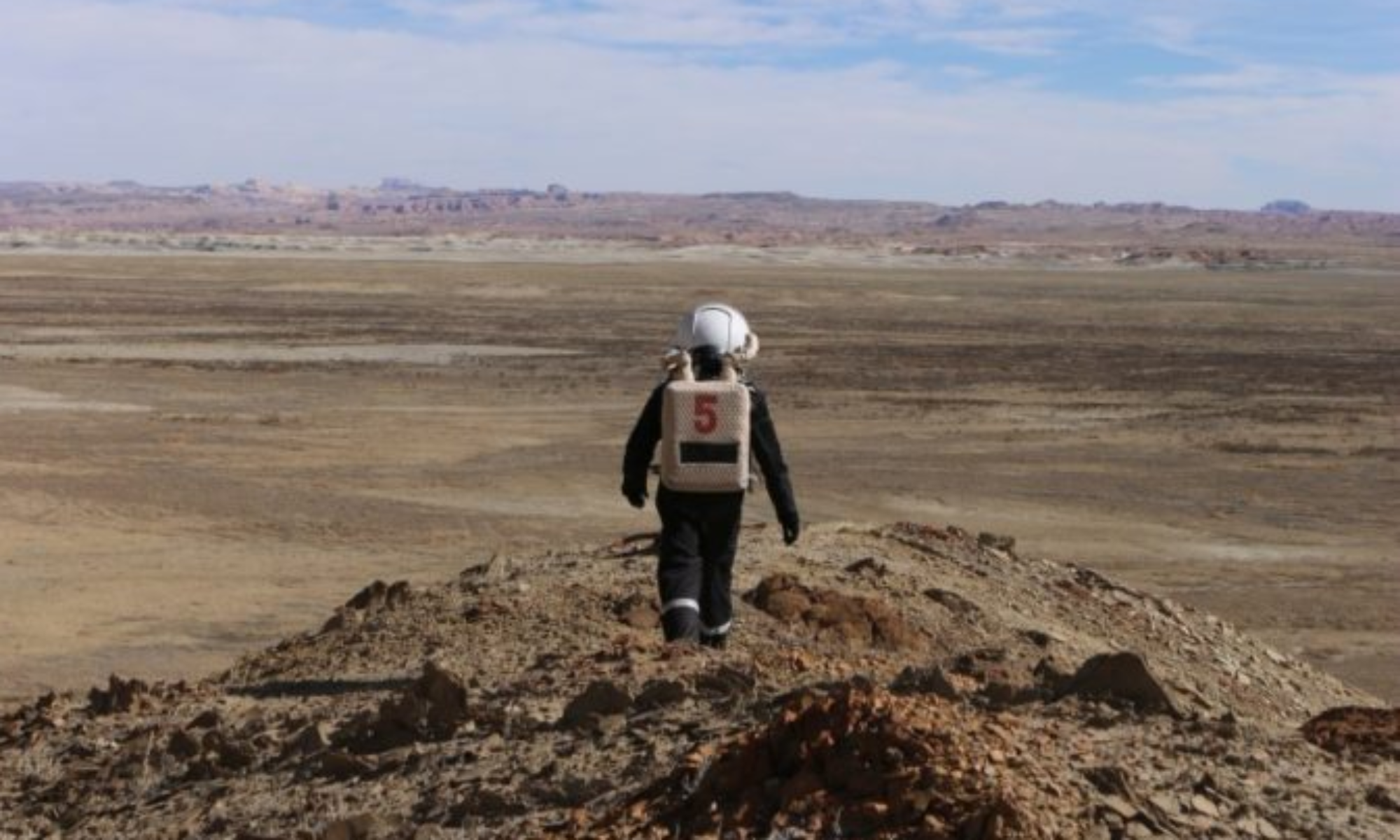
During selected EVAs, and under the guidance of the mission commander, I will explore the landscape surrounding MDRS, focusing on areas characterized by exposed geology and terrain conditions that resemble Martian environments. Alongside the geological landscape, I will observe and visually document the desert flora that survives in these extreme conditions, with particular attention to species of Astragalus—the plant represented on the mission patch—as well as other native plants. When possible and permitted, I may collect small plant references. Through photography, field notes, and observational drawing, I will gather visual material of the landscape and vegetation encountered during the EVAs. Some of these references will be brought back to the habitat and developed into drawings during the mission, which will later inform the development of ceramic sculptures once I return to the Netherlands.
External Collaborators and Partners: CBK Rotterdam, Mondriaan Funds, Rode & Cone Films
Title: Cinematic Documentation and Mars-Analog Landscape Photography
Investigator: Matteo Calore
Objective: To document the mission through cinematography and to photograph desert locations that present geological similarities to Martian landscapes.
Description: During the mission I will collaborate with Elisa Strinna on the cinematography of a film documenting daily life at the Mars Desert Research Station. Using digital cameras and video equipment, I will record activities inside the habitat and during EVAs. In parallel, I will develop a photographic survey of locations in the Utah desert that present visual similarities to Martian terrain.
Procedure: During daily mission activities and EVAs I will film life inside and outside the habitat, focusing on crew routines and field activities. At selected EVA locations under the suggestion of the commander I will also photograph geological formations that resemble Martian landscapes, creating a visual archive of Mars-analog environments.
Title: Operational Impact of Pre-Traverse Aerial Reconnaissance on Surface Route Planning Efficiency
Investigator: Katherine (Kat) Berry
Objective:
To evaluate whether pre-traverse aerial reconnaissance improves rover route planning efficiency, hazard avoidance, and overall navigation performance in an analog Mars environment.
Description:
This study investigates the operational benefit of using a manually piloted aerial drone to inform rover navigation decisions. The experiment compares two conditions: (1) rover traversal based solely on ground-level observation and (2) rover traversal informed by pre-traverse aerial reconnaissance. The study focuses on human-in-the-loop decision-making and aims to quantify how additional situational awareness impacts traversal outcomes. Results will contribute to analog astronaut operations research and surface mission planning strategies relevant to planetary exploration.
Procedure:
A series of rover traverses will be conducted across predefined terrain routes at MDRS. For each route, two runs will be performed:
Ground-Only Condition:
The operator plans and executes the rover route using only ground-level observation.
Drone-Assisted Condition:
The operator conducts a pre-traverse aerial survey using a drone, then plans and executes the rover route based on aerial observations.
During each run, the following data will be recorded: traversal time, number of directional corrections, number of stops, and hazard encounters. Observational notes on operator decision-making and perceived workload will also be documented.
Each condition will be repeated across multiple terrain types to ensure comparability. Results will be analyzed through direct comparison of performance metrics between conditions, supported by visualizations such as route overlays and performance charts.
Title: Panoramic Landscape Photo Survey
Investigator: David Laude
Objective: To provide future crews with photos from locations of potential interest for EVA planning to improve EVA efficiency and help ensure field research project success.
Description: This is a panoramic landscape photo survey for use by future crews with locations of interest based upon my previous experiences at MDRS.
Procedure: I will plan EVAs to areas I have found interesting while on previous missions. Once at a location within the area of interest I will perform a panoramic photo survey by standing and rotating around clockwise starting facing north. The photos with GPS locations will be arranged by region and given to MDRS management as MS Word files. Perhaps they could be entered into the Apple PC on the lower deck and easily accessed for EVA planning purposes.
Title: Evaluating Drone Piloting Performance During Simulated EVA Operations in a Mars Analog Environment
Investigators: Katherine Berry, Dave Laude
Objective: To assess how simulated EVA conditions impact human drone piloting performance and identify operational constraints relevant to future Mars exploration.
Description: This study evaluates differences in drone piloting performance between standard conditions and simulated EVA conditions. As aerial systems become more integrated into planetary exploration, understanding how EVA limitations (such as restricted mobility, reduced dexterity, and limited visibility) affect human control is critical. Results will help inform operational strategies and human-in-the-loop drone use during surface missions.
Procedure: Investigators will conduct drone flight trials under two conditions: (1) no EVA suit and (2) simulated EVA suit. Standardized flight tasks will be performed across MDRS terrain, including waypoint navigation and target approach.
Performance will be measured using:
• Accuracy (distance to target)
• Task completion time
• Flight stability and control adjustments
Qualitative observations on difficulty, visibility, and control limitations will also be recorded. Comparative analysis will be conducted between conditions to identify performance differences and operational impacts.
Title: Foraging Wild Clay
Investigator: Lot Brugge
Objective:
Sourcing local clay provides a more sustainable approach to living on Mars while contributing to art and culture, which is an essential part of human history and expression.
Description:
This project explores the process of locating, processing, and working with wild clay. I will experiment with treatment methods and investigate how the material behaves when shaped into different forms and objects.
Procedure:
I will conduct EVA’s to locate and collect naturally occurring clay. The collected material will be processed by sieving and refining it, followed by experimentation with varying sand-to-clay ratios to achieve a workable consistency. Once suitable material properties are reached, I will attempt to fire the clay using a microwave kiln. Finally, I will invite fellow crew members to participate in a workshop to explore creative applications of the processed clay.