
Report title: Photos of the Day
Crew #: 328
Position: Crew Journalist
Report prepared by: Tom Bickmore
Date: 26-01-2026
Sol: 1
GreenHab Report – January 26th
Report title: GreenHab Report
Crew #: 328
Position: Greenhab Officer
Report prepared by: Rebeca Goncalves
Date: 26-01-2026
Sol: 1
Environmental control (fan & amp; heater): Fan max: 85F, Fan min: 80F, Heater: 70F
Average temperatures (last 24h): 76.2F
Maximum temperature (last 24h): 84.5F
Minimum temperature (last 24h): 67.8
Hours of supplemental light: 2h (6pm to 8pm)
Daily water usage for crops: 0
Daily water usage for research and/or other purposes: 0
Water in the Tank (160 gal useful capacity): 159 gallons remaining
Time(s) of watering for crops: TBA
Changes to crops: N/A
Narrative: Material was moved to the greenhouse today, but the experiment is awaiting for soil sample collection before being set up.
Harvest: (include which crop and mass in grams) N/A
Support/supplies needed: Emailed GreenHab Coordinator to ask about revisions to supplemental lighting schedule
EVA Report – January 26th
Report title: EVA Report
Crew #: 328
Position: Journalist
Report prepared by: Tom Bickmore
Date: 26-01-2026
Sol: 1
EVA #: 1
Purpose of EVA: Training Mission to Marble Ritual Site for 3 Crew
Start time: 3:05PM
End time: 3:57PM
Narrative:
We drove to the Marble Ritual Site (slightly past as it was hard to see in the current lighting & with suit helmets, quickly corrected). We took pictures and observed soil texture & composition in a few places around the ritual site. We then returned to Hab.
Destination per MDRS Map: Marble Ritual
Destination Coordinates (use UTM WGS 84): 518750, 4251000
EVA Participants: Marillo (Commander), Rebeca (Greenhab Officer), Tom (Crew Journalist)
Road(s) and routes per MDRS Map: Cow Dung Road
Mode of travel: Driving
Picture(s) attached.
[attach 1]
Journalist Report – January 26th
Journalist Report
Crew #: 328
Position: Crew Journalist, Comms Officer, & Astronomer
Report prepared by: Tom Bickmore
Date: 25-01-2026
Sol: 0
Journalist Report Title: Dodging Asteroids in the Earth-Mars Transport Shuttle
Hello from the Mars Desert Research Station! Today marked the exciting start of our mission as Crew 328, where we’re simulating life on Mars right here in the Utah desert. We kicked things off with health checks to ensure everyone was ready for "launch" – and we all passed with flying colors! Our journey to "the Hab" was an adventure in itself.
The crew shuttle (which looked a lot like an old Chevy Suburban with some bumpy suspension) dodged "rogue asteroids" along the way. Yes, we actually had to swerve around a massive 2-meter tumbleweed that barreled right in front of us, looking just like a real space rock!
Our first task upon arrival: unloading cargo and hauling supplies upstairs with solid teamwork. Then, before simulation kicked in, we suited up in flight suits for a group photo in front of the Hab — a classic shot to inspire future explorers.
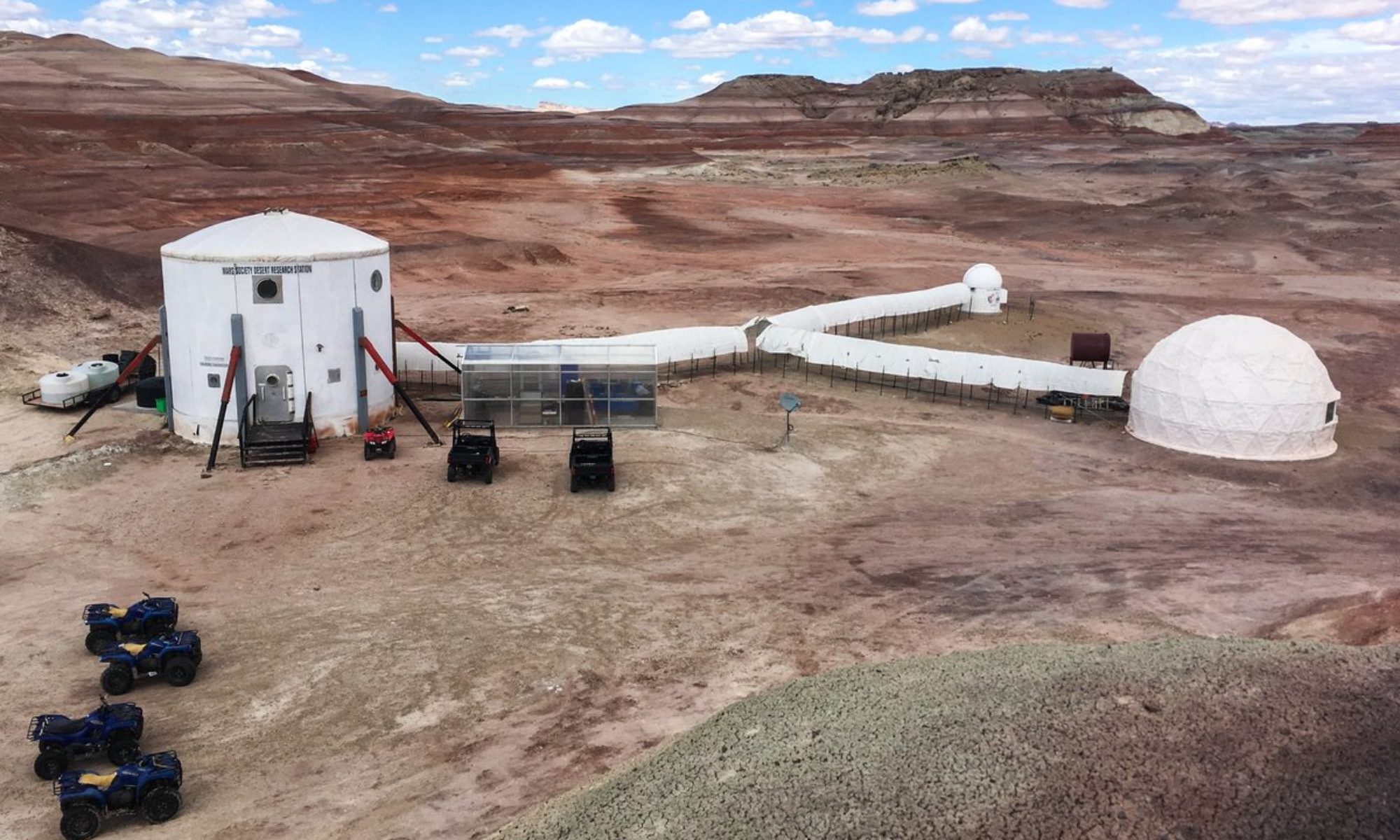
We then eagerly explored our new Martian home (and claimed our bunks). The Hab is incredibly clever, with compact living quarters, a science dome, and even a greenhouse for growing food (with some veggies still alive from previous crews, so we’ll get to eat fresh greens!)
Our 5-hour orientation & training covered everything from safety procedures and tours to trying on a spacesuit (I got to be the demo model – it felt like gearing up for a real Mars walk!).
We wrapped up the day by taking inventory of our supplies, including plenty of freeze-dried meats and veggies alongside cereals, cheeses, powdered milk, & baking items. To make meals more fun, each of us "smuggled" in some personal shelf-stable delicacies to supplement the standard rations — variety is key on Mars!
We also made inventory checks on emergency and medical supplies, then filed our first reports. Late into the evening, we dove into geological maps to plan tomorrow’s EVA – we’re hunting for soil samples that mimic Martian regolith to grow space tomatoes and radishes in our greenhouse.
Stay tuned for Sol 1, where the real Mars simulation begins!
[attach 1]
[attach 2]
[attach 3]
Journalist Report – January 26th
Journalist Report
Crew #: 328
Position: Crew Journalist, Comms Officer, & Astronomer
Report prepared by: Tom Bickmore
Date: 26-01-2026
Sol: 1
Journalist Report Title: The First Full Sol
Hello from the Hab on Sol 1!
We’re now fully in simulation at the Mars Desert Research Station, and today was our first complete day of routines plus our introductory EVA.
A resupply drop came in today, topping off our inventory with the missing items—nice to have everything squared away.
We spent time prepping the suits and radios for the first EVA. Getting the radios positioned and working reliably while fully suited took some coordination, but we sorted it out without major issues. This EVA was our required training outing to the Marble Ritual site, a short, easy walk (or rover drive) from the Hab that’s ideal for first-timers to practice suit mobility and procedures. If the rovers had any trouble, walking back is straightforward. Commander Mariló Torres led the group. GreenHab Officer Rebeca Gonçalves checked soil along the route, scouting locations for tomorrow’s sample collection that are as close as possible to Martian regolith while still suitable for growing.
I, Tom Bickmore the Crew Journalist, took a couple hundred photos, some 360 video, and helped with navigation.
Supporting our mission on comms and GPS monitoring, we had Aaron Tenner, Engineer & Safety Officer, and Jahnavi Dangeti, our Crew Scientist.
Driving the rovers in suits is an adjustment: you can’t easily turn your head to check sideways or behind, so we relied on clear radio communication and extra caution during turns to keep the group together.
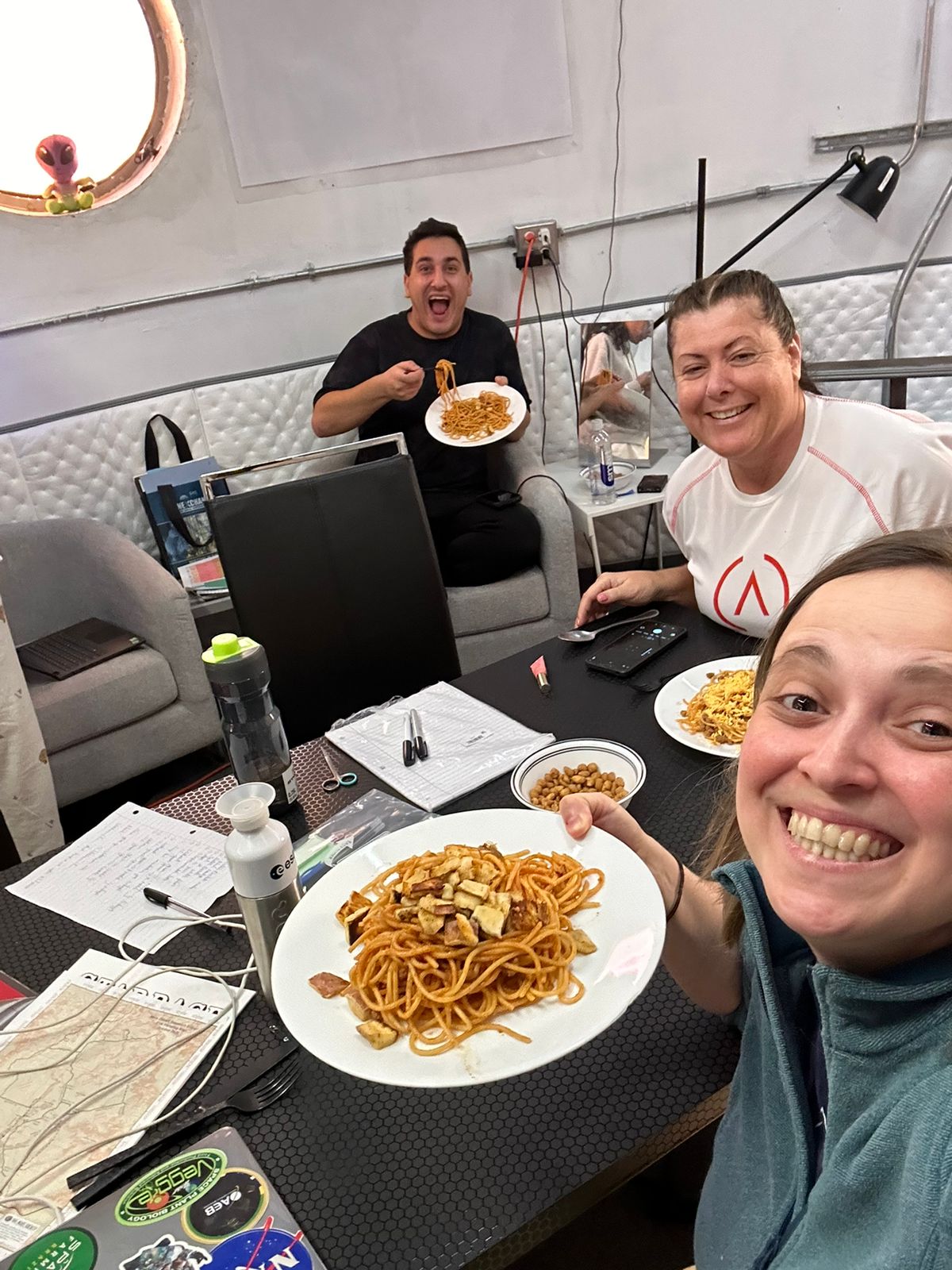
Back in the Hab, we assembled our first full cooked meal: spaghetti with tomato powder, chunks, and ground beef. It came out well: tasty and a solid win for our expectations for what we can do with the available supplies. We also found the bread-maker and plan to run a test batch tonight after reports are filed. Daily reports are getting smoother, experiments are starting up, and the crew is working well together.
Picture(s) attached
Sol Summary – January 26th
Report title: Sol Summary Report
Crew #: 328
Position: Commander
Report prepared by: Mariló Torres
Date: 26-01-2026
Sol: 1
Summary Title: Initial contact
Mission Status: Starting engines
Sol Activity Summary:
The crew’s morale and spirits are very high. We are filled with excitement at the prospect of an exciting and productive stay on Mars.
We will be waking up at eight o’clock every day to enjoy a hearty breakfast.
The morning was spent attending to the Mission Control’s requests via radio and email and performing the necessary engineering systems check. But there was also time for a special communications briefing given by the commander and, of course, to prepare for our first EVA, which we carried out right after lunch.
We plan to end the day with a game night before going to sleep.
Look Ahead Plan:
Tomorrow we will complete two EVAs and work on our personal experiments.
Anomalies in work:
None
Weather:
Clear skies
Crew Physical Status:
Healthy and fit
EVA:
EVA training composed of the Commander, Green Hub Officer and Crew Journalist.
Operations Report – January 26th
Report title: Operations Report
Crew #: 328
Position: Crew Engineer/HSO
Report prepared by: Aaron Tenner
Date: 26-01-2026
Sol: 1
Non-nominal systems: Pressurized tunnel system, crew quarters.
Notes on non-nominal systems: Tunnel required several new zip ties near the science dome. There was a nail head sticking up in the front left corner of the platform for the 3rd room from the right. The nail has been hammered in and is no longer sticking out.
ROVERS
Spirit rover used:
Hours:
Beginning charge:
Ending charge:
Currently charging: Yes
Opportunity rover used:
Hours: 50 mins
Beginning charge: 100%
Ending charge: 60%
Currently charging: Yes
Curiosity rover used:
Hours:
Beginning charge:
Ending charge:
Currently charging:
Perseverance rover used:
Hours: 50 mins
Beginning charge: 100%
Ending charge: 60%
Currently charging: Yes
General notes on rovers:
Curiosity rover from 25/01/2026 may have warping on rear brake disks (discovered during orientations). Perseverance e-brake is nonfunctional.
Summary of Hab operations:
Water Use (see notes): 17.39 Gal
Main tank level (remaining gallons, see notes): 373.52 Gal
Main water tank pipe heater (ON or OFF): ON
Main water tank heater (ON or OFF): ON
Toilet tank emptied (NO or YES): NO
Summary of internet: Internet looking great, Downlink speed 520.26 mbit/s, upload 26.16 mbit/s
Summary of suits and radios: Suits used for todays EVA were 1,4, 5, they have all been cleaned up and replaced back where they were initially, same for the GPS trackers. Radios all functioned nominally during the EVA and were replaced back on the charging rack.
Summary of GreenHab operations:
Water use: 0 gallons
Heater (ON or OFF): ON
Supplemental light (hours of operation): 6 – 8pm (Will confirm with GreenHab Coordinator)
Harvest (name, weight in grams): N/A
Summary of ScienceDome operations: Conducted checks of chemicals and instruments, assessed what was available and what is needed for a regolith growth study. The rest of the materials and equipment should arrive 29/01/2026.
Dual split (Heat or AC, On or Off or Automatic): Automatic
Summary of RAM operations: Used hammer to put nail head back in flooring.
Summary of any observatory issues: N/A
Summary of health and safety issues: Several crew members are still recovering from jet lag.
Questions, concerns and requests to Mission Support: Currently we have half a roll of paper towels and there are 6 rolls listed on the inventory sheet; we are requesting more paper towels.
Mission Plan – January 25th
Mars Desert Research Station
Mission Plan
Crew 328
Jan 25 2026 – Feb 7 2026
Crew Members
Commander: Mariló Torres Soto
Crew Engineer and HSO: Aaron Tener
Crew Scientist: Jahnavi Dangeti
Green Hub Officer: Rebeca Gonçalves
Crew Journalist: Tom Bickmore
General Mission Plan
We represent the first generation of Martian colonists. In the preceding years, through a series of unmanned missions, an army of machines and robots have landed on the Martian surface and constructed a life-support habitat, equipping it with the necessary elements and devices to make human life possible there.
Our crew was recruited to establish a settlement on the Red Planet, and, after a long and arduous journey, they are finally safe in the aforementioned facilities.
The pilot commander has successfully completed the first part of the mission, the journey, and now remains in command with the objective of protecting the valuable team of scientists, coordinating communications with Earth, and making operational and safety decisions.
The chief engineer and medical officer will improve the technical conditions in the module and monitor the health of their colleagues; the chief scientist will conduct research with bacteria to create a future breathable atmosphere; the Green Hub officer will initiate the production of food and vegetables in extraterrestrial soil; and finally, the crew journalist will conduct global outreach to raise awareness of the importance of space exploration for the future of humanity.
Main Objectives
– Replicate the same routines and limitations of a hypothetical crew on Mars through daily schedules.
– Perform research in the fields of engineering, astrobiology, geology and communications on the Red Planet.
– Keep the maximum level of fidelity and realism during the simulation, so that the results of the experiments are as reliable as possible.
– Develop emergency procedures and safety protocols.
– Analyze the interaction and coexistence of the group from a neuropsychological point of view.
Crew Projects
As this is a team of professionals, the studies to be conducted do not include titles, descriptions, or methodology.
The astrobiologist will compare the growth of tomato and radish seeds that have been on the International Space Station, subjected to radiation and microgravity, with that of other standard seeds from Earth.
The chief scientist will investigate, at a chemical level, certain types of bacteria found in minerals from the area and will also analyze the effect of the extreme desert environment on the skin of the astronauts in an effort to better protect the epidermis.
The chief engineer objective is to implement the functionality of the station’s systems and devices through improvement proposals and, at the same time, address any health needs of the group and conduct periodic checkups, especially before and after EVAs.
Finally, and no less important, the crew journalist will conduct online broadcasts, media connections, and mass outreach events to gauge the response of young people and learn about their concerns regarding Mars.
As for EVAs, after the first two training sessions for the entire crew, they will proceed successively along these lines: commander assessment and exploration, sample collection, audiovisual documentation, organic and chemical checks, and emergency plan drills.
Leadership Structure, Roles and Responsibilities
Crew Commander – With five successful analogous missions completed and extensive experience as a pilot and aerospace safety specialist, she is ultimately responsible for the expedition, coordinating daily operations and schedules, serving as the main point of contact with Mission Support, making overall decisions, and overseeing the progress of the simulation while prioritizing complete immersion in the performance. The purpose of her participation is to continue her training for future collaborations as a commercial/private astronaut.
Crew Engineer and HSO – Due to an understanding of the safety and emergency procedures, he acts as an Subcommander/Executive Officer, taking over command in the case the Commander is indisposed or otherwise unreachable.
Crew Scientist – In the unlikely case both the CC and HSO are indisposed, leadership role will fall to her, considering her skills and abilities acquired in two previous analog missions.
For EVAs: An effort will be made to place the Commander or HSO on each EVA and that person will take a leadership role for the EVA. Either the commander or the HSO will always remain in charge at the station during EVAs. Neither of them will ever leave the habitat at the same time. They take the role of mission leader and assume leader responsibilities for EVA’s at all times.
Responsibilities for Each Role
Crew Commander focused on tasks related to research and reporting, handling the daily Sol Summary reports and primary point of contact for Mission Support.
Engineer and Health and Safety Officer is the commander’s right-hand man and her trusted support person. As an aerospace engineer, his advice and recommendations are essential and vital. Monitor physical and mental health of crew and report on all health and safety issues as they arise. Ensure First Aid kits, fire extinguishers, fire blankets and other safety devices are in proper working order. Also, monitoring and maintenance of access tunnels., ensuring all communications equipment is working properly prior to EVAs and charging properly post EVAs. Maintenance and cleaning of RAM. Handling of daily operations report.
Green Hab Officer is leading the main and central research of this mission. Monitoring of plant growth in Green Hab as outlined by Green Hab coordinator Ben Greaves, and also the maintenance and cleaning of Green Hab. Of course handling of daily Green Hab reports. She receives assistance from the other crew members in her work if she requests it.
Crew Journalist tracking of daily activities performed by crew members at the station and on EVA. Gathering and cataloguing of all pictures taken by crew members throughout the day and, at the same time, handling of daily Journalist reports.
Crew Scientist maintenance and cleaning of Science Dome ensuring proper use and storage of equipment in the Science Dome. Handling of EVA requests when applicable.
Expected Deliverables
All crew members are expected to perform daily tasks that pertain to the research projects that were accepted. They will strive to make significant progress to be reported at the mid mission mark and have data generation and collection finished by the end of mission date. Data analysis and final reporting can happen post mission.
Crew Performance
Crew members are expected to improve on aspects of daily mission life, such as EVA prep and daily report writing. They will build a daily routine that is a healthy balance between work and relaxation in order to avoid excess stress and burn out while maintaining productivity.
Risk Management and Safety Protocols
The crew is thoroughly familiar with the emergency procedures in case of medical emergencies, fire, power outage and comms failure.
Through briefings and debriefings, the commander ensures the full commitment of the entire team to safety, especially during EVAs.
There is constant monitoring and observation of preventive measures and cautious and prudent actions in order to avoid incidents and accidents.
The MDRS manual is frequently consulted by everyone.
Any health concerns due to environmental factors, such as dehydration, heat exhaustion, extreme cold or others, will take priority over sim.
Journalist Report – January 30th
Journalist Report
Crew #: 328
Position: Crew Journalist, Comms Officer & Astronomer
Report prepared by: Tom Bickmore
Date: 30-01-2026
Sol: 5
Journalist Report Title: Sol 5
Hello from the Hab on Sol 5. A big day here at the Mars Desert Research Station: Our first live-delayed outreach session and a solid EVA, plus some nice progress inside.
Last night (Sol 4 evening) we had a movie night. It took surprisingly long to find a sci-fi film none of us had seen. We thought we had one, but halfway through two crew members realized they’d watched it years ago. Fun to see how the group reacted to the movie crew’s actions and reactions and to discuss what we’d handle differently in a similar scenario.
Today we ran our first Live-but-delayed outreach event: about a dozen kids from 4 countries joined us for a continuous conversation with the ~10-minute interplanetary comms delay simulated (constant video feeds both ways, delayed between parties). This was a rehearsal with our co-host students to test the full setup before the larger-audience version. We were all impressed by the kids’ questions, the depth of their knowledge, and how well they answered each other. Their variety of knowledge and their enthusiasm were incredible. The delay felt real and impactful: watching Earth respond to our "past" selves, then seeing our own delayed feed return. It made the interaction feel connected rather than isolated. Everyone had a great time.
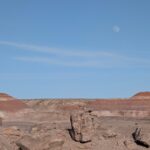
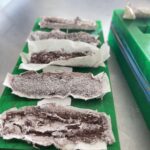
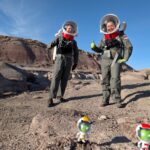
We also had an EVA: Commander Mariló Torres and I went to the northern limit of our range, an area reported for signs of ancient life (it’s an active dinosaur quarry). No fossils or ancient traces found, but we did spot a very small live "dinosaur" (a lizard). Active dig sites had protective covers in place. The geology was striking. We saw distinct layers of rock with varied erosion patterns. On the drive to and from, we noticed crystalline patterns in the dirt where water gathers, looking a lot like the growths in Jahnavi’s soil experiments and similar to road-salt crystallization during Canadian thaws. Since it’s a desert dirt road with no added salt, these must be natural salts efflorescing from the soil. We plan to look more closely and sample these locations on a future EVA.
Commander Mariló Torres and HSO Aaron Tenner gave us a thorough safety briefing on additional Hab emergency procedures—good refresh and details.
A previously "delayed in orbit" supply drop arrived today with key chemicals and additives for Jahnavi’s soil experiments (to mix into local regolith for bricks and materials). This unblocks the main Science Dome work that was waiting on these items. Very exciting!
In the GreenHab, radish seeds are already germinating in the hydroponics setup. The other experiments (radish microgreens across four conditions, tomatoes in lab-regolith with 10% organic) continue progressing well.
Another day of progress with personal experiments planned for Sol 6!
Crew Photos – January 30th
Report title: Photos of the Day
Crew #: 328
Position: Crew Journalist
Report prepared by: Tom Bickmore
Date: 30-01-2026
Sol: 5
You must be logged in to post a comment.