EVA Report – February 10th

Crew 240 EVA Report 08-02-2022

EVA # 11

Author: Pierre Fabre

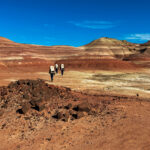
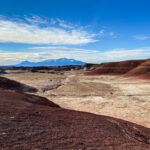
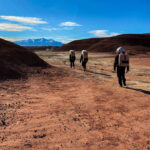
Purpose of EVA: Replacing batteries for atmospheric experiment, performing climb of North Ridge with updated 3D mapping data, this time with the remainder of the crew for additional data from our biometrics tools

Start time: 10:26

End time: 12:15

Narrative: Everything was fine, no issues were noted when replacing batteries. Climb occurred nominally, except for one crewmember with poor ventilation in their suit. Crew returned early thanks to more efficient climbs than planned.

Destination: North Ridge

Coordinates (use UTM NAD27 CONUS): 518 500, 425 0500

Participants: Pierre Fabre, Marion Burnichon, Julie Levita, François Vinet

Road(s) and routes per MDRS Map: Entrance Road, Cow Dung Road

Mode of travel: Rovers, foot

Journalist Report – February 10th

Sol 10: A day in a Martian’s life – What do we do every day on Mars?

Author : Pierre Fabre

Hi everyone welcome back! Today is a special report! I am going to describe the best I can what we do on a typical day (or Sol) on Mars! I hope you will enjoy this format !

7:10 – You wake up in your small individual room and turn on the light. On Mars you don’t stay in bed chilling on your phone because your HSO is waiting for you downstairs for the morning workout and moreover as there is no internet there is nothing to do on your phone. So, you get up and put on your sport clothes. You leave your room and say good morning to your crewmates who are little by little joining you at the upper deck. You hydrate a powder orange juice and drink it to give you some energy for the workout. Then you go downstairs where Julie is already installing the mats on the floor and taking care of the music.

7:30 – The workout starts. Some are still sleepy and some others like Julie are already full of energy! You start by a warmup with some running on the spot, jumping jacks, high knees, and butt kicks

Then you start the real workout:

-Legs: squats, squat holds, squat jumps, lunges, burpees… (I’m not going to lie, those exercises hurt but it kind of feels good after)

-Abs and back: crunches, knee to elbow, heels touching, superman, plank, flutter kicks

-Upper body: curl ups with resistance bands and push-ups

-Sometimes you also do some cardio training like air boxing

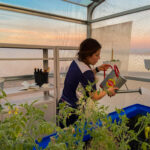
Then you stretch for a while. You stay with Julie to clean the lower deck while Marion goes to the GreenHab to water the plants and the others go up to start preparing the breakfast. You are lucky, your Commander likes to prepare pancakes for everyone.

8:00 – Breakfast! Everyone has their routine for breakfast. Some eat cereals, others pancakes or oats. You talk with your crewmates about the workout and about the incoming day and in the meantime, you complete the questionnaire about sleep for Marion’s experiment.

8:40 – Breakfast ends. You clean the table with your crewmates and go back to your room to prepare for the day.

9:00 – EVA briefing! The big map of the MDRS is on the table and the EVA leader of the day explains the destination, the objectives, who is your buddy, which rover you will take, who will be the HabCom and finally the timeline of the EVA.

9:10 – The briefing is over and you go to the lower deck with the others to suit up, test your radio, put your EVA shoes on, put what will be needed for the EVA in the airlock and go through the checklist with the HabCom.

9:25 – You step into the airlock with your crewmates. Then you wait 5 minutes until the depressurisation is over. Sometimes your HabCom puts some music in the radio, it makes the waiting funnier.

9:30 – Your HabCom gives the green light, you step out of the airlock, you are outside, on Mars. The EVA can start. You go to the rover you’ve been assigned to and give the battery data of the rover to the HabCom.

The EVA can be an exploration EVA (like the one at the Moons or at Candor Chasma) or an EVA related to an experiment like the one we did today at North Ridge for the drone mapping experiment. By the way, it was really cool and I think I definitely broke the record of number of ascents of North Ridge in 1 hour!

For the sake of storytelling, let’s stay you leaves the station for a 3 hours and a half long exploration EVA.

In the meantime, those who stay at the Hab monitor the temperature in the GreenHab and open the door if it is too warm in it. They also work on their experiments, perform tasks for human factors experiments or start writing their reports. If the journalist is there, he can also take that opportunity to interview the other crew member. They also have to cook something good for lunch to feed the starving explorers.

12:55 – You come back with your crewmates from the long but incredible exploration EVA! Your back hurts a little, you are thirsty, tired and you smell bad but you are so happy because it was an amazing EVA and you can’t wait to tell everything you saw to your crewmates who stayed at the Hab. You ask your HabCom the permission to enter the airlock and finally step into it for pressurisation.

13:00 – Pressurisation is over. You enter the lower deck and your crewmates help you take off your spacesuit and you start telling them about the EVA even if you still have your helmets and they can’t hear a word of what you say. Then you go upstairs where it smells so good thanks to your wonderful crewmates.

13:10 – Debriefing and lunch. The EVA leader does a short debriefing about what went well and what didn’t. Every member of the EVA including you gives a short summary of how they felt and then the crew can finally start to eat! You thank a thousand times the cooks for their job in between two stories of the EVA you just did.

14:00 – The kitchen is being cleaned and you are answering another questionnaire for another human factors experiment. This time the experiment comes from the University of Bourgogne and the questionnaires are between 5 and 15 minutes long. When it is done, you take a break on the couch to talk with your crewmates while others, tired by the EVA, take a short nap in their room.

15:00 – Start of the afternoon’s activities.

These can change a lot depending on the day.

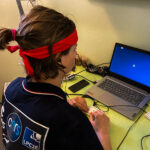
Sometimes, if it is your turn, you will have to perform some tasks for a human factor experiment. Today, it was TELEOP and the experiment created by the University of Lorraine (with the famous « shapes test » which is currently my number one nightmare).

If not, you will be able to work on your experiments or do the job related to your role. On a typical day, on our crew:

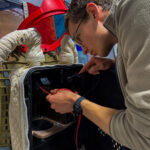
-François goes to the RAM to repair things (like our spacesuits) or helps other crew members on their experiments.

-Maxime goes to the Musk Observatory to observe the Sun or stay in the Hab to create beautiful pictures from observations made with a telescope in New Mexico.

-Marion goes to the GreenHab to take care of the plants or to the Science Dome for the Aquapad experiment.

-Julie take care of the spirulina and soja in the GreenHab or goes to the Science Dome to recycle our water.

-Clément manage our planning for the next days or takes and photoshops pictures.

-And I, work on my drone experiment or start writing the report you are currently reading.

18:00 – Relaxation break! After an afternoon of hard work, your HSO organise a relaxation session. You sit on the upper deck’s floor with your crewmates and Julie guides the session while your eyes are closed and you think to nothing but your breathing.

18:30 – Reports time! You write your report for the day and the EVA request for tomorrow because you will be the EVA leader. Some crewmates are also writing their reports while others are debating next to Clement’s laptop on which photos to choose for today. Your journalist is in his room trying to find inspiration to finish his report in time.

19:00 – Beginning of the communication window. One person is behind the laptop exchanging with the MDRS staff and sending the reports. We also send them our questions and doubts. We start to receive their answers and their feedbacks on our reports and pictures. In the meantime, you start to cook a delicious recipe with one of your crewmates!

20:00 – Most of the reports are already sent (sometimes the journalist report takes a little bit longer) and you start to enjoy your dinner! Everyone congratulates you for the food. The person in charge of the communication window keeps an eye on the laptop in case we receive an email

21:00 – End of the communication window. You help your crewmates clean the kitchen while your journalist is translating his report in French for the website and the families.

21:30 – You sit at the table with your crewmates on which Julie is preparing a team-building game. You play, you try to cheat, you laugh and before you realise it, an hour has passed.

22:30 – You say good night to your crewmates and go to bed, tired by your amazing day on Mars. You need to sleep because tomorrow will be another unique day on Mars and moreover, it will be your first time as an EVA leader! You fall asleep really quick and start dreaming about what you saw during this Sol 10…

Sol Summary – Feb 10th

Crew 240 Sol Summary Report 10Feb2022

Sol: 10

Summary Title: Pretty well grounded

Author’s name: Clément Plagne

Mission Status: Nominal

Sol Activity Summary: Another day, another EVA to North Ridge, another “Hey Clément, see if you can get some pictures of us up there from the Hab!”. Talk about a picturesque place – while every picture out of the window looks awesome, I probably have to find another photographic endeavour. Besides, we’ve gotten through a first thorough test of how well our crewmembers handle the 3D maps our drones got.

Later on in the Hab, we’ve been looking at the busy part of the mission regarding our human science research, with two very time-intensive, and a little tiring, experiments scheduled on the same two days for the first time. That means everyone’s always doing something, and you can tell from the stillness in the Upper Deck.

Look Ahead Plan: Waiting expectantly for those batteries of questionnaires and computer tests to be over for the week tomorrow night. Trying to get in a big EVA to the Special Region.

Anomalies in work: Another spacesuit (2nd version) has had some issues, with the crewmember using it having little ventilation soon after leaving on EVA (no matter how they set it on the dial). Trying to find a definitive reason for it, but it just looks like the batteries are very tired from use in cold weather, and perhaps age.

Weather: Warm

Crew Physical Status: All fine

EVA: One, nominal besides battery issues.

Reports to be filed: Sol Summary, EVA Report, EVA Request, HSO Report, Operations Report, Journalist Report, Crew Pictures, Astronomy Report

Support Requested: We just wanted to make sure when water would be replenished. We should be right on the money with our water management if it comes on Saturday, Sunday should be fine too.

Astronomy Report – February 10th

Astronomy Report

Name: Maxime Jalabert

Crew: 240
Date: 10 feb 2022

MDRS ROBOTIC OBSERVATORY

Robotic Telescope Requested (choose one) : MLC-RCOS16

Objects to be Imaged this Evening: M 36, M43, M42

Images submitted with this report: Object M51_220210

Problems Encountered: None

MUSK OBSERVATORY

Solar Features Observed: /

Images submitted with this report: /

Problems Encountered: /

Operations Report – February 10th

Crew 240 Operations Report 10-02-2022

SOL: 10

Name of person filing report: François Vinet

Non-nominal systems: NA

Notes on non-nominal systems: NA

ROVERS

Spirit rover used: no

Hours: 154.8

Beginning charge: NA

Ending charge: NA

Currently charging: handled by Atila

Opportunity rover used: yes

Hours: 83.6

Beginning charge: 100%

Ending charge: 98%

Currently charging: left uncharged, handled by Atila

Curiosity rover used: no

Hours: 166.5

Beginning charge: NA

Ending charge: NA

Currently charging: handled by Atila

Perseverance rover used: yes

Hours: 226.9

Beginning charge: 100%

Ending charge: 96%

Currently charging: left uncharged, handled by Atila

General notes and comments: NA

Summary of Hab operations:

WATER USE: 24 gallons

Water (static tank): 158 gallons

Water (loft tank): 32 gallons

Water Meter: 0155686.7 units

Static to Loft Pump used – yes

Static tank pipe heater (on or off): on

Static tank heater (On or off): on

Toilet tank emptied: no

Summary of internet: NA

Summary of suits and radios: Still doing some tests but it seems that there is no big issue on the suits.

Summary of GreenHab operations:

WATER USE: 12 gallons at 8:10am and 8 gallons at 6pm

Heater: On

Supplemental light: On

Harvest: N/A

Summary of ScienceDome operations:

Dual split: off

SOC: 76% at 7.00pm

Summary of RAM operations: NA

Summary of any observatory issues: NA

Summary of health and safety issues: NA

Questions, concerns and requests to Mission Support: one burnable and one non-burnable trash are waiting for pickup in the rear airlock. Thank you!

Journalist Report – February 9th

Sol 9: Focus on: Mars’ Atmosphere – LOAC, Mega-ARES, Purple Air, and weather station

Author: Pierre Fabre

Hi everyone! Welcome back to this new report! Today is a new episode of “Focus on”, our format in which we talk about the experiments we brought with us on Mars. In this episode, we are going to talk about several experiments we perform for the French center of scientific research that aim at gathering data about the air on Mars. This will surely be very interesting!

But before, as usual, let’s talk about what happened during this Sol 9 on Mars!

I have to talk to you about something. At MDRS, the toilet goes directly into a tank. One of the missions of Francois, our engineer, is to empty that tank when it is full. I can assure you that this is not a pleasure at all and for all of us, he is kind of the hero of this station. Since the beginning of the mission, we’ve noticed that he had to empty that tank way too frequently. This morning, the tank was full again and with the help of our Commander, they decided to finally address the problem.

They discovered that there was a solid part (yes, this is disgusting) at the bottom of the tank and that was the reason why the tank was getting full so fast. We will hopefully now be able to find a solution to this issue knowing the origin! We really owe them one on this one. When we will be back on Earth, we will definitely offer them a good Earthly burger to thank them for their courage and their devotion.

The EVA of this morning was dedicated to my experiment of 3D mapping with drones. Without spoiling what will be said in a future episode of « Focus on », this experiment aims, in short, at showing that having a 3D map while preparing your EVA’s itinerary makes you safer during the EVA and less tired at the end of it. Now that we know that drones can fly on Mars thanks to Ingenuity, it can be interesting to question their usefulness. A potential use can be to avoid Marsonauts taking useless risks or losing energy in vain on a hard path if a better path can be found by a drone.

For that purpose, I will compare how my crewmates perform at reaching the summit of North Ridge regarding whether or not they had the 3D map during their preparation. I already said too much but it will be clearer in the « Focus on » episode so don’t miss it!

So, as I was saying, this morning we went to North Ridge and reached its summit for the first time. It was a great moment and we were really happy to contemplate the Hab from the top of the same Ridge we see from the kitchen’s window. Tomorrow, the crew members that stayed at the Hab this morning will do the same ascent of North Ridge and then I will be able to analyse the data from the whole crew.

This afternoon, after all the energy he lost in the toilet’s tank this morning, Francois, our Engineer, and friendly neighbourhood hero, still managed to find the motivation to work on our spacesuits. In fact, some crew members noticed two or three days ago that the air cooling in their helmets was not as strong as at the beginning of the mission.

This can be a huge problem for physically demanding EVAs like the one we did this morning because during the effort the helmet fogs up and you lose your visibility. Losing your visibility means you might fail to see a rock on the floor and fall. I can assure you that falling during an EVA, with a heavy spacesuit on your back and the risk of breaking your helmet, is all you want to avoid!

After some tests, he discovered that the issue came from the batteries. Since yesterday, he has been performing tests on the batteries and on their chargers to find what was the issue and how to fix it. He is exchanging with the staff of the MDRS that gives him advice on what to do regarding the results of the tests he performed. He is getting close and we know he will succeed soon! Francois will soon have the opportunity to talk to you directly about his work at MDRS in an episode of « Interview with » dedicated to the Engineer so don’t miss it!

But now it is time to talk about science, it is time for the « Focus on »!

“-Ok Clément, so first, why did we bring those experiments with us?

-Well, we’re lucky enough at MDRS that the terrain and environment we work in resembles, in many ways, things we can expect to find on Mars. In particular, what we have here is a particularly arid environment, with lots of dust that can be kicked up by winds. So, this is a good testbed for the study of atmospheric phenomena we could expect to see there.

In particular, one of the atmospheric events that can have a big impact on a Martian mission is dust storms. They can get extremely large, and have an effect on the efficiency of solar panels, visibility on terrain, or also long-distance communications. This is why developing tools to study the presence and characteristics of this dust in the air, and the properties of the atmosphere during those events can be very useful for ensuring the safety of the first people to set foot on Mars. This is the main purpose of these experiments.

-Ok that’s cool! What is LOAC?

LOAC stands for Light Optical Aerosol Counter. This is a piece of equipment that was developed in an atmospheric sciences laboratory in Orléans, France, for the purpose of counting particles of dust in the air, their sizes, and the flow – this is very helpful to study the composition of dust storms. It’s been used in numerous campaigns not only on the ground but also in the upper atmosphere on high altitude balloons, and it’s even planned for a launch on a nanosatellite to ensure it is space ready for a potential launch to another planet!

-Ok, that first one is cool! And what is Mega-ARES?

-Mega-ARES is an instrument that measures the electric field in the air near the ground. There are many atmospheric events that can modify the electric field, and dust particles rubbing on one another can create electric charges in the air that can be measured by this very sensitive equipment. In the dust storms of Mars, we’re studying the possibility that large amounts of friction can cause electric currents in the air. So, when particles are heavy in the air and hit each other between the large antenna of the tool and the ground, or hit the antenna directly, it gets detected. While LOAC measures the types of particles in the air, Mega-ARES studies the influence these particles have on the low atmosphere.

Mega-ARES is the bigger, Earth-primed brother of Micro-ARES, which was a payload on the Schiaparelli lander designed by the European Space Agency, and that was scheduled to land on Mars around 10 years ago. Unfortunately, the lander failed when arriving on the Red Planet, and the researchers are hard at work trying to get it on a mission in the future. In the meantime, tests like those done at MDRS help gather data that shows how useful this sort of tool could be on Mars.

-Those experiments were both brought by previous Supaéro crews but this year we have a newcomer. What is Purple Air?

-PurpleAir is a tool for measuring air quality – this means it detects some particles that could be linked to human activity. It’s a very useful extra tool to have all the details we need for the other experiments. Both of them work better far away from human influence and will gain valuable data from knowing more about the composition of some of the particles in the air.

-And why is the weather station so important?

-The weather station is a great tool for double-checking our data – many experiments do their own measurements of temperatures and other data, but getting this specific information twice helps us make sure that there are no issues with the equipment. In addition to this, knowing wind speed and direction are important pieces of data to correlate with the measurements from the tool, for the obvious reason that high winds create dust storms, which are the important things we’re studying with these experiments.

As an aside, the station directly emits data to our receivers in the station, which helps us get live data about the outside conditions – and that’s been particularly helpful for those few times with high winds where, unfortunately, that station got knocked over!”

Okay, that’s it for this episode of “Focus on”! I hope you enjoyed it and that you learned something! I can’t wait for the next episode to tell you more about our experiments!

EVA Report – February 9th

Crew 240 EVA Report 09Feb2022

EVA # 9

Author: Pierre Fabre

Purpose of EVA: Change of batteries for the atmospheric experiment, and carrying out EVA based on 3D maps for summiting of the North Ridge

Start time: 10:01 am
End time: 11:22 am

Narrative: Battery change was carried out nominally. The ascent went extremely well, aided by the 3D maps, which have proved a very valuable asset, and allowed us to return much earlier than previously estimated.

Destination: North Ridge

Coordinates (use UTM NAD27 CONUS): 518 500, 425 0500

Participants: Pierre Fabre, Maxime Jalabert, Clément Plagne, Marion Burnichon

Road(s) and routes per MDRS Map: Entrance Road, Cow Dung Road

Mode of travel: Rovers, foot

Operations Report – February 9th

Crew 240 Operations Report 09-02-2022

SOL: 9

Name of person filing report: François Vinet

Non-nominal systems: NA

Notes on non-nominal systems: NA

ROVERS

Spirit rover used: no
Hours: 154.8
Beginning charge: NA
Ending charge: NA
Currently charging: managed by Atila

Opportunity rover used: yes
Hours: 83.6
Beginning charge: 100%
Ending charge: 97%
Currently charging: left uncharged, managed by Atila

Curiosity rover used: no
Hours: 166.5
Beginning charge: NA
Ending charge: NA
Currently charging: managed by Atila

Perseverance rover used: yes
Hours: 226.9
Beginning charge: 100%
Ending charge: 95%
Currently charging: left uncharged, managed by Atila

General notes and comments: NA

Summary of Hab operations:

WATER USE: 59 gallons
Water (static tank): 185 gallons
Water (loft tank): 29 gallons
Water Meter: 0155656.2 units
Static to Loft Pump used – yes
Static tank pipe heater (on or off): on
Static tank heater (On or off): on

Toilet tank emptied: yes (we followed the procedure given by Shannon to see if there is some solid matter in the corners of the tank. There is indeed probably some matter in the corners (Clément sent an email with the results). We put a lot of water in the tank, while it was emptying but it is unfortunately not sufficient to fix that problem).

Summary of internet: NA

Summary of suits and radios: To continue about the problem of yesterday about the charge of the batteries, our engineer is still doing some tests about it but the batteries seem ok (at least 3 of them which have been tested).

Summary of GreenHab operations:

WATER USE: 12 gallons at 7:50 am and 8 gallons at 7 pm
Heater: On
Supplemental light: On
Harvest: 290 grams cherry tomatoes

Summary of ScienceDome operations:

Dual split: off
SOC: 53% at 7.00pm

Summary of RAM operations: NA

Summary of any observatory issues: NA

Summary of health and safety issues: A sanitary problem occurred but was fixed with Atila and Shannon.

Questions, concerns and requests to Mission Support: NA