Journalist Report – December 29th

Sol: 11

Author’s name: Helen Eifert, Crew Geologist

Title: Clayke

CONTENT WARNING: Dad jokes ahead. 11 days is a lot of days to come up with witty food puns and similes. I refuse to discard this bit, so buckle up for all the creative juice I have left.

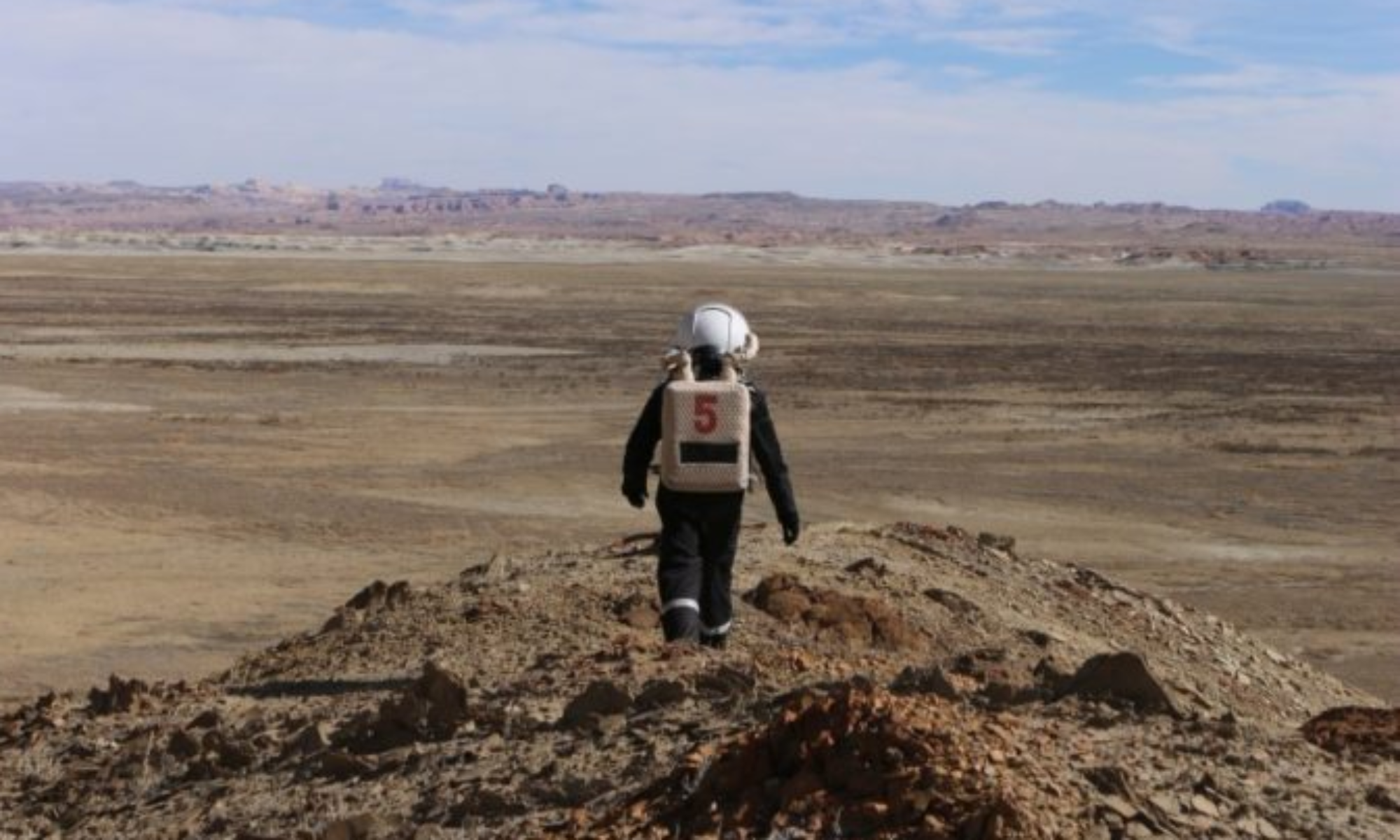
Today was our last day on Mars! Crew 271 enjoyed a slow morning while all the dirt outside dried. Naturally, I watched the whole ordeal from one of the small windows in the Hab. By 1200, Guariniello, Iakymov, Kaosaar, and Eifert suited up one more time for the last EVA on Mars. We took a pleasant 8 km stroll from the Hab to Skyline Rim for spectacular views. Here, we gathered Mancos shale samples for Cesare’s research.

As we ascended towards Skyline Rim, we encountered thin beds of white sandstones like frosting between layers of cake. In this case the proverbial cake is clay. Clayke. Here we see more influence of water in the form of potholes where groundwater makes its way through cracks in the clay, creating vertical channels. A hazard for astronauts, but if you think of it in the clayke context, that light fluffy texture would impress the likes of Paul Hollywood. Once we topped Hab Ridge (Amazonis Planitia), Skyline Ridge ahead displayed magnificent mass wastings, which could also be used to describe the activity of Crew 271 devouring cake. Along with large colluvial fans, there were gullies, and thin layers of shale towering above us. Source shale we shall.

All the while, Andres filmed us, not for studying our behavior, but this time for Estonian TV. Just to paint the picture fully, this involved him scuttling ahead in the bulky EVA suit, plopping down the tripod, filming us walk by, and then scurrying ahead again for another shot. We look forward to our inevitable rise to super stardom in Estonia.

Upon return, Levesque and Grete had baked goods waiting for the four hungry astronauts. There was bread, obviously, but also cake to celebrate our last day on Mars. We completed one final jigsaw puzzle and reflected on the successful mission behind us. Tonight we will go to sleep on Mars and wake up back on Earth, where I am positive my jokes will be significantly less funny. To those who aren’t slap happy from living in a tin can on Mars for two weeks I say, let them eat clayke.

Operations Report – December 29th

SOL: 11

Name of person filling report: Sergii Iakymov
Non-nominal systems: Kitchen sink cabinet hinge, headset#2, solar observatory.
Notes on non-nominal systems: Kitchen sink cabinet hinge is not repaired yet.

ROVERS
Spirit rover used: No
Hours: 206.0
Beginning charge: Not measured
Ending charge: N/A
Currently charging: Yes

Opportunity rover used: No
Hours: 110.4
Beginning charge: Not measured
Ending charge: N/A
Currently charging: Yes

Curiosity rover used: No
Hours: 217.8
Beginning charge: Not measured
Ending charge: N/A
Currently charging: Yes

Perseverance rover used: No
Hours: 252.5
Beginning charge: Not measured
Ending charge: N/A
Currently charging: Yes

General notes on rovers: None

Summary of Hab operations:
WATER USE 29.41 gallons
Water (static tank): 252.66 gallons
Static tank pipe heater (on or off): On
Static tank heater (On or off): On
Toilet tank emptied: No
Summary of internet: Nominal
Summary of suits and radios: Headset #2 button velcro strap needs to be replaced, it is not repairable.

Summary of GreenHab operations:
WATER USE: 11 gal
Heater: On
Supplemental light: plugged
Harvest: 13g beans, 30g microgreens
Summary of ScienceDome operations: used for Eifert, Guariniello projects.

Dual split: On

Summary of RAM operations: N/A.
Summary of any observatory issues: Stop limit switch for second shutter of the solar observatory is getting stuck from time to time.
Summary of health and safety issues: None
Questions, concerns and requests to Mission Support: N/A.

Astronomy Report – December 29th

[category 

astronomy-report]

Sol 11

Astronomy Report
Name: Cesare Guariniello
Crew: 271
Date: 12/29/2022

MDRS ROBOTIC OBSERVATORY
Robotic Telescope Requested: None
Objects to be Imaged this Evening: — (cloudy)
Images submitted with this report: None
Problems Encountered: None

MUSK OBSERVATORY
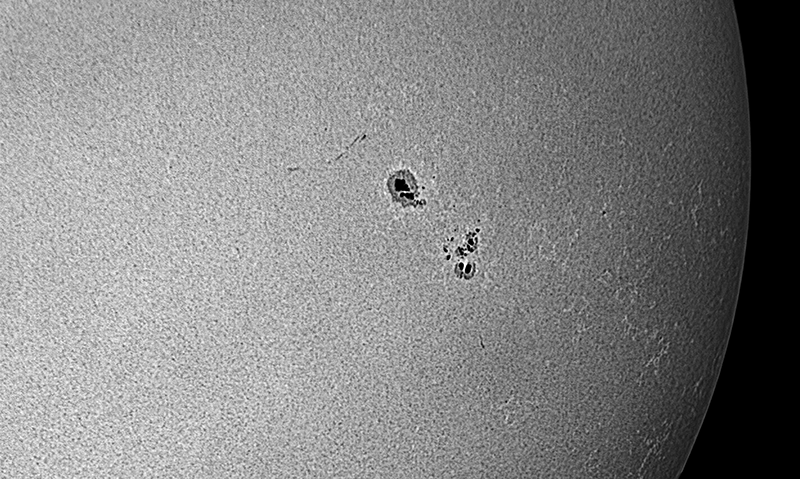
The whole crew took turns to observe the Sun, using the H-alpha filter and protection for visual observation. Then, the Crew Astronomer Guariniello and the Crew Engineer Iakymov worked on focusing and tuning the camera to observe sunspots.
Images submitted with this report: Sunspots_20221229
Problems Encountered: Astronomy Laptop had an issue with the bios (date not set), after fixing that it started properly. Stopping button for the second shutter sometimes gets stuck in low position which, after closing the shutter, prevents the reopening until the button is manually pulled.

Sol Summary Report – Jan 8th

Crew 272 Sol Summary Report 08-01-2023

Sol: 7

SummaryTitle:Relaxing Sol at the Hab

Author’s name: Kshitij Mall

Mission Status: All nominal

SolActivitySummary:The crew decided to take a day off mid-mission very similar to what happens with the astronauts on the ISS. Since the EVA crew yesterday performed very well, I rewarded them with their first showers, which all have taken by today. I also rewarded them with extra sleep, which most of them desired, especially our Crew Geologist Adriana who has been on all EVAs but one. The crew slept last night by 11 pm so they were allowed to wake up at the latest by 9 am. Since I was the chef for the morning, I thought of sharing traditional Indian breakfast with the crew. This was the first time I made Poha (a popular flattened rice breakfast) on Mars and it served more as a brunch item for the team, satiating their hungry stomachs. To spice things up as my Poha recipe had no green chilli, I shared Indian Spice Tea (akin to the ones we find on tapri or street side tea stalls in India) with the crew. Indian biscuits were also offered, and it was the first time for most of threw to have this kind of a breakfast that too on Mars. While preparing tea, I encountered an issue: I accidentally left my tea strainer back on Earth and I knew no emergency interplanetary cargo ship was available today to deliver me this very important item. Thinking like a Maritan the breakfast crew comprising myself, XO Arly, and Crew Journalist Kenneth found a jugaad (Indian word for a makeshift solution) to address this problem. In the kitchen, we identified a very small strainer unit, which seems to be for some type of tea, but certainly not for the humungous amount I made. We poured the tea to be strained in one of the measuring beakers to gain a steady flow out of it and then strained tea carefully to 7 cups. Two of these cups were Martian Kulhads (traditional unpainted and unglazed handle-less clay cups being used for over 5000 years in India and now being made on Mars using Martian clay). The breakfast was followed by Mission Clean Kitchen, in which all crew members participated. After all this is our home on Mars and sanitation is of high importance. We plan on vacuuming the upper and lower decks today. We also completed our daily human factors tests and reports for Arly and Andres. Even though the crew gulped lot more water and did cleaning sessions, we consumed only about 23 gallons of water. The crew did get used to Martian world by mid-mission.

The Greenhab Officer watered the plants and monitored their growth. She also harvested some beans and chives for the crew to feast upon after the sumptuous breakfast. On the 3D printing front, Megan got the rock hammer ready, and another hammer would be ready by the end of the mission for use in one of our upcoming EVAs. Adriana turned Science Dome into a rock party place by hammering some rocks. Kenneth, Megan, Arly, and Madelyn joined the procession. Megan, Arly, and Madelyn returned while Mason and I went to continue the rock party.

The crew led by Kenneth then solved some crossword puzzles. Teamwork was at display once again as was it during the EVAs or any other activity our crew has been a part of. Adriana took half of the crew to the science dome to perform a water cleaning session of her new geo-baby she named Petrie. The dinner for tonight was Chili, which was prepared by Megan and Madelyn. The crew is planning on watching a Bollywood movie (most likely half of it as it is slightly longer, and Kenneth wants to practice the dance steps from this movie). The crew also decided to play a card game called Monikers. We plan to sleep early, and part of the crew will head out to the first Search and Rescue operation.

Look Ahead Plan: First search and rescue test at the end of Gateway to Candor

Anomalies in work: None

Weather: Overcast, Winds Calm

Crew Physical Status: Good

EVA: None

Reports to be filed: Sol Summary, Operations Report, Journalist Report, EVA Request, Greenhab Report.

Support Requested: None

Journalist Report -January 8th


Crew 272 Journalist Report 1-8-2023

Sol: 7

Author: Kenny Pritchard, Crew Journalist

Title: Give us a Break!

Although every minute counts on an extraterrestrial surface mission, our time is not devoted entirely to work. In the evenings and during downtime, we often read books, play games, or communicate with our friends and family to pass the time. Currently, we’re taking an entire sol off to do so! This kind of recreation time is important to preserve the mental and social health of astronauts, especially on longer missions. Mars has plenty enough sun and sand to resemble a vacation destination, sans the water, and also the breathable atmosphere. Kshitij kicked off our sol-off with a lovingly made Poha and Tapri chai breakfast. This was a unique and delicious treat for our crew, and I seriously doubt any of our other breakfasts will beat the effort involved. Lacking an appropriately sized colander to drain the chai, we thought like Martians and improvised a tedious yet effective solution: pouring the chai through one half of a metal tea ball.

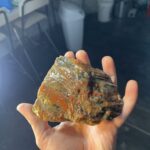
The rest of the sol was spent exerting ourselves on books, naps, and word puzzle games around the upper deck of the hab. Madelyn caught up on journaling and watered her plants as usual (they’re sprouting nicely!), Adriana cleaned off her desk and read several maps of various locations, Megan collected her finished rock hammer 3d-print, Arly finished her book (Brandon Sanderson – The Way of Kings – she does recommend it to fans of fantasy), Kshitij partook in a photo-op in the commander’s bedroom, Mason organized his room and took out the trash, and I reached some chilling revelations about the Dark Lord Voldemort in my Harry Potter read-through. After all these exhausting activities, we took turns ferrying geologic samples over to the Science Dome for cleaning and expert analysis: another rock party. A few of us took turns swinging the hammer to crack rocks. Everyone celebrates when a sample is identified as petrified wood or an interesting mineral, and laments when it’s something more common. Poor feldspar…

We’ve named just about every inanimate object in the Hab – psychologists need not comment. The radio transmitter is BTS, the drone is Garud, the 3d printer is Pima, our 3d-printed rabbit is named Linus, the geology hammer is Little Rocky, and Adriana’s giant petrified wood chunk is Petri. We’re only missing Wilson the volleyball. Megan put together some chili mac for a relatively early dinner, and we’re 2 for 2 on banger meals for the sol. I can’t believe this didn’t win the recent chili contest she entered it in! Over dinner, we’re writing our sol-ly reports as usual, and planning out EVAs for the coming week. Afterwards, we’ll continue our recreation by playing some Monikers and watching the movie ‘Lakshya’ per Kshitij’s glowing recommendation. Though it still feels like we’ve only just arrived, we’re now just about halfway through the rotation. It’s go-time for the rest of the mission!

GreenHab Report – January 8th

Crew 272 GreenHab Report 08-01-2023

GreenHab Officer: Madelyn Whitaker

Environmental control: heater, fan

Average temperatures: 73 F

Hours of supplemental light: 4 hours

Daily water usage for crops: 7 gallons

Daily water usage for research and/or other purposes: 1 gallons

Water in Blue Tank : 250

Time(s) of watering for crops: 1030, 1600

Changes to crops: Harvested beans.

Narrative: Monitored and watered GreenHab crops, monitored and watered experimental crops. Harvested beans for a snack, anxiously awaiting the cherry tomatoes!

Harvest: (include which crop and mass in grams): 5g beans

Support/supplies needed: N/A

Operations Report – January 8th

Crew 272 Operations Report 8-1-2023

SOL: 7

Name of person filing report: Mason Kuhn

Non-nominal systems: None!

Notes on non-nominal systems: N/A

ROVERS

Spirit rover used: No

Hours: 206.8

Beginning charge: 100%

Ending charge: 100%

Currently charging: Yes

Opportunity rover used: No

Hours: 111.2

Beginning charge: 100%

Ending charge: 100%

Currently charging: Yes

Curiosity rover used: No

Hours: 218.7

Beginning charge: 100%

Ending charge: 100%

Currently charging: Yes

Perseverance rover used: No

Hours: 253.5

Beginning charge: 100%

Ending charge: 100%

Currently charging: Yes

General notes on rovers: None were used.

Summary of Hab operations: Rest day, very minimal activity other than some cleanings. The 3 crew members who did not shower during sol 6 did during this sol, so water use was again higher than some previous days but still sustainable. Very basic calculations were made, and the crew is well on track to have (more than enough) water for the entire duration of the mission.

WATER USE: 22.9 gallons

Water (static tank): 249.4 gallons

Static tank pipe heater (on or off): On

Static tank heater (On or off): On

Toilet tank emptied: No

Summary of internet: Nominal

Summary of suits and radios: All suits are currently charging. All radios are charged and off of the charging docks. No issue was found during the investigation of suit 7 today, but further inspection will be done tomorrow.

Summary of GreenHab operations: Watered and monitored all crops. Watered experimental crops.

WATER USE: 8 gallons

Heater: On

Supplemental light: 4 hours

Harvest: 15g beans

Summary of ScienceDome operations: Geologic sample inspection, cleaning, and organization.

Dual split: On (from approximately 8:00 pm – 8:00 am)

Summary of RAM operations: Last night after the operations report was already filed, the old-generation EVA Radio Headsets were organized, labeled, and placed in the RAM with notes on each from testing.

Summary of any observatory issues: N/A

Summary of health and safety issues: N/A

Questions, concerns, and requests to Mission Support:

  • Request for a new salt shaker & new dishwashing sponge

Mission Summary – December 30th

Crew 271 – Mars Society
Crew Commander: Marc Levesque (United States)
Executive Officer/Crew Astronomer: Cesare Guariniello (United States/Italy)
Crew Engineer/Health and Safety Officer: Sergii Iakymov (Ukraine)
Crew Geologist/Journalist: Helen Eifert (United States)
Crew Medical Researcher/Green Hab Officer: Alicyn Grete (United States)
Crew Researcher: Andres Käosaar (Estonia)
MDRS 271 was a Mars Society crew, self-named I.M.A.R.S. (International Mars Analog
Research Simulation), was comprised of a diverse group of individuals representing four
countries, providing an international flavor to the mission. Three members were
veterans of past MDRS missions, while three were MDRS rookies. The crew’s priorities
were to maintain all MDRS facilities, vehicles, and equipment in a safe and operable
condition and to complete geological, astronomical, psychological, medical, and
operational projects.
Prior to the mission, the crew met for 10 video sessions to organize and prepare
themselves for their stay at MDRS. These meetings provided an orientation to the
station, expectations for accommodations and living conditions, additional simulation
protocols beyond those outlined in the MDRS Handbook, and expedition behavior
characteristics derived from several sources. For a crew assembled from individual
applications, the latter topic was vitally important to establish a cohesive and
cooperative effort immediately upon arrival at MDRS. As was proven during the
commander’s two previous missions, this set of expedition behaviors allowed this crew
to work and live together and support each other extremely well throughout the duration
of this mission. This also assisted in the completion of all planned projects and for
achieving the safe and effective operation of the station that had been established as
priorities for the mission. From this commander’s perspective, I could have not asked for
a better crew.
A brief summary of crew project accomplishments follows, with a full description found
in the Crew 271 End of Mission Science and Operations Report.

Titles: Coping Strategies for Long-Duration Space Exploration (Study 1); Team
Challenge Resolution Mechanisms in Isolated and Confined Space Analog
Mission Through Ethnographic Methods (Study 2)
Crew member: Andres Käosaar
The data gathering for the projects well very well – the members of Crew 271 patiently
filled in my surveys, and there seemed to be no missing data points. While there weren’t
too many overtly observable coping strategies or team challenge resolution
mechanisms executed, there were some instances that were noted for further analysis.
Due to the individual profiles of the Crew 271 members and the overall resemblance to
a potential real long-duration space exploration team (i.e., culturally and professionally
diverse crew very interested in human spaceflight), the data are good, and the sample
has high validity. While unable to access all the data collected from surveys and
journals, I'm quite hopeful and optimistic regarding the potential findings and
conclusions from the studies.
Title: Drying trends of a clay-rich surface
Crew member: Helen Eifert
The goal for this particular experiment was to observe the drying trends of a clay-rich
surface for a longer period of time following controlled wetting of the surface to
understand chemically bound water trends better. This contributes to the overall
understanding of how water may be retained, persevered, and detected on Mars. A
location was selected north of the Hab for an experiment to measure drying trends of a
clay-rich and Mars-like surface over the course of the MDRS mission. The initial wetting
of the experiment was conducted on Sol 4, and the immediate drying trends were
measured for an additional two hours following saturation of the surface on this first
EVA using an ASD FieldSpec3. Return EVAs were conducted on Sol 5, Sol 6, and Sol 9
for an additional two measurements each day. On the last day of measurement, a dry
sample was collected from a nearby site to get initial water content and an additional
sample was collected from the experiment site, which still appeared damper than its
surroundings. The two samples collected were returned to the Science Dome for loss
on ignition analysis. The spectral data was post processed and will be plotted and
analyzed to be used to supplement the findings of prior field campaigns. This work is in
preparation for publication in the late spring 2023.

Title: Geology – Samples for In-Situ Resource Utilization
Crew member: Cesare Guariniello
Three long-distance EVAs collected samples in the area of Barrainca Butte (black
vesicular igneous rocks, conglomerates, and light-colored mudstone), Candor Chasma
(Summerville formation: red mudstone and sandstone with cross-cutting gypsum veins),
and Skyline Rim (Dakota conglomeratic sandstone and Mancos Shale samples).
Samples were weighted and processed in the oven in the Science Dome, then weighted
again to ascertain water content. The samples will be shipped to Purdue University for
further spectroscopic analysis to identify geotechnical properties for ISRU via remote
sensing. In particular, spectra will be studied for indicators of water content and bulk
size.
Title: Astronomy
Crew member: Cesare Guariniello
Robotic Observatory: After adjusting the MDRS-14 telescope, multiple observations
were taken when the sky was clear. The most notable was M42 (Orion Nebula). Other
objects that were sampled are M1 (Crab Nebula), M3, M31 (Andromeda Galaxy), M97,
M101 (Pinwheel Nebula), Rosette Nebula, Barnard 33 (Horsehead Nebula). The
Astronomy Support will work further on the telescope focus.
Musk Observatory: The sky was hazy or cloudy on most sols. One observation of the
Sun was performed towards the end of the mission. This allowed the whole crew to
participate in a solar observation. One photo of a group of sunspots with visible umbrae
and penumbrae was captured and processed.
Title: Analog Mars Crew Evaluation of a Uniplanar External Fixation Training
Module
Crew member: Alicyn Grete
The purpose of this project was to verify whether Martian analog crew members could
use an offline, self-assessed module, and locally reproducible 3D printed bone
simulation models to become confident and competent in performing external fixation
procedures to manage open tibial fractures in an austere environment without access to
specialist support from Mission Control. The first two days were spent having
participants take a pre-learning confidence survey and complete the training materials
and video. Over the next four days, each participant successfully completed a skills test,
achieving a go ahead on each competence objective and verifying their work with self-
assessment photos. Afterwards, each participant completed a post-learning survey and
received Medical Makers certificate and memorabilia to commemorate their
accomplishment. These results suggest that my hypothesis was correct: the Tibial
Fracture Fixation Training Module can provide analog space crew members with the
confidence and competence necessary to teach themselves a new surgical skill. I will
be submitting an abstract to present this research at the West African College of
Surgeons Conference in Togo this spring, and I am working on an article to submit to
Aerospace Medicine and Human Performance journal.
Title: MDRS Engineering Projects
Crew member: Sergii Iakymov
During Crew 271 all 11 EVA suits were inspected for their power systems, and
especially wiring connections, charging hardware, and rechargeable batteries. Issues
were identified, changes were made to equipment, and recommendations made for
better suit maintenance by future crews. A second project evaluated MDRS power
consumption at the request of Mission Support by evaluating active station electrical
devices. A spreadsheet of the station components and power consumption was created
and sent to Mission Support.
Title: Radio communications system maintenance
Crew member: Marc Levesque
A maintenance check was conducted on the new MDRS radio repeater, and its antenna
was raised to improve reception between the Hab and EVA teams, since
communication gaps were discovered by crews this season. Communications checks
during Crew 271 validated this problem, and a recommendation is made to relocate the
repeater to the North Ridge. It is also recommended to re-establish Communications
Officer duties on each MDRS crew, with those duties most likely assigned to the Crew
Engineer to ensure proper radio usage and battery recharging.
The I.M.A.R.S. crew would like to extend its appreciation to Dr. Robert Zubrin and Dr.
Shannon Rupert for the opportunity to participate in a mission at MDRS and hope that
we performed in a manner befitting the safe and effective operation of the station while
contributing to the long term goal of human exploration and colonization of Mars.
Submitted by:
Marc Levesque
Crew 271 Commander

Research Report – December 30th

[category science-report]

MDRS Crew 271 End of Mission Science and Operations Summary 30-12-2022
Submitted by: Marc Levesque, Crew Commander

Titles: Coping Strategies for Long-Duration Space Exploration (Study 1); Team
Challenge Resolution Mechanisms in Isolated and Confined Space Analog
Mission Through Ethnographic Methods (Study 2)
Crew member: Andres Käosaar
Overall, the data gathering for the projects well very well – the members of Crew 271
patiently filled in my surveys and there seems to be no missing data points. Due to the
high cohesion and professionalism of the crew, there haven't been too many overtly
observable coping strategies or team challenge resolution mechanisms executed (don't
get me wrong – not that expressing those aspects is unprofessional, but we just haven't
had many problems to deal with), but there have been some instances that I've been
able to note down for further analysis. On the other hand, due to the individual profiles
of the Crew 271 members and the overall resemblance to a potential real long-duration
space exploration team (i.e., culturally and professionally diverse crew very interested in
human spaceflight), the data are good and the sample has high validity. Since I'm not
able to access all the data (the survey answers and post-mission interviews) before
leaving the station, I can't make any further conclusions, but I'm quite hopeful and
optimistic regarding the potential findings and conclusions from the studies.

Title: Drying trends of a clay-rich surface
Crew member: Helen Eifert
A location was selected north of the Hab for an experiment to measure drying trends of
a clay-rich and Mars-like surface over the course of the MDRS mission. The experiment
is supplemental to a series of desert field campaigns that assessed thermophysical
properties of different Mars-like environments and their associated drying trends. The
goal for this particular experiment was to observe the drying trends of a clay-rich
surface for a longer period of time following controlled wetting of the surface to
understand chemically bound water trends better. This contributes to the overall
understanding of how water may be retained, persevered, and detected on Mars.
The initial wetting of the experiment was conducted on Sol 4, 22 Dec 2022. The
immediate drying trends were measured for an additional two hours following saturation
of the surface on this first EVA using an ASD FieldSpec3. This data shows visible near-
infrared surface reflectance in order to better understand water molecules that may
become trapped in the chemical structure of clays and how long it can be retained.
Return EVAs were conducted on Sol 5, Sol 6, and Sol 9 for an additional two
measurements each day. On the last day of measurement, a dry sample was collected
from a nearby site to get initial water content and an additional sample was collected
from the experiment site, which still appeared damper than its surroundings. Due to
incoming rain, the observation period needed to end on Sol 9. The two samples
collected were returned to the Science Dome for loss on ignition analysis. Here, they
were baked at just over 100C to burn off any water. Weights were recorded before and
after to understand the water content of the samples and how close the experiment site
got to equilibrium with the dry sample. The spectral data was post processed and will be
plotted and analyzed upon return from MDRS to be used to supplement the findings of
prior field campaigns. This work is in preparation for publication in the late spring 2023.

Title: Geology – Samples for In-Situ Resource Utilization
Crew member: Cesare Guariniello
Three long-distance EVAs covered regions not visited before by Guariniello. Samples
were collected in the area of Barrainca Butte (black vesicular igneous rocks,
conglomerates, and light-colored mudstone), Candor Chasma (Summerville formation:
red mudstone and sandstone with cross-cutting gypsum veins), and Skyline Rim
(Dakota conglomeratic sandstone and Mancos Shale samples). Samples were weighted
and processed in the oven in the Science Dome, then weighted again to ascertain water
content. The samples will be shipped to Purdue University for further spectroscopic
analysis to identify geotechnical properties for ISRU via remote sensing. In particular,
spectra will be studied for indicators of water content and bulk size.

Title: Astronomy
Crew member: Cesare Guariniello
Robotic Observatory: After adjusting the MDRS-14 telescope, multiple observations
were taken when the sky was clear. The most notable was M42 (Orion Nebula). Other
objects that were sampled are M1 (Crab Nebula), M3, M31 (Andromeda Galaxy), M97,
M101 (Pinwheel Nebula), Rosette Nebula, Barnard 33 (Horsehead Nebula). The
Astronomy Support will further work on the telescope focus.
Musk Observatory: The sky was hazy or cloudy on most sols. One observation of the
Sun was performed towards the end of the mission. This allowed the whole crew to
participate in a solar observation. One photo of a group of sunspots with visible umbrae
and penumbrae was captured and processed.

Title: Analog Mars Crew Evaluation of a Uniplanar External Fixation Training
Module
Crew member: Alicyn Grete
The purpose of this project was to verify whether Martian analog crew members could
use an offline, self-assessed module, and locally reproducible 3D printed bone
simulation models to become confident and competent in performing external fixation
procedures to manage open tibial fractures in an austere environment without access to
specialist support from Mission Control. I hypothesized that the Tibial Fracture Fixation
Training Module would provide analog space crew members with the confidence and
competence necessary to teach themselves a new surgical skill. To test this hypothesis,
I conducted an observational study with participants from a Mars Society Desert
Research Station analog crew.
I began by obtaining consent from all participants at the beginning of the mission. The
first two days were spent having participants take a pre-learning confidence survey and
complete the training materials and video. Over the next four days, each participant
successfully completed a skills test, achieving a go ahead on each competence
objective and verifying their work with self-assessment photos. Afterwards, each
participant completed a post-learning survey and received a certificate and Medical
Makers memorabilia to commemorate their accomplishment.
From the surveys, all eight confidence variables showed a statistically significant
increase following simulation-based training (p values < 0.0290 and a change on the
Likert scale of 1 point or greater at the 95% confidence level). All procedure steps for
uniplanar external fixation were completed to standard by all six crew members, five of
them on the first try without practice on the equipment. These results suggest that my
hypothesis was correct: the Tibial Fracture Fixation Training Module can provide analog
space crew members with the confidence and competence necessary to teach
themselves a new surgical skill.
I will be submitting an abstract to present this research at the West African College of
Surgeons Conference in Togo this spring, and I am halfway done with an article draft to
submit to the Aerospace Medicine and Human Performance journal, the most used and
cited journal in the field of Aerospace Medicine. Additionally, I made a film
commemorating our experience at MDRS with tibial fracture fixation that depicted how a
Martian crew would respond to a tibial fracture occurring during an EVA.
https://youtu.be/EvrtrTh3gVU.

Title: MDRS Engineering Projects
Crew member: Sergii Iakymov
During this season MDRS teams have encountered some issues with power systems of
the EVA suits. During Crew 271 all 11 EVA suits were inspected for their power
systems, and especially wiring connections, charging hardware, and rechargeable
batteries. The results of this inspection revealed the following:
1) All wiring was in working condition.
2) All charging hardware was in working condition and operating nominally.
3) There was a problem with the station generator, and there is a possibility it was
causing the previous problems with the suit batteries. After the generator was
fixed, no further problems were observed.
4) Four EVA suits were plugged into a power strip that had a loose connection with
the chargers. As a result, these suits were not charging to the top level of the
battery capacity. The power strip was replaced with a new one which provided a
solid connection with the chargers. This change allowed the suits to be charged
to the maximum battery capacity.
5) In order to measure battery level charge, crews have needed to use a multimeter
to measure voltage via charging ports or open backpacks. These actions are
wearing down suits components and increasing the risk for parts to be broken by
inexperienced crews. In order to avoid this happening it is recommended to
include into the suit systems a battery charge indicator next to the charging ports.
A second project evaluated MDRS power consumption at the request of Mission
Support by evaluating active station electrical devices. A spreadsheet of the station
components and power consumption was created and sent to Mission Support during
the last communications window.

Title: Radio communications system maintenance
Crew member: Marc Levesque
A new radio repeater for MDRS was installed in October 2022 west of the station on
Hab Ridge. Based on radio propagation analysis, this site was believed to provide radio
coverage between the Hab and EVAs teams throughout all the areas teams would
travel. During the first few missions this season, this turned out to not be the case, as
several communication gaps were discovered. Some of this was believed to result from
the numerous hills in the area that blocked receptions, while some were also likely due
to a lack of proper radio operation on the part of crew members.
To determine the major cause for the lack of communication in some areas, the project
undertook several steps. The first was to check the repeater’s battery status and overall
operation by opening the repeater shelter and conduct a visual inspection of the
equipment, all of which were in working order. The second step raised the repeater
antenna by attaching it to a six meter mast, which was then secured by new guy wires.
Communication checks were conducted during EVAs to determine the effectiveness of
the heightened antenna, but no significant improvement in reception to and from the
field was noted. A mag mount antenna was also used on a rover during one EVA to test
its effectiveness, but this was also found to be ineffective. A further task monitored the
battery drain on the handheld radios during EVAs to determine an appropriate
recharging interval.
Based on the results of this project, the following recommendations are made:
1. Move the repeater to a permanent site on North Ridge. This was the site of a test
project during Crew 265, during which a small repeater was established and
provided excellent radio communications between the Hab and most all EVA
areas. Permission to establish a permanent repeater on North Ridge will likely
require BLM approval, and if granted, would also require an arduous equipment
move during the fall 2023 work party, including the building of a new repeater
housing or enhancing the existing shelter, along with erecting a robust tower
structure for the antenna. Note: At the end of the mission, a possible route for
transporting the repeater equipment to a North Ridge site was located though a
field trip.
2. Consider re-establishing Communications Officer duties on each MDRS crew,
with those duties most likely assigned to the Crew Engineer. These tasks would
include instructing all crew members on the proper operation and care of the
handheld radios, monitoring radio battery consumption, and monitoring
recharging status to insure they are removed when they reach charged status.
This is important because batteries that are fully recharged and left on the
charger will cause rapid battery decline. Assigning a Communications Officer will
help ensure that this procedure is followed.