
Journalist Report – November 23rd

Sol 11 Journalist Report 23-NOV-2023

Liz Cole

Morning:

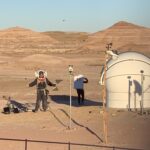
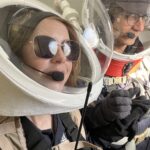
The crew rose at dawn to capture images of a spectacular red Martian sunrise and prepare for the last EVA of the mission.

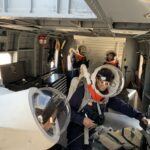
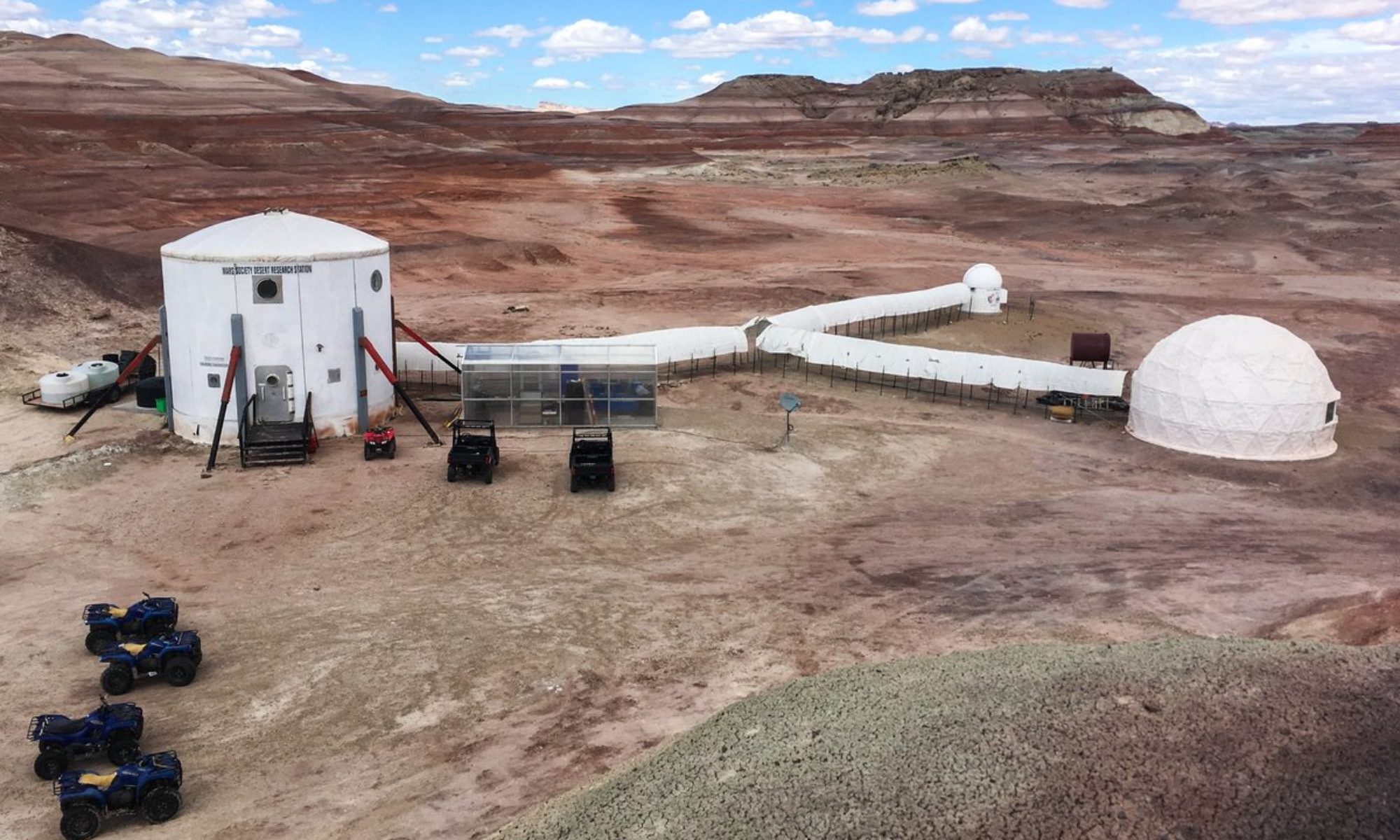
The purpose was to demonstrate a simplified EVA mission onboard the MASH (Mobile Analog Space Habitat), a mobile habitat with an integrated ecological life support system including heating, cooling, food and water supply, and waste handling.
The MASH can take four astronauts aboard and travel further than the rovers. When parked it can serve as the base station for walking EVAs, allowing astronauts to return, rest and refresh aboard, then return to the MDRS habitat as needed.

Donald “Ducky” Jacques, crew Executive Officer and Chief Scientist at Earthseed, designed and built the MASH to approximate the features that NASA is including in their Space Exploration Vehicle (SEV) concept.

Ducky, Crew Scientist Guillaume Gégo, Crew Documentary Filmmaker Hugo Saugier and brought our suits and gear into the MASH, and detached from the docking portal. We drove down Moon Walk Road, exited the campus and drove south on Cow Dung Road to Kissing Camel.

Moving an entire ecological life support system through rough, sandy roads is no small task, and the drive went very well.

Ducky performed a turn-around at the previously identified location, then parked. The MASH depressurized its front section, and Guillaume. Hugo and I exited. Ducky remained aboard as local Cap-Com.

Hugo captured images of the MASH operating in the stunning deep red terrain around Kissing Camel.

Guillaume and I walked along the base of the nearby ridge, and we took turns piloting a drone capturing high resolution video of the magnificent geology, stunning rock formations, views and vistas around Kissing Camel. We captured drone footage of the Baby Dragon rock formation and captured a fly through of a valley full of dried stream beds flanked by gorgeous red and purple striped Martian hills.

We could have spent all day out there admiring the beauty of the area.

While capturing the fly through of the valley, we received word that the MASH was having a problem. Unexpectedly, after parking, the MASH control panel showed a “check engine light” and the engine would not start. Ducky contacted Cap-com and consulted with them about the situation. Cap-com informed Mission Support, and options were discussed. Ducky suited up, depressurized, checked fluids and added oil to the engine, remaining fully in-sim the entire time.

Hugo was pleased to capture an unexpected situation, and though it did not develop into a full “emergency,” it provided him with some moments of true drama and concern.

All parties having captured their video and completed their tasks on the EVA, we boarded, repressurized and returned to MDRS in the comfort of the pressurized MASH interior.

Afternoon:

Upon returning, Ducky harvested fresh sunflower greens, broccoli greens and radish greens for the evening meal.

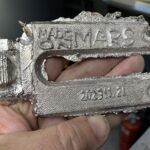
Roger Gilbertson (crew commander) successfully modified his plaster mold, then melted down the third bismuth part, and recast it. He then trimmed the pieces, and performed a test assembly of an icosahedron.

Back in the Science Dome, Guillaume performed another sampling of his purple bacteria from the bioreactor bags, and was pleased to find that the bacteria growth had reached a plateau in growth. The bacteria had multiplied in numbers to the greatest possible extent inside the confines of the bioreactor bags, indicating a successful end to his experiment for this mission.

Evening:

The crew started cleaning, packing and preparing the holiday dinner and for our departure from MDRS.
Sol Summary – November 23rd

Crew 286 Sol 11 Summary Report 23-NOV-2023
Sol: 11
Summary Title: “A monster MASH success, followed by mashed potatoes”
Author’s name: Roger Gilbertson
Mission Status: Nominal
Sol Activity Summary: In the morning, the EVA 11 crew loaded up the MASH vehicle with suits and equipment for their excursion. Guillaume completed another live media interview, then boarded with the three other MASH crew members: Don, Lizzy and Guillaume.
They detached from the docking portal next to the Science Dome at 9:15 am, backed out, then drove down Moon Walk Road, exited the campus and drove south on Cow Dung Road to Kissing Camel. There they performed a turn-around at the previously identified location, then parked.
All astronauts suited up, then the MASH depressurized its front section, and three astronauts exited. Ducky remained aboard as local Cap-Com. Lizzy and Gee walked along the base of the nearby ridge, with Liz piloting a drone scan of the magnificent geology, while Hugo captured images of the MASH operating in the the exotic terrain.
Unexpectedly, at about 10:55 am the MASH control panel showed a “check engine light” and the engine would not start. The crew contacted Cap-com and consulted with them about the situation. Cap-com informed Mission Support, and options were discussed. Ducky suited up, depressurized, and went out to check the fluids on the vehicle, remaining fully in-sim the entire time. Oil was added to the engine, and the vehicle then restarted properly.
Filmmaker Hugo was pleased to capture an actual unexpected situation, and though it did not develop into a full “emergency,” it provided some much-hoped-for moments of true drama and concern.
Once all had reboarded and repressuized, they were able to have a small snack, then returned to MDRS in the comfort of the pressurized MASH interior. Redocking at the portal occurred smoothly, and the vehicle doors were opened at exactly 12:00 pm.
Roger successfully modified the plaster mold, then melted down the failed third metal part, and recast it. He then trimmed the pieces, and performed a test assembly.
Guillaume performed another sampling and was pleased to find that the bacteria growth had reached a plateau in growth, indicating a successful completion of his experiment for this mission.
We gathered images and text for our Final Mission Report, then turned to the kitchen to prepare our much-anticipated Thanksgiving dinner.
EXIT PLAN: Tomorrow morning we plan to exit sim upon awakening, then pack our things, clean, do the food inventory, and load the Crew Car. Then we plan to borrow the Habitat Car and visit the Special Area to the north. We will return to campus by 4 PM so that we can depart in the Crew Car before sunset, and head for Grand Junction.
Anomalies in work: none
Weather: overcast
Crew Physical Status: nominal
EVA: EVA 11 completed
Reports to be filed: Sol Summary, Journalist report, Photos, Operations report, Green Hab report, EVA 11 report, Final Mission Report.
Support Requested: May we have the Crew Car delivered to the habitat by 10 AM or so, for loading? And we still hope to borrow the Hab Car to visit the Special Area before we depart, as time and weather allows.

Operations Report – November 23rd

Crew 286 Operations Report 23-11-2023
SOL: 11
Name of person filing report: Donald "Duckie" Jacques
Non-nominal systems: None
Notes on non-nominal systems: I realized I forgot to include photos of the repair of Suit #5 yesterday. They are attached below.
ROVERS
Spirit rover used: No
Hours: (before EVA)
Beginning charge: (Before EVA)
Ending charge: (On return from EVA, before recharging)
Currently charging: Yes
Opportunity rover used: No
Hours:
Beginning charge:
Ending charge:
Currently charging: Yes
Curiosity rover used: No
Hours:
Beginning charge:
Ending charge:
Currently charging: Yes
Perseverance rover used: No
Hours:
Beginning charge:
Ending charge:
Currently charging: Yes
General notes on rovers: Nothing to report
Summary of Hab operations: Today we focused on our final EVA, and wrapping up experiments. As I write this, a Thanksgiving meal is being repaired
WATER USE: gallons
Water (static tank): 326.75 gallons
Static tank pipe heater (on or off): On
Static tank heater (On or off): On
Toilet tank emptied: Yes
Summary of internet: Nominal
Summary of suits and radios: 4 suits and 5 radios were used during today’s Excursion EVA in the MASH, all functioned well, and are now plugged in and waiting for next journey.
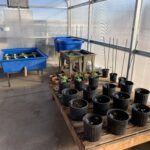
Summary of GreenHab operations: Plants were still lightly moist this morning, but needed watering this afternoon. I was able to acquire a small harvest of 47 grams of greens to contribute to our Thanksgiving meal.
WATER USE: 6.5 gallons
Heater: On
Supplemental light: On
Harvest:
Sunflower greens 6g
Broccoli greens 7g
Radish greens 34g
Summary of Science Dome operations: The MASH undocked from the dome, executing the Excursion EVA with Guillaume, Hugo, Liz, and Don. Guillaume is wrapping up his purple bacteria work this afternoon and preparing for departure.
Dual split: Off
Summary of RAM operations: (Tools used, work done) Roger completed his Tensegrity sculpture from the molds and pouring earlier this week.
Summary of any observatory issues: Nothing to report
Summary of health and safety issues: Nothing to report
Questions, concerns and requests to Mission Support:
Thank you Sergii and Ben for a great support team during our mission!

GreenHab Report – November 23rd

Crew 286 GreenHab Report 23-11-2023
SOL: 11
GreenHab Officer: Donald "Duckie" Jacques
Environmental control: heater on, fan off, door closed
Average temperatures: 70 F @ 8am, 73 F @ 3pm
Hours of supplemental light: 4 hours
Daily water usage for crops: 6.5 gallons
Daily water usage for research and/or other purposes: 0
Water in Blue Tank (200 gallon capacity): 154 gallons
Time(s) of watering for crops: 3 pm
Changes to crops: None
Narrative: I spent the morning on EVA, and in the afternoon, cleaned up a bit, watered, took ending photos, and harvested a few greens.
Harvest:
Sunflower greens-6g
Broccoli greens-7g
Radish greens-34g
Support/supplies needed:
A personal thank you, Dr Rupert for working with me during this mission!

EVA Report – November 23rd

Crew 286 EVA #11 report 23-NOV-2023
EVA # 11
Author: Roger Gilbertson
Purpose of EVA: To demonstrate a simplified MASH (Mobile Analog Space Habitat) EVA mission, with four persons aboard, able to travel further than the rovers. When parked it can serve as the base station for one or more walking EVAs, allowing astronauts to return, rest and refresh aboard, then return to the MDRS habitat as needed.
Start time for EVA: 9:00 am
End time for EVA: 12:00 pm
Narrative: The four astronauts boarded the MASH unit on time, with four EVA suits, radios and chargers already aboard. They detached from the docking portal next to the Science Dome at 9:15 am, backed out, then drove down Moon Walk Road, exited the campus and drove south on Cow Dung Road to Kissing Camel. There they performed a turn-around at the previously identified location, then parked.
All astronauts suited up, then the MASH depressurized its front section, and three astronauts exited. Ducky remained aboard as local Cap-Com. Lizzy and Gee walked along the base of the nearby ridge, with Liz piloting a drone scan of the magnificent geology, while Hugo captured images of the MASH operating in the the exotic terrain.
Unexpectedly, at about 10:55 am the MASH control panel showed a “check engine light” and the engine would not start. The crew contacted Cap-com and consulted with them about the situation. Cap-com informed Mission Support, and options were discussed. Ducky suited up, depressurized, and went out to check the fluids on the vehicle, remaining fully in-sim the entire time. Oil was added to the engine, and the vehicle then restarted properly.
Filmmaker Hugo was pleased to capture an actual unexpected situation, and though it did not develop into a full “emergency,” it provided him with some moments of true drama and concern.
When all had reboarded and repressuized, they were able to have a small snack, then returned to MDRS in the comfort of the pressurized MASH interior. Redocking at the portal occurred smoothly, and the vehicle doors were opened at exactly 12:00 pm.
Destination and Coordinates (use UTM WGS 84):
• Kissing Camel (518250, 4249510)
EVA Participants:
• Donald Jacques
• Liz Cole
• Guillaume Gégo
• Hugo Saugier
Road(s) and routes per MDRS Map: Cow Dung Road south to Kissing Camel (518250, 4249510)
Mode of travel: MASH vehicle, walking (not further than 100 meters from MASH)
Vehicles you will be using: MASH

Journalist Report – November 22nd

Sol 10 Journalist Report 22-NOV-2023

Liz Cole

Morning:

Scott Beibin (crew inventor) and Liz Cole (crew journalist) embarked on a morning EVA, capturing LiDAR scans and drone footage of the exteriors of the MDRS campus and facilities.

After a short break to rehydrate and recharge batteries, preparation started for the afternoon EVA.

Afternoon:

Donald Jacques (crew executive officer) and Guillaume Gégo (crew scientist) prepared the MASH for its EVA on Sol 11. The Mobile Analog Space Habitat will serve as the base station for a walking EVA, providing an opportunity for astronauts to rest aboard the MASH after they achieve the mission of the EVA, then return to the habitat. Scott set up to perform a Ptelepathetique concert just before the Martian sunset near the Observatory dome, with Liz recording the concert with the drone camera.

We used the RAM again as the airlock to accommodate Scott’s equipment for his concert, and Don and Guillaume’s preparation for getting the MASH ready for EVA.

Roger Gilbertson (crew commander) poured his third casting for medium complexity metal castings made of bismuth.

The plants continue to sprout in the GreenHab. Our hope is to have a harvest of sprouts by Thanksgiving.

Guillaume took samples, and further readings from the purple bacteria experiment. The Rhodopseudomonas palustris TIE-1 and Rhodospirillum rubrum SH1 are both growing well.

Sol Summary – November 22nd

Crew 286 Sol 10 Summary Report 22-NOV-2023
Sol: 10
Summary Title: “Droning on the Campus”
Author’s name: Roger Gilbertson
Mission Status: Nominal
Sol Activity Summary: In the morning, the EVA 9 crew realized they would not need the entire duration originally planned, and requested a later departure time to allow for better lighting of the campus structures.
Guillaume conducted a live video tour of the interior of the habitat and the various buildings, including the suiting up for the EVA 9.

Suiting up for EVA 9 went smoothly, and equipment was placed in the airlock. Their work proceeded effectively. Liz encountered some configuration errors with the drone, and eventually realized that the information provided in the manual was not entirely correct, or that something had changed from the standard settings. Many excellent scans and aerial clips were captured. They successfully returned, but five minutes past the requested ending time.
The Afternoon EVA 10 preparations for the music performance involved moving video and drone equipment to the RAM for departure. Don and Guillaume assisted with the opening of the RAM door, then went to the MASH vehicle to perform activities needed for tomorrow’s EVA 11. They completed their work in good time, then sat outside the habitat building, and had a discussion about the prospects for bringing living to Mars, which was recorded on video and audio by documentarian Hugo.
Scott and Liz moved out to the area between the two observatory domes. Liz conducted drone surveys of the buildings while Scott prepared his equipment. Liz again encountered challenges with the drone, nevertheless some excellent scans and aerial video clips were captured. Scott also encountered technical and system problems, however they were all eventually overcome, and the music performance began about 4:00 pm. The weather and lighting cooperated, and the sounds of “martian” music drifting across the surface could be heard from the Observatory dome enclosure, enveloping the observers in magical moments of calm and stillness.
After, equipment was collected and they both returned to the RAM airlock, closing the door about 5 minutes behind plan.
Roger successfully cast the third and final bismuth metal piece, and will be trimming them for final assembly this evening.

Don prepared the MASH for tomorrow morning’s proposed EVA. Discussions were held about maximizing the results of our final full sol, and the need to write up our Final Mission Report tomorrow.

SOL 10 PLAN (tomorrow, our last full day of sim): The science program will continue to monitor bacterial growth. Guillaume has a video interview in the morning. EVA 11 with the MASH vehicles is planned for 9 am to noon. We will then submit our Final Mission Report, and celebrate with a martian Thanksgiving dinner.

EXIT PLAN: At present we plan to exit sim after awaking Friday morning. We will clean, inventory, pack, and load the Crew Car. Then, as time allows, we would like to borrow the Habitat Car and conduct an out-of-sim drive to the Special Area to the north. We will return to campus by 4 PM, then depart in the Crew Car for Grand Junction.

Anomalies in work: none
Weather: sunny
Crew Physical Status: nominal
EVA: EVA 9 completed, EVA 10 completed, request for EVA 11 submitted.
Reports to be filed: Sol Summary, Journalist report, Photos, Operations report, Green Hab report, EVA 9 report, EVA 10 report, EVA 11 request.
Support Requested: none

Research Report – November 24th [status draft

[category science-report]

END-MISSION SCIENCE REPORT – G. GÉGO – MDRS 286

Introduction
The CO2PROT project aims to develop an efficient, sustainable and reliable Bacteriological Life Support System for manned space exploration using purple bacteria.
Purple bacteria are known for their metabolic heterogeneity, which allows for different compounds, like wastes or in situ resources, to be envisaged as substrates.
Among these, carbon dioxide remediation is by far the most attractive option, as it traps waste into potentially edible biomass. With the carbon source defined, multiple electron sources are available, but no comparative data has ever been accumulated to rule out the better option, would it be for space exploration or terrestrial applications.
In this study, three main metabolisms leading to CO2 fixation will be compared by studying the growth of purple bacteria model Rhodospirillum rubrum in:
Photoheterotrophy: High-electron-content volatile fatty acids (Butyrate/Valerate).
Photoautohydrogenotrophy: Hydrogen.
Photoautoelectrotrophy: Electron flux (current).
The bacteria will be grown inside low-cost bag photobioreactors to assess the possibility of mass-production in altered gravity, while reducing costs of terrestrial downfalls of the study. Analog missions are therefore ideal platforms to test if such installations are feasible on other planets. Since photoheterotrophy was already studied in another analog (AATC, Poland), photoautohydrogenotrophy will be tested at MDRS as a follow-up.

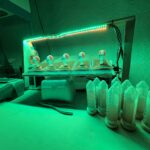
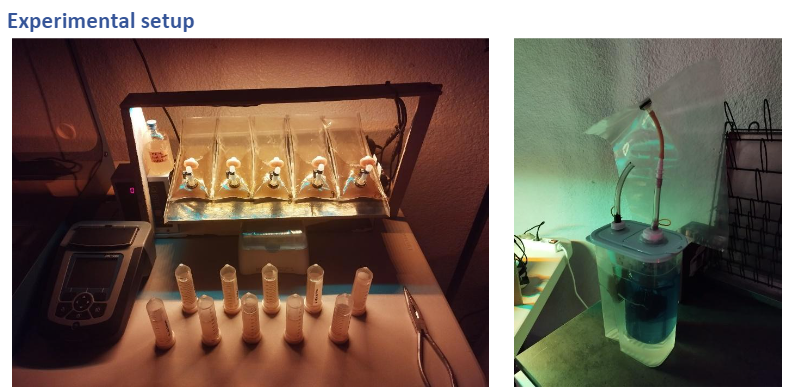
Figure 1: Cultivation chamber & electrolyser. Five bag bioreactors were inoculated with purple bacterium Rhodopseudomonas palustris TIE-1. The carbon source used is baking soda, and the electron source is hydrogen produced via electrolysis. The bags are constantly agitated by a rocking platform, which helps solubilize the gas phase within the freshwater media. Green (525nm), Orange (592nm) and infrared (850nm) LED strips are used to supply photons to the anoxygenic photosynthesis pigments.

Methods
In the science dome, the 5 bags inoculated with purple bacteria Rhodopseudomonas palustris TIE-1 are continuing their growth steadily. Turbidity (optical density), measured by spectrophotometry, increased in all photobioreactors, indicating nominal conditions. One sample is taken each 24h for each bag, centrifugated, and the supernatant is separated from the pelleted bacteria, then stored at -20°C. H2 is produced using water electrolysis (300 g of NaOH in 3 L of H2O were used). H2 is supplied ad libitum daily, since the expected consumption of H2 cannot be estimated easily.
Results
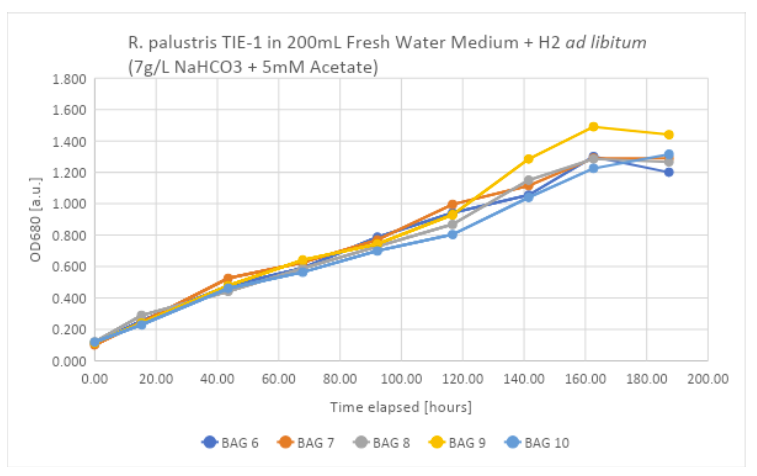
Here is a graph showing the evolution of OD (measured at 680nm) for all 5 bioreactors.

Figure 2: OD measurements between SOL 3 and 5. Growth is visible and follows known trends. Similar experiments will then be performed at the University of Mons to check the results that were obtained.

On day 9 of the experiment, the bacteria finally showed a stationary phase, indicating that the growth of the bacteria reached its peak. Final ODs oscillate around 1.2 and 1.4, with bag n°9 showing higher growth than the others. This could be due to better lighting, better agitation, or errors in measuring the OD and contamination.

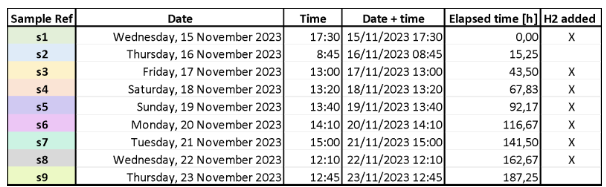
Table 1: Low-cost bag photobioreactors sampling schedule.

Operations Report – November 20th

Crew 286 Operations Report 20-11-2023

SOL: 8

Name of person filing report: Donald "Duckie" Jacques

Non-nominal systems: Toilet Room door knob

Notes on non-nominal systems: It is becoming increasingly difficult to open the door. Upon inspection, I noted deep grooves in the actuator shaft for the latch, indicating the assembly is approaching end-of-life. The handle is still barely functional, however, sometimes it takes multiple attempts to open the door for exit.

ROVERS

Spirit rover used: No

Hours: (before EVA)

Beginning charge: (Before EVA)

Ending charge: (On return from EVA, before recharging)

Currently charging: Yes

Opportunity rover used: No

Hours:

Beginning charge:

Ending charge:

Currently charging: Yes

Curiosity rover used: No

Hours:

Beginning charge:

Ending charge:

Currently charging: Yes

Perseverance rover used: No

Hours:

Beginning charge:

Ending charge:

Currently charging: Yes

General notes on rovers:

Summary of Hab operations: put notes here

WATER USE: 13.07 gallons

Water (static tank): 223.250 gallons

Static tank pipe heater (on or off): On

Static tank heater (On or off): On

Toilet tank emptied: Yes, in early morning

Summary of internet: Nominal

Summary of suits and radios: Nominal, all charging. One internal zipper tag was clipped, and we found it greatly improved zipper operation. I will apply tag removal to remaining suits tomorrow.

Summary of GreenHab operations: Crops watered at 5pm, Timer for supplemental lighting was prepared to operate from 6-7 pm. At time of report preparation, lights had come on.

WATER USE: 3 gallons

Heater: On

Supplemental light: On

Harvest: None

Summary of Science Dome operations: Guillaume has been harvesting Spirulina this afternoon, and working with Roger on molds. This afternoon Roger set the molds in the oven for drying.

Dual split: Heat or AC, Of

Summary of RAM operations: (Tools used, work done) The RAM was used as a large airlock for this morning’s EVA to great success. EVA team donned radios and suits in the downstairs of the Hab, where we completed radio checks. They then carried their helmets to the RAM. We mounted their helmets, and the team was prepared for departure. Team arrived at end of EVA with a few minutes to spare, and after re-pressurization, removed their helmets, and returned to the Hab to stow the gear.

Summary of any observatory issues: Nothing to report

Summary of health and safety issues: Immediately after entering the airlock, Liz began experiencing severe shoulder pain. The team reacted quickly to release her suit pack straps and support its weight temporarily relieving her immediate issue. Following depressurization, Liz was extricated from her helmet, and encouraged to return to the Hab and treat her muscle pain. When the remainder of the team returned, we found her somewhat recovered, and in much better spirits.

Questions, concerns and requests to Mission Support:

Liz reported that while the adjustment of the lower strap on her suit did provide a noticeable improvement in the muscles of the lower back, clearly additional work will be needed to realize relief for the shoulder area as well for individuals sharing her stature.