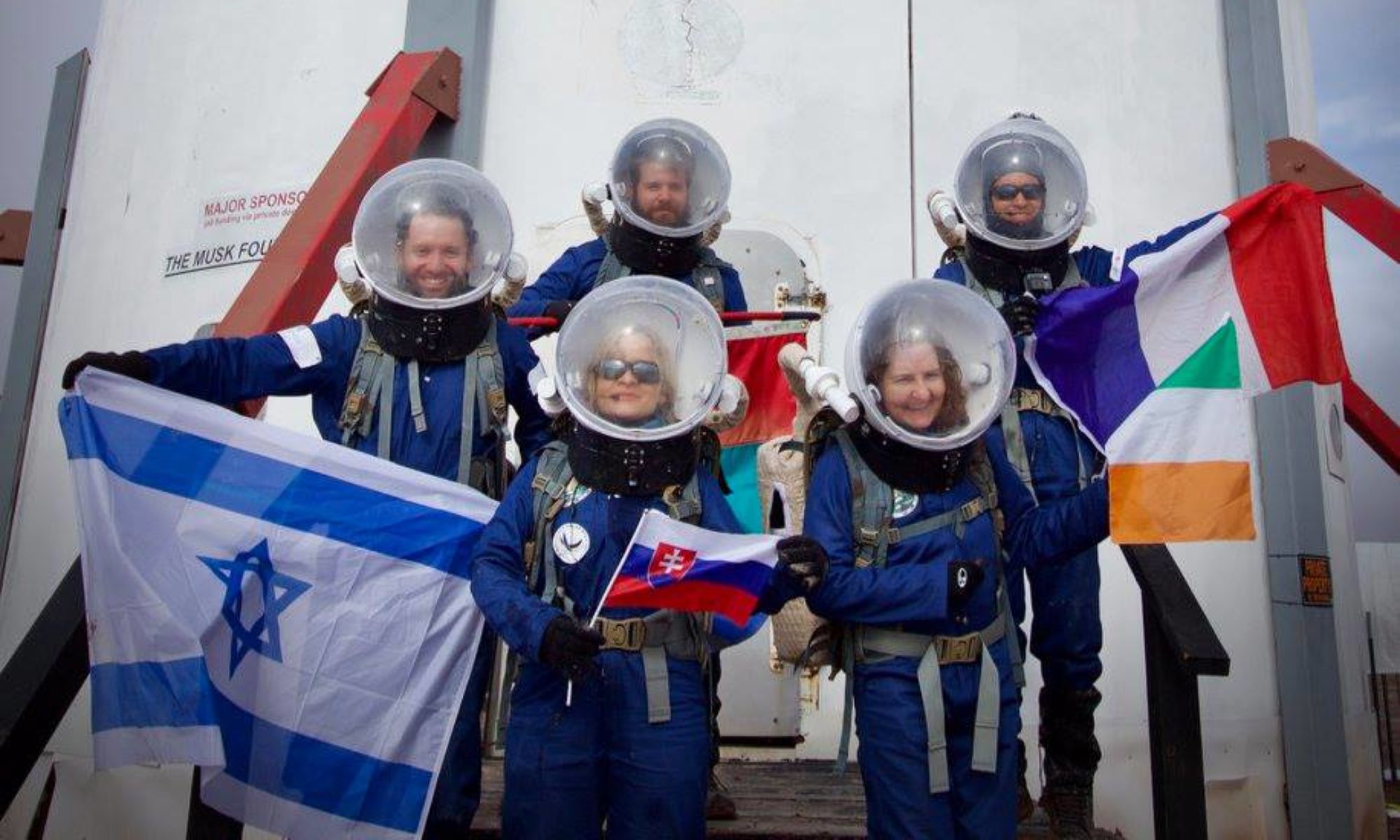

Mission Plan – February 5th

HxsvyISDyP97FuXhQ67h4cWh-8PGKTq93I0GekK2OwbC78Yac6xMpk0hWMV9HInqMQcb9tFHM3kWphlplBK2d9M4V-L2brhDyDWMfQHhNbu9r7aXZQyCCZLXx9Lil2Gos-1pNUCpMOUV-OLoX4M3TQ
MANGALYATRI Mission Plan
Mars Desert Research Station
Crew 292, February 4-17, 2024

Crew 292 Mangalyatri comprises of:

Bharti Sharma- Science lead and Crew Geologist.
Daniel Loy- Crew Biologist and Health and Safety Officer.
Clare Fletcher- Geoconservationist and Crew Journalist.
Mehnaz Jabeen- Geoinformatics specialist and Green Hab Officer
Rajvi Patel- Crew Engineer
Aditya Krishna Karigiri Madhusudhan- XO and Crew Astronomer.
Annalea Beattie- Artist in Residence and Crew Commander.

Outreach and on-the-ground crew:
Sakshi Sharma in Jaipur, India and Ilankuzhali Elavarasan in Texas, USA.

External Directors:
Dr. Jen Blank
Dr. Siddharth Pandey
Dr. Anushree Srivastava

Mangalyatri means ‘Mars Expeditioners’ or ‘Mars Crew’ in Hindi. Mangalyatri Crew 292 to the Mars Desert Research Station has a team mission focus on learning as much as we can about Mars analogues from the largest and longest running analogue research station in the world, with the aim of building a science desert research station in Ladakh. In other words, this mostly Indian national crew has a mission focus on what we can learn from one analogue station to build another.

Mangalyatri is fielded by Mars Society Australia. MSA has a long history of sending crews to the Mars Desert Research Station and we would like to build own station at Arkaroola one day with the support of the U.S Mars Society. In the last decade we have also worked with institutions in India such as the Centre of Excellence in Astrobiology, Amity University, Mumbai, Birbal Sahni Institute of Palaeobotany, Lucknow and more, at Mars analogue sites in India. We have fielded expeditions to sites like Lonar which is a basalt crater similar to that of Jezero, to one of the biggest salt deserts in the world, the Great Raan of Katchchh, and in the past few years we have jointly organised three consecutive expeditions to the high glacial deserts of Ladakh with the team from Amity University’s Centre of Excellence in Astrobiology.

In Utah our interdisciplinary MSA Crew 292 will consider the implications of what it means to live and work in simulation in a Mars-like environment, in a vast and ancient desert that is an actual geological Martian analogue. At the same time, overall, our team goals focus on what we can learn from the systems, science and science operations in Utah to apply this knowledge to future work in Ladakh.

Geologist Bharti Sharma is our Science lead and her mission is to study the geological and geomorphological features of Utah, intricately linking them with the terrain of Ladakh and Mars. Equipped with field analysis and remote sensing techniques, her primary goal remains the comprehensive understanding of terrestrial analogue sites, thus bridging the gap between Mars and Earth geology.

As our Crew Biologist, Daniel Loy’s project will focus on recovering and extracting DNA from halophiles and other extremophiles to investigate the functional and taxonomic diversity of salt deposits and other gathered samples. Importantly, Daniel will also develop, modify and employ field-appropriate cultivation-independent techniques to provide a baseline of fundamental cultivation dependant (isolations) and cultivation independent techniques (DNA extraction and PCR) that are achievable under analogue mission parameters. This will inform a methodological framework for training, and protocols that could then be carried out by non-biologists for future crews⎯at the MDRS, at the Ladakh research station site in the Himalayas or other locations. Daniel is also our Health and Safety Officer.

Clare Fletcher’s PhD focuses on exogeoconservation of Mars – understanding important geological sites and features, particularly potential evidence of life and palaeoenvironments, and how we can best protect them while allowing continued exploration of Mars. Clare is participating in both MSA Crew 291 Expedition Boomerang 3 and Crew 292 Mangalyatri. The key outcome of Clare’s time at the MDRS will be to create a method to determine in situ what astrobiological features need to be protected and how to best do that. The purpose of the study is to come up with a way for astronauts and mission teams to effectively consider exogeoconservation as they explore and sample, without necessitating extensive reconnaissance for every location or outcrop. In Crew 292 Mangalyatri Clare will also undertake the role of Crew Journalist.

As the designated crew astronomer, astrophysicist Aditya Krishna Karigiri Madhusudhan’s central objective is to formulate comprehensive plans and effective strategies for the construction of an observatory in preparation for the upcoming analogue station in India. In addition to this, his secondary objective is to make use of the MDRS Musk observatory to capture and analyse potential solar events which in turn will provide a deeper understanding of solar phenomena and its implications for space travel and exploration. Aditya is second in command and XO for this crew.

Rajvi Patel is our Crew Engineer. Her role is to keep all our general and particular systems in the hab, and the equipment inside and out, running and safe. Her duties will include providing daily status reports for each piece of equipment. In addition to these responsibilities, she will conduct research that primarily focuses on understanding propellant production utilizing water-bearing minerals at the Mars Desert Research Station (MDRS), Utah. Utilizing such propellants could decrease the cost of interplanetary travel and prove to be an additional source of propellant for the space exploration crew.

An active member of the Ladakh Science Foundation and a Geoinformatics professional, Mehnaz Jabeen is experienced in applying geospatial technologies to solve real world challenges in environmental, social and economic domains by acquisition of data, exploring, visualizing and analyzing various spatial data. In Utah she will take on the role of Green Hab Officer. Her own interest is how we might combine traditional nomadic knowledge to establish a greenhouse at our research station in Ladakh where natural vegetation grows and survives in winters when temperatures drop to minus 20 degrees. In Utah Mehnaz will explore the spatial and temporal variations of temperature, humidity and soil moisture to identify critical thermo-hydrological thresholds in the Green Hab, those that influence evapotranspiration dynamics. She will collect data and calculate actual and potential evapotranspiration through established equations, applying the Budyko curve to decipher the ecosystems response to altered temperature and humidity regimes. The outcome of her research will not only contribute to our fundamental understanding of controlled ecosystem dynamics but will also provide precise insights into optimizing temperature and humidity parameters for enhanced plant growth and resource management in artificial habitats, especially in Ladakh (India) with extreme climate conditions and Mars like terrain.
Dr. Annalea Beattie is Crew Commander and artist for Mangalyatri 292. Annalea’s own art-based research will focus on environmental stewardship, exploring a politics of care through dialogue, reflection and making art. Through co-creation, art making will address the nuances and complexities of what constitutes a frontier environment, looking closely at concepts of ‘wilderness’ and ‘free’ space. The crew of Mangalyatri will be given their own art materials and sketchbooks. They will be invited to think laterally, to search for alternative knowledge through drawing and writing as they begin to recognise something of their own unique position in the vast landscape of the desert. This project aims to broaden understanding of how we imprint onto worlds that are not our own. Our team will be encouraged to develop an ethics of reciprocal responsibility, one that can be translated to elsewhere⎯to Ladakh⎯and when we travel off-Earth to Mars.
In terms of outreach to India, during the second week of our rotation our crew will join online with Amity University’s Centre of Excellence in Astrobiology Mumbai, in conversation with the very first cohort of postgraduate astrobiology students in India. For this live event we will be joined by members of Women in Space South Asia, an organisation which emerged from our Ladakhi expeditions in 2021and is supported by Mars Society Australia. Three of our crew are founding members of Women in Space South Asia including Sakshi Sharma who is our outreach person on the ground in India. With our partners in India, our team goal is to learn as much as we can from our experiences in Utah and apply that knowledge in Ladakh – to ensure the significance of astrobiological and analogue research studies, especially in relation to Mars.

Sol Summary – February 2nd

Sol: 12
Summary Title: The return to Earth
Author’s name: Andrew Wheeler
Mission Status: Nominal
Sol Activity Summary: Overcast with rain showers clearing. No outside activities and so the time was spent finalising reports, archiving data and culling samples to be returned to their points of origin. One final series of analyses was carried out with the carbonate (CO3) concretions to determine whether the particles or the matrix are the CO3 material. Having crushed and sieved the material down to -63 microns, the relative levels of effervescence suggests that the matrix is the source of the CO3 that released CO2 in the presence of vinegar. Mind you n=2. When these analyses were completed, there was no more to be done. After lunch, our simulation was completed at 2:00pm local and we were on our way home to Earth.
Look Ahead Plan: Cleaning, tidying and packing for departure from MDRS and arrival home.
Anomalies in work: Nothing to report.
Weather: Overnight rain of 3.0 mm with temperatures ranging from 5C to 13C. Winds were light to variable.
Crew Physical Status: Nominal.
EVA: No EVAs for this morning.
Reports to be filed: Sol Summary, Journalist’s Report, Greenhab Report, Operations Report, Crew 291 Mission Summary.
Support Requested: Nothing to request.

Operations Report – February 2nd

SOL: 12
Name of person filing report: Scott Dorrington
Non-nominal systems: None
Notes on non-nominal systems: None
ROVERS
Spirit rover used: Not used
Opportunity rover used: Not used
Curiosity rover used: Not used
Perseverance rover used: Not used
General notes on rovers:
Summary of Hab operations: put notes here
WATER USE: ??? gallons (water tank filled prior to measurement)
Water (static tank): 360.5 gallons (depth 14.5”)
Static tank pipe heater (on or off): On
Static tank heater (On or off): On
Toilet tank emptied: no
Summary of internet: Nominal during comms window
Summary of suits and radios:
Summary of GreenHab operations:
WATER USE: 7 gallons
Heater: On
Supplemental light: 10pm – 2am
Harvest: 5x Tomatoes (36g), 3x peas (9g), 1x cucumber (24g)
Summary of ScienceDome operations: ScienceDome used to test rock for carbonates using vinegar.
Dual split: Nominal
Summary of RAM operations: Tools put away.
Summary of any observatory issues: None
Summary of health and safety issues: None
Questions, concerns and requests to Mission Support:
None.
Thank you for your support!

Mission Summary – February 2nd

Crew Members:
Commander: Andrew Wheeler
Health and Safety Officer: Steve Hobbs
Crew Scientist: Clare Fletcher
Crew Engineer and Green Hab Officer: Scott Dorrington
Crew Astronomer and Medical support: Rob Hunt
Crew Journalist: Alexander Tobal

Mission Plan:
Expedition Boomerang III saw an all Australian crew from the Mars Society Australia (MSA) bring a multidisciplinary team to MDRS to undertake our investigations. The mission objectives were divided into eight disciplines. In no particular order of importance they were: a) revisit geologically relevant analogue locations that can be shown to be appropriate to ISRU on Mars, b) deploy sensors to monitor the local environment including basic weather data, c) characterize mineralogy using a push broom VIS/NIR spectrometer, d) test the ability of a remote controlled rover to deliver the spectrometer over a variety of sloping ground and roughness, e) locating known prominent features for navigation purposes using trigonometry and dead reckoning rather than GPS and compass, f) revisit previously documented geological features for weathering and degradation with a view to develop strategies for geoheritage preservation, g) evaluate the set out of the MDRS and developed procedures with a view to inform the deployment of MSA’s Mars-Oz habitat in Australia and h) observe the current disposition of the Sun’s surface utilising the solar observatory.

Mission Activities:
The geology at the MDRS has been mapped at large scale by many crews over the years. EVAs were undertaken to revisit sites that have exposed minerals analogous to the minerals appropriate to ISRU on Mars. The two majority targeted minerals were gypsum and carbonate concretions. These locations were GPS located and saved to a format that can be transferred to multiple GIS software packages and used by following crews. Samples were collected and processed in the science dome to demonstrate usefulness. Secondary targets such as fossil beds and petrified wood (signs of preserved life) were also GPS-located when identified. Concurrent with these EVAs, the spectrometer was deployed both as a handheld tool and delivered by a remote controlled rover to the various sandstone, silstone and mudstone lithologies surrounding the MDRS. Samples were collected and returned to the MDRS for more controlled analysis and compared to the field data. Approximately 5GB of data was collected and continues to undergo processing.
Again, in parallel with these EVAs, angles and distances to prominent features were collected and positioned on a localised global map and tested for conformity to GPS positioning and compass bearings. Accuracy of positioning improved from approximately 100m to 40m but the majority of processing will be conducted away from the MDRS.
Two sensors were meant to be deployed at the beginning of the rotation and re-deployed at greater distance from the MDRS after an undefined number of days. One, a solar logger previously deployed during the FMARS15 mission in July/August 2023, was successfully positioned outside the science dome in view of the panoramic window. The battery needed recharging on four occasions. The second sensor, an electronic Stevenson Screen with multiple environmental sensors, was unable to be initiated due to circuitry burnout in the secondary battery pack and an untraced, electrical fault in the primary battery pack and was only ever deployed as a test of the setting up procedure rather than to collect weather data.
In 2005 and 2006, geomorphological features such as yardangs and mudstone and siltstone outcrops were located and photographed for follow-on studies. These were revisited, measured and re-photographed in an effort to determine degradation over the prior 18 years. How much is due to natural weathering and how much to human interaction is not obvious at MDRS but the data will be informative to a geoheritage conservation strategy.
Procedures for EVAs, communications, moving between elements of the habitat, conserving water, stocking the pantry and design of the habitat and its elements were continuously evaluated inside and outside the habitat during this rotation to inform the design of the proposed Mars-Oz.
Finally, due to the weather and issues with the software, the solar observations were severely curtailed. Though a short lived prominence was observed, only a solar limb with sunspot activity was imaged for processing.
aUeMPtAru6BpXDqpmvOYmOssBimNcdXsVjjz7hjjvS6n43S6LXjHucWpKpJXglIiLc3P-pgXRab_ElyYo1FRty1Fx6MK3lvFqgfN7bK0ydOtnPP2PUcTAzWbumBQNInRSMP8vcWWDYub8X_ODwq9MQ
42Rek75Q2Yr1ePrgPj9Evtl71qNUEZDR3Zu7oijZVGA2sNMRosnHJqHCAxicwW8VZJ5NSRjL8hdHSMkPVU-VqBukDmZU9Ee7MIrh_W6nrqoCsYTAPRHrlFCoxc31UQ_PG4aHPsmJMMd0-MdxQ5-x8A
aaQzOW3KNAk4Crt3Y9JwDEEvbtE2HNm8UzFrbRUMOsLnUMO365OVxANyNiJxZZZ8Z69JEVFdCvJEzef6MOLcM7Eko1W88-KR0g3Y3V3RNM-hzqA1qpfiuBwjwnYcGywYM5FJr3SrtKsHIU1Iw6tcuA
YrMulUxDzB4rPKSNM66ktED4N-LMRJ8mA-fRFVtgQHdF6aJWDOLFd-dXUEvsJkmOWxAk1Q99eyzS9AK5hZdx8pLA3J7kQYpWKzW4YEw8DlXlpzE_J3cRgJ6kSz7XF248mIbpyWXgm7jW9yHNgFqd2w
_zBl8jGaZQ54c8ypg6NzswX-DNo6muJ1xsMBsdV1PJuOnKAGqHrWn6IHrt-39UEflt7twAuHLwny490833k8o8bTOBrVOeG4VOlOX6kgQze6r4VVtxXVPf-lcDV2rjWzkk96gwDG3bapZ2zBrxoIwg
7UU4drDZesZ4-fXo5aVMRihOvxssDKDFDHXCz_FSAk6uS1K-Rpth_CbUGMH8DX0kF7aOBs1rE-4_pKWKrjQG2Z_km2Z3ThRmEHHoyfh3oGdrhiY8kKmu8U6hyOGyCZ5TLmSjVZaBRcN8GsXh-v4iNw

Journalist Report – February 2nd

The Sun Sets on Mars
Well this is it. We’ve now passed the end of sim. Theoretically we could all sprint out of the airlock without suits and frolic across the hillsides, but Commandrew’s advised us that the bentonite clay outside is too waterlogged and swollen for that. Or maybe he just wants to preserve our remaining dignity.
It’s been a bit of a strange (but satisfying) day. With no EVAs on the scope, members of the crew spent their last morning as proper Martians finishing off experiments in the science dome (like testing the reactivity of powdered concretion), doing some preliminary cleaning, or just chilling/warming in the kitchen. We had some good convos and laughs around the table, as always, discussing everything from Hawking radiation and space elevators to sunsets, duck feet and TV shows. The Greenhab decided to bequeath us some parting gifts: five tomatoes, three peas and a cucumber. A few of us also trudged through the mud to get some picturesque photos of the landscape, and when it got dark, did some stargazing under the northern hemisphere sky.
I think this is the point where I give a formal shout out to the fine folks of Crew 291, who are genuinely all fun, easygoing, considerate people. Maybe we’re all steadily succumbing to cabin fever… but there have been so many hysterical moments between us, and we’ve become fast friends in a very short span of time. Everyone brings something interesting to the table. Everyone pulls their weight. We’ve succeeded and failed as a team. Somehow, there’s been no bad blood whatsoever between us… which I didn’t expect, being thrown into a living situation with five other strangers (and one toilet between us). These people are passionate about – and very skilled at – what they do, and it’s been inspiring to document them fulfilling their professional and personal goals at the MDRS.
What have I learned from this experience? There’s the obvious stuff, about how a habitat is run and the kind of day-to-day tasks that life on Mars might one day entail. Then there are the less obvious things. The geology lessons, realising the unseen ways (and innate beauty) with which the landscapes around us tell their ancient stories – from the mightiest chasms to the most mundane pebbles underfoot. Or how profoundly the simplest things, like food, can uplift crew culture, morale and cohesion. The way a great crew can make the challenges trivial.
So there you have it. Our last report from the MDRS. Tomorrow we leave the MDRS and journey all the way back to Australia. I’d like to thank everyone who got involved in this expedition, including the directors of Mars Society Australia. While we’re all looking forward to returning home (more than ready to see some Terran green and blue), I think I speak for all of us in saying that this has been an unforgettable experience that will stay front-of-mind for a very long time. It’s not every day you get to be Martian.
And thanks to you, readers, for following and supporting us. If you’d like to reach out to the crew about our activities and experiences at the MDRS, please contact Mars Society Australia.
Farewell from Andrew Wheeler (Commandrew), Steve Hobbs, Rob Hunt, Clare Fletcher, Scott Dorrington, and Alexander Tobal!
Highlights of the day: Steve’s landscape photography (reportedly “the best sunset he’s seen in thirty years, in either hemisphere”), pasta, send-off harvest, stargazing, Clare is a LotR/fantasy fan (finally, something to get her out of the lowlights), Commandrew "doesn’t think any of us need putting down".
Lowlights of the day: Rob used buttermilk again as a milk substitute (in fruit porridge), Steve’s clay-caked boots, Clare "didn’t have any thoughts today" (ah well, back into the lowlights), crew got rained on through the ‘tornado-proof’ hab roof, more extraterrestrials checking us out.

– Alexander Tobal, Crew 291

GreenHab Report – February 2nd

GreenHab Officer: Scott Dorrington
Environmental control: heater on automatic
Average temperatures:
10:05: 75.6 F, 50%
10:30: 75.9 F, 50%
12:18: 76.6 F, 42%
14:48: 75.6 F, 36%
16:19: 67.5 F, 42%
18:03: 71.4 F, 41%
19:39: 71.6 F, 36%
Hours of supplemental light: 4 hours overnight
Daily water usage for crops: 7 gallons
Daily water usage for research and/or other purposes: 0 gallons
Water in Blue Tank (200 gallon capacity): 86 gallons
Time(s) of watering for crops: 10:05 water, 14:48 water, 19:40 mist
Changes to crops: None
Narrative:
We’ve reached the last sol. Today was another overcast day, with some rain about, so lots of humidity in the outside air. There were also puddles of water and mud in the walkway, so I wanted to minimize the number of trips I did back and forth to the GreenHab today. Luckily, from yestersol’s readings, I expected that the temperature would remain relatively stable throughout the day. In the morning, I found the moisture meter was showing the tomato plants getting towards the dry scale, so decided to give them a big watering early in the day. This brought the moisture levels back up to nicely moist. I also took down the shade cloth in the morning to give the plants some extra sun during this cloudy day. We officially ended our sim at 2pm today, however I still made trips back and forth to check in on the plants, and giving them a top up of an additional gallon and a misting in the afternoon. As a send off treat for crew 291, we harvested the 3 red tomatoes from tomato #9 that I have been eying off for the past few sols and an additional two smaller tomatoes from tomato #3. Tomato #6 has a nice bunch of yellow tomatoes that should be ripe for crew 292. There was some debate also about harvesting the growing cucumber. Some googling of cucumber harvesting suggested to pick them slightly immature as they become bitter as they turn yellow, and that delayed harvesting reduces the quality of the produce. The current fruit looked to be similar to the reference photo of a ready-to-pick cucumber (though a little smaller – but then this cuke is growing in a pot and not a vineyard). So, the decision was made to harvest the cuke to enjoy with the tomatoes as part of our send off. We are very thankful to the GreenHab officer from Crew 290 for taking such good care of the cukes through their troubling times with the heater issues. We topped off our last harvest with three peas from the vines.
Throughout this mission, the GreenHab has been a welcome escape from the Hab. I feel the greenery has had a noticeably positive influence on the mood of the crew, who have brightened up with each new tomato, cucumber or pea that emerged. I think in a real Mars mission, I would be spending a lot of time in the GreenHab.
So long, and thanks for all the fruit!!!
– GreenHab Scott, Crew 291
Harvest: 5x Tomatoes (36g), 3x peas (9g), 1x cucumber (24g)
Support/supplies needed: None

Sol Summary – February 1st

Sol: 11
Summary Title: The penultimate day
Author’s name: Andrew Wheeler
Mission Status: Nominal
Sol Activity Summary: Overcast, above freezing and potential for rain greeted us this morning. A complete contrast to the previous day. Two EVAs were planned to extend previous knowledge at Candor Chasma and White Moon. Prior to that, however, at 9:00am, we observed a minute silence in memoriam for the crew of Columbia on the 21st anniversary of their loss. Whilst the EVA team was away to Candor Chasma, concretion samples were processed and sorted for analysis. Lunch was the other half of the Hunza pie and very welcome indeed. The afternoon EVA to White Moon never got close due to the cold conditions. The turn around point for the rovers ended at a previous visited site past Cowboy Corner and so we expanded our investigations here. By good fortune, we were able to identify another concretion layer in the strata and located endoliths in a new setting. The EVA was wrapped up a little early as the distant snow capped mountains started disappearing behind misty cloud. Minutes after return, a sprinkling of rain pattered the roof. Burgers and chips were our last meal in simulation in the hab.
Look Ahead Plan: Tidying up the accrued data and the last analyses before leaving sim.
Anomalies in work: Nothing to report.
Weather: Overcast and warm under the clouds at 1C and 60% humidity. Temperature only rose to the low teens throughout the day. Snow appeared to be coating the distant mountains but only a sprinkling of rain was encountered at MDRS. The wind was faint to gentle during the day.
Crew Physical Status: Nominal.
EVA: EVA 19 with Steve, Scott and Alex to Candor Chasma. EVA 20 with Clare. Andrew and Rob to Cowboy Corner.
Reports to be filed: Sol Summary, Journalist’s Report, Greenhab Report, Operations Report, EVA report, EVA Request(s), Astronomer’s report (not needed)..
Support Requested: Nothing to request.

Operations Report – February 1st

SOL: 11
Name of person filing report: Scott Dorrington
Non-nominal systems: None
Notes on non-nominal systems: None
ROVERS EVA 19
Spirit rover used:
Hours: 244.9
Beginning charge: 100%
Ending charge: 18%
Currently charging: No
Opportunity rover used:
Hours: 159.5
Beginning charge: 10%
Ending charge: 39%
Currently charging: No
ROVERS EVA 20
Curiosity rover used:
Hours: 283.1
Beginning charge: 100%
Ending charge: 41%
Currently charging: No
Perseverance rover used:
Hours: 283.1
Beginning charge: 97%
Ending charge: 36%
Currently charging: No
General notes on rovers:
Spirit got very low upon return. Battery light on dash was flashing. Hypothesis: Spirit is shaded from the morning sun by the Science Dome, so may start colder in the morning than the other rovers, leading to inferior battery performance.
Summary of Hab operations:
WATER USE: 19.65 gallons
Water (static tank): 203.6 gallons (depth 26.5”)
Static tank pipe heater (on or off): On
Static tank heater (On or off): On
Toilet tank emptied: yes
Summary of internet: Nominal during comms window
Summary of suits and radios:
Suit #8: Retrieved bolts + nuts left in Hab for suit #8. Tried to fit into charging port, but slightly too big to fit. Located M3 screws + nuts + washers in RAM. Charging port is now secured. Spare screws returned to RAM.
Suit #11: Battery terminal reapplied. Confirm fan runs?
. Back re-screwed in. Screws do not go all the way in, sticking out about 0.5 cm. Left on rack but not charging (only 4 chargers for one-piece suits).
Comms kit #1 radio harness – the Velcro is coming lose. May need to be re-sowed on.
Summary of GreenHab operations:
WATER USE: 6 gallons
Heater: On
Supplemental light: 10pm – 2am
Harvest: None
Summary of ScienceDome operations: Not used
Dual split: Nominal
Summary of RAM operations: Entered to retrieve new weather monitor and screws for suit 8
Summary of any observatory issues: Not used
Summary of health and safety issues: Changed bandages on crew member’s head (reported in yesterday’s report).
Questions, concerns and requests to Mission Support: None