Sol Summary – February 21st

Crew 293 Sol Summary Report 21-02-2024

Sol: 3

Summary Title: Story of an EVA

Author’s name: Marie Delaroche, Crew Commander

Mission Status: Nominal

Sol Activity Summary:

On this third Sol of our mission, our first high-stakes EVA rested on the shoulders of the designated crew, composed of Erin, Léa and Leo. Their task was to set up the main atmospheric instruments : MegaAres and LOAC, which they performed beautifully. Communications between the EVA Leader and HabCom were clear and efficient, procedures were executed efficiently, and all tests of the instruments’ correct function have been validated. The EVA Crew enjoyed a well-deserved rest period after lunch !

In the afternoon, all Crew members continued implementing their experiments: the location tracking system was tested by the Crew HSO, and the Crew Engineer and GreenHab Officer finished deploying all environmental sensors. Part of AI4U experiment (testing of an AI assistant designed for astronauts) is also deployed, allowing crewmembers to request information about the station to the AI.

Léa and I also performed the AMI (Anomaly Monitoring Interface) preliminary tests. This interface, designed by Quentin Royer, former Crew Engineer at MDRS, will be used to simulate basic operations for a space station (resource management, power management, etc.) and trigger simulated anomalies requiring action from the Crew.

Look Ahead Plan:

Tomorrow (Sol 4), the Crew is aiming to perform a second EVA to deploy the rest of the atmospheric instruments (a Field Mill and a weather station). All Crew members will also be trained on the AMI interface, and the EchoFinder sessions are to continue regularly in the coming weeks.

Anomalies in work: Solar observatory offline

Weather: Mostly cloudy in the morning, moderate winds. Low 5°C, High 15°C

Crew Physical Status: Nominal

EVA: EVA #3; deployment of atmospheric instruments (MegaAres and LOAC)

Reports to be filed: Sol Summary, Journalist’s Report, GreenHab Report, Operations Report, Photos (6-8 pics), EVA Report, EVA Request

Support Requested: NA

GreenHab Report – February 20th

Crew 293 GreenHab Report 20-02-2024

GreenHab Officer: Mathurin FRANCK

Environmental control: (heater, fan, door open?) Heater turning on automatically

Average temperatures: 75F 9:00am

Hours of supplemental light: 22h-2h

Daily water usage for crops: 9G

Daily water usage for research and/or other purposes: 0.1G

Water in Blue Tank (200 gallon capacity): 180.9 gallons

Time(s) of watering for crops: 9:00am 6:20pm

Changes to crops: None

Narrative:

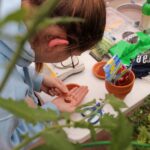
We began the SEEDS OF MARS experiment with Erin. This project represents an educational experiment designed for school children. The objective is to engage two classes in our mission, fostering awareness of space exploration and cultivating their scientific processes. Their task is to experiment with the scientific premise of the movie "The Martian," specifically the cultivation of potatoes in Martian soil. The experiment will involve a test group planted in analog Mars soil and a control group (in potting soil), both cultivated under precisely identical conditions (water, luminosity…). Today, we planted cress in two different pots following the school children protocol. We setup an environmental sensor (temperature, humidity, luminosity) to monitor, we also setup a phone to take a time-lapse during the entire mission.

Harvest: (include which crop and mass in grams) : 333g of tomatoes

Support/supplies needed: None

Operations Report – February 21st

Crew 293 Operations Report 21-02-2024

SOL:2

Name of person filing report: Leo Tokaryev

Non-nominal systems:None

Notes on non-nominal systems: None

ROVERS

Spirit rover used: No

Hours: (before EVA)

Beginning charge: (Before EVA)

Ending charge: (On return from EVA, before recharging)

Currently charging:

Opportunity rover used: No

Hours:

Beginning charge:

Ending charge:

Currently charging:

Curiosity rover used: Non

Hours:

Beginning charge:

Ending charge:

Currently charging:

Perseverance rover used: No

Hours:

Beginning charge:

Ending charge:

Currently charging:

General notes on rovers:none

Summary of Hab operations: put notes here

WATER USE: 5.5 gallons

Water (static tank): 421.3 gallons

Static tank pipe heater (on or off): ON

Static tank heater (On or off): ON

Toilet tank emptied: no

Summary of internet:

Summary of suits and radios:

Summary of GreenHab operations: put notes here

WATER USE: 9.1 gallons

Heater: On

Supplemental light: 10pm-2am

Harvest: 333g tomatoes

Summary of ScienceDome operations: None

Dual split: Heat or AC, On

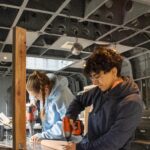
Summary of RAM operations: (Tools used, work done): same as yesterday : Used drill, diverse tools(hammer, screwdrivers, etc.), used a few screws.

Summary of any observatory issues: none

Summary of health and safety issues: none

Questions, concerns and requests to Mission Support:

We have a question about the power supply of the station: we have 1 laptop that is supposed to be on 24/7 for important measures. The issue is that this laptop is the only one capable of doing it and unfortunately it has serious power issues: it shuts down as soon as it’s not plugged in. Yesterday when the power supply of the station was switched from solar panels to generator, everything shut down and we had to restart everything. Do you think it is possible to change the way of switching power so it doesn’t turn off the electricity of the entire station? Maybe you could leave the lower deck powered but not the rest of the station while switching the power source?

GreenHab Report – February 23rd

Crew 293 GreenHab Report 23-02-2024

GreenHab Officer: Mathurin FRANCK

Environmental control: (heater, fan, door open?) Heater turning on automatically

Average temperatures: between 70°F- 90°F

Hours of supplemental light: 22h-2h

Daily water usage for crops: 6G

Daily water usage for research and/or other purposes: None

Water in Blue Tank (200 gallon capacity): 162.9 gallons –

Time(s) of watering for crops: 9:30am – 4:30pm

Changes to crops:

I seeded spinach on a free space

Narrative: /

Harvest: (include which crop and mass in grams) : 4g of basil

Support/supplies needed: None

Journalist Report – February 23rd

SOL 5: Science is our AMI*

“It’s the possibility of having a dream come true that makes life interesting.” -The Alchemist, Paulo Coelho

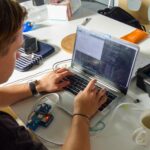
Today, we started to use the AMI software, Anomaly Monitoring Interface, which was developed by former MDRS SUPAERO Crew members. Thanks to that, we simulate the time used for technical management of the station. Indeed, in the International Space Station, astronauts are reserving half of their time on reparation and maintenance operations of different station’s systems. AMI enables us to reinforce our simulation, allocating time in our schedule to virtually manage our station in the Martian desert. How does it work? On the interface, we can virtually follow our energetic consumption in real time, activate systems in each module like scientific equipment, heat activation, … For example, if Yves goes to the Science Dome to turn an experiment on, we can switch them all in the software and AMI calculates our energetic consumption by lowering the battery level. Our purpose is to simulate our real energetic consumption, so we can optimize it. Energy is a precious resource on Mars (like on Earth!). Every station’s module is linked to the interface: the Hab, the place we live; the RAM, our repairing facility; the Science Dome where we perform experiments; the Observatory and the GreenHab. The software can alert the Crew if an anomaly occurs. They can be minor, and resolved quickly, or deteriorate emergencies such as module depressurization! Regarding simulation, this interface enables us to really dive into conditions closer as possible as the real space mission conditions. We want to ameliorate the software, pass it from Crew to Crew, and, at the end, correlate our reaction times to our physiological sensors ‘data.

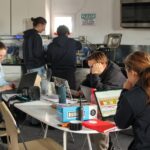
During lunch, Mathurin and Leo called us to eat after cooking an excellent meal for two hours. We all left our computers where, for some of us, we had been working all morning. Others came back from different modules. On the Upper Deck’s table, we installed the meal. We ate vegetable pancakes, cooked thanks to the MELiSSA activity, an ESA project, whose aim is to study how much time we need to prepare our meals with real vegetables! We’re aiming to prepare three MELiSSA meals per week. It was a pleasant time because we didn’t eat dehydrated food for once! After enjoying all our delicious pancakes, we continued working during the afternoon.

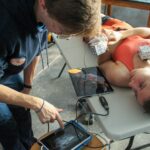
A lot of Crew members went to the Science Dome this afternoon! Indeed, we have a lot of our experiments set up there. Léa, Marie, Lise and Mathurin performed their first session of the Neuroergonomy experiment. They alternatively laid down on the ground or sat down in front of their computers. Mathurin worked on the settings of AI4U, an artificial intelligence designed to help astronauts in their everyday life. Finally, Marie was once again the patient for ultrasounds, due to the EchoFinder experiment. It might happen often during our mission: she’s the only subject of the experiment, and we all need to try the software various times on her!

*AMI means “friend” in French

Sol Summary – February 23rd

Crew 293 Sol Summary Report 23-02-2024

Sol: 5

Summary Title: Science is our AMI*

Author’s name: Marie Delaroche, Crew Commander

Mission Status: Nominal

Sol Activity Summary:

Today was a rather quiet Sol; most of the long-running experiments are starting to be a part of our routine, from cognitive tests to daily questionnaires. The Science Dome was put to good use this afternoon, housing EchoFinder, Orbital Architecture and the TILT experiment.

Tests were also conducted on all EVA suits to determine which are safe to use for future EVAs, as our EVAs dedicated to our photogrammetry study will be longer and take us farther away from the Hab.

The AMI interface was tested again this morning and presented to the Crew, who will be tasked with making suggestions for potential edits. The objective is to collect as much feedback as possible for the developers, to prepare the interface for the next crew, and to eventually correlate our reaction times to the data from the physiological sensors we wear at all times.

Look Ahead Plan:

During the previous atmospheric instruments EVA, there was an issue with the Field Mill, and measurements have not started. The instrument must be retrieved for repairs in the RAM, therefore it will be retrieved during an EVA scheduled on Sol 6.

Sol 7 has been declared a rest day, during which we will clean the Hab, treat ourselves to some pancakes, and have a longer sports session than our daily workout.

Next week, we will begin working on the Photogrammerty experiment at a first location (to be determined). The study will require 3 EVAs over the course of Week 2.

Anomalies in work: Suits 3, 4, 6 (see Operations Report for details)

Weather: Some clouds, low 5°C, high 20°C

Crew Physical Status: Nominal

EVA: None

Reports to be filed: Sol Summary, Journalist’s Report, GreenHab Report, Operations Report, Photos (6-8 pics)

Support Requested: NA

* "Ami" means friend in French

Operations Report – February 22nd

Crew 293 Operations Report 22-02-2024

SOL:4

Name of person filing report: Leo Tokaryev

Non-nominal systems: Suit n°2 and Suit n°6

Notes on non-nominal systems:

Suit n°2: one of two attachments that is supposed to hold the red circle that is holding the helmet is broken, we suppose that it broke during yesterday’s EVA.

Suit n°6: the suit has a serious problem with power. After 3 hours of EVA, the suit was on 9V, which made the ventilation system inefficient and caused a medical event right at the end of the EVA. The suit loses energy too fast, and still is too dangerous to use even though the battery was replaced by the previous crew.

ROVERS

Spirit rover used: No

Hours: (before EVA)

Beginning charge: (Before EVA)

Ending charge: (On return from EVA, before recharging)

Currently charging:

Opportunity rover used:Yes

Hours: 164.2

Beginning charge:100

Ending charge:72

Currently charging:Yes

Curiosity rover used: No

Hours:

Beginning charge:

Ending charge:

Currently charging:

Perseverance rover used:Yes

Hours:284.4

Beginning charge:95

Ending charge:61

Currently charging:Yes

General notes on rovers:

Summary of Hab operations: put notes here

WATER USE: 9.8 gallons

Water (static tank): 407.9 gallons

Static tank pipe heater (on or off):On

Static tank heater (On or off)On

Toilet tank emptied: yes

Summary of internet: none

Summary of suits and radios: The radios were functioning well.

Summary of GreenHab operations: put notes here

WATER USE: 6 gallons

Heater: On

Supplemental light: 22h-2h on automatic

Harvest: nothing

Summary of ScienceDome operations: put notes here

Dual split: Heat or AC, On

Summary of RAM operations: RAM wasn’t used today

Summary of any observatory issues: none

Summary of health and safety issues: see the HSO report about the medical event that was caused by the malfunction of one of the EVA suits.

Questions, concerns and requests to Mission Support:

1) We decided to test all the suits’ battery usage, we will inform you after we have our results. Our protocol is to put all the suits on maximum ventilation mode and take voltage and air flow measurements every 30 minutes to test their battery usage. We will conduct this testing for 4 hours since it is the maximum time of an EVA. I believe that previous tests that were made on suit N°6 were conducted only for one hour, that is why the problem wasn’t detected. We will send you the full results, but for the moment we already identified some problems in suits 4 and 6.

We had an issue with toilets today: the odors were too strong not only in the restroom, but in the whole lower deck and even in some rooms in the upper deck. We emptied the toilets hoping that it would solve the problem, but the sensor only indicated that the tank was 1/3 full. I don’t know what is the source of the problem: the ventilation, the toilets or the sensor that wasn’t indicating the right value.

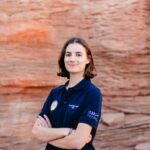
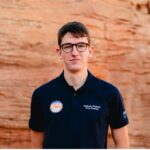
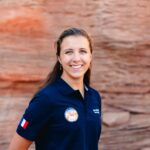
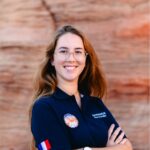
Crew 293 Crew biographies, photos and mission patch – 18Feb2024

[title Crew biographies, photos and mission patch – February 18th]

Yves Bejach

Yves Bejach joined ISAE Supaero to pursue his passion for space. With this in mind, and to get closer to the world of research, he joined the crew as Crew Scientist, responsible for ensuring that experiments run smoothly and protocols are respected. Together with his crew, he hopes to continue extending the scientific scope of the project, and to take advantage of this mission to popularize science.

Léa Bourgély

Léa Bourgély joined ISAE-Supaéro after completing a degree in physics in Paris, with a major in astrophysics. In line with her passion for astronomy and astrophysics, she has taken on the role of Astronomer for Crew 293. She will be in charge of the station’s two telescopes, and her astronomy project will involve studying Coronal Mass Ejections and sunspots, in order to assess their speed and direction.

Lise Lefauconnier

Lise Lefauconnier, a 2nd year student at ISAE and originally from Normandy, has long been interested in space exploration, and more particularly in the physiological impact of manned flight on human beings. This interest in the study of human reactions and behavior, her natural sensitivity and attentiveness to others, and her experience as a gymnast are what motivate her in her role: she will be a health and safety officer, in charge of the moral and physical well-being of the crew, through daily sports sessions in the station and moments of team-building.

Leo Tokaryev

A long-standing space enthusiast, Leo Tokaryev has joined crew 293 as a flight engineer to conduct experiments that will advance scientific research in space. During this mission, he will be responsible for keeping the station and its scientific instruments in good working order. Leo is particularly interested in space hardware test experiments, which will help develop tools for astronauts.

Marie Delaroche

Marie Delaroche is a student at ISAE Supaero. Having grown up in New York in a multicultural environment, she decided to return to France to study space engineering and manned flight. After a first mission at MDRS as Crew Journalist, she joined Crew 293 to serve as Commander, with the aim of continuing to extend the scientific and educational reach of Supaero’s MDRS project.
Her experience and kindness will be major assets to the success of crew 293’s mission in 2024!

Erin Pougheon

Erin Pougheon is a second-year student at ISAE-SUPAERO. Having heard about the MDRS project, she decided to join the school to study space and manned flight, a field she’s been passionate about since childhood. MDRS is an opportunity to realize her dream of contributing to space exploration efforts. An avid writer, she will be the crew’s journalist, reporting on the mission and sharing her experiences with the spacefaring community.

Mathurin Franck

After completing preparatory classes at the Lycée Pierre de Fermat, Mathurin Franck went on to pursue his dreams of space exploration and piloting at ISAE SUPAERO. With his heart set on collaborating as closely as possible with the major entities in the space sector, he wants to participate and bring his conviction, values, seriousness and skills to space exploration, to contribute to technological evolution and to be a stakeholder in this formidable human adventure that breaks down all frontiers. So it’s with great pleasure that he takes part in this mission in the role of botanist, and is ready to take science to the next level!

Mission Plan – February 19th

Crew 293 Mission plan 19Feb2024

Name of person filing report: Yves Bejach

Our Crew is as follows:

Commander: Marie Delaroche

Executive Officer / GreenHab Officer: Mathurin Franck

Astronomer: Lea Bourgély

Engineer: Leo Tokaryev

HSO: Lise Lefauconnier

Journalist: Erin Pougheon

Scientist: Yves Bejach

Crew 293, gathering 7 students of ISAE-Supaero (Toulouse, France) is planning to perform a range of scientific experiments that articulates around two main axes: human factors experiment and technology demonstrations. It is the 10th consecutive mission from Supaero students and the second one to last 4 weeks.

Physics

Two experiments from the French National Center of Scientific Research (CNRS) have been performed at the MDRS for several years already. We are planning to gather additional data for this season as well. These activities will require EVAs.

· LOAC (Light Optical Aerosol Counter): LOAC is an optical aerosol counter, measuring the concentrations of different particles in the air and classifying them by size.
Related EVAs: Two EVAs planned for the first week to install the device. Every two days, the batteries will have to be changed and the data will have to be collected. The latter procedures can be part of other EVAs.
External points of contact: Jean-Pierre Lebreton and Jean-Baptiste Renard, CNRS.
Point of contact within the crew: Lea Bourgely.

· Mega-Ares: Mega-Ares is a sensor precisely measuring the electric field and the conductivity of the air. It is the little brother of Micro-Ares, the only payload of the Schiaparelli lander (ExoMars 2016). This year we’ll also install a wind-mill that will give us aditionnal data.
Related EVAs: Performed simultaneously with the EVAs planned for LOAC. Two EVAs planned for the first week to install the device. Every two days, the batteries will have to be changed and the data will have to be collected. The latter procedures can be part of other EVAs.
External points of contact: Jean-Pierre Lebreton and Jean-Baptiste Renard, CNRS.
Point of contact within the crew: Lea Bourgely.

Technology

Technology demonstrations are planned, one of them being the continuation of the two last missions of ISAE-Supaero (Crew 263 and 275). They are based on technologies developed by the French Space Agency (CNES) and its health subsidiary (MEDES).

· AI4U: AI4U is an AI tool designed to help and assist astronauts in their daily tasks (environmental measurements, voice recognition). The aim is to test this AI assistant in real or close-to-real scenarios.
Related EVAs: None.
External points of contact: Gregory Navarro and Laure Boyer, CNES.
Point of contact within the crew: Mathurin Franck.

· Echofinder: Onboard the ISS, ultrasound scanners are teleoperated by trained specialists. As we travel further away from Earth, communication delays will increase and teleoperated devices will no longer be usable. The goal of Echofinder is to enable autonomous ultrasound acquisition sessions without any knowledge in medicine and any communication link with an experienced sonographer. The Echofinder tool uses augmented reality and an AI to help the operator capture usable imagery of the subject’s organs.
Related EVAs: None.
External point of contact: Aristée Thévenon, MEDES.
Point of contact within the crew: Yves Bejach.

· Photogrammetry: Re-conducting an experiment started by last year’s crew (Crew 275) which aims to determine how a 3D map created thanks to drone photogrammetry could improve an EVA crew’s performance during an outing.

Related EVAs: Three EVAs per week, starting the second week. The first one’s goal is to create the 3D map and decide where to position checkpoints on a designated area (one area per week). For the 2nd and 3rd ones, the EVA team will go to each checkpoint, having prepared the EVA using the standard 2D and 3D map respectively.

External point of contact: Alice Chapiron, ISAE Supaero student (Crew275)

Point of contact within the crew: Yves Bejach

· Neuroergonomy: Experiment aiming to evaluate the importance of vision compared to other senses in our perception of space.

Related EVAs: None

External point of contact: Maelis Lefebvre, ISAE-Supaero

Point of contact within the crew: Leo Tokaryev

Human factors

Human factors experiments are arguably the ones that benefit the most from taking place during an analogous mission.

· KTHitecture: Measure of the stress of analog astronauts and of the influence of environmental parameters on the stress using Polar bands bracelets, sleep monitoring using Dreem headbands, questionnaires, evaluation of the position of the analog astronauts in the station, and environmental measurement (temperature, humidity, etc.).
Related EVAs: None.
External point of contact: Michail Magkos, KTH.
Point of contact within the crew: Lise Lefauconnier.

· MELiSSA: The MELiSSA project (Micro-Ecological Life Support System Alternative) is a European project led by the European Space Agency (ESA) aiming at developing a highly circular and regenerative life support system for space missions. The ALiSSE methodology (Advanced Life Support System Alternative) was developed as part of the project to provide an impartial evaluation tool of each technology system, including mass, energy and power, efficiency, crew time, crew risk, reliability, and durability. The proposed activity within the MELiSSA project focuses on the operational aspects of preparing recipes from higher plants and aims for a preliminary evaluation of the "crew time" criterion.

Related EVAs: None

External point of contact: Blandine Gorce, ESA

Point of contact within the crew: Mathurin Franck
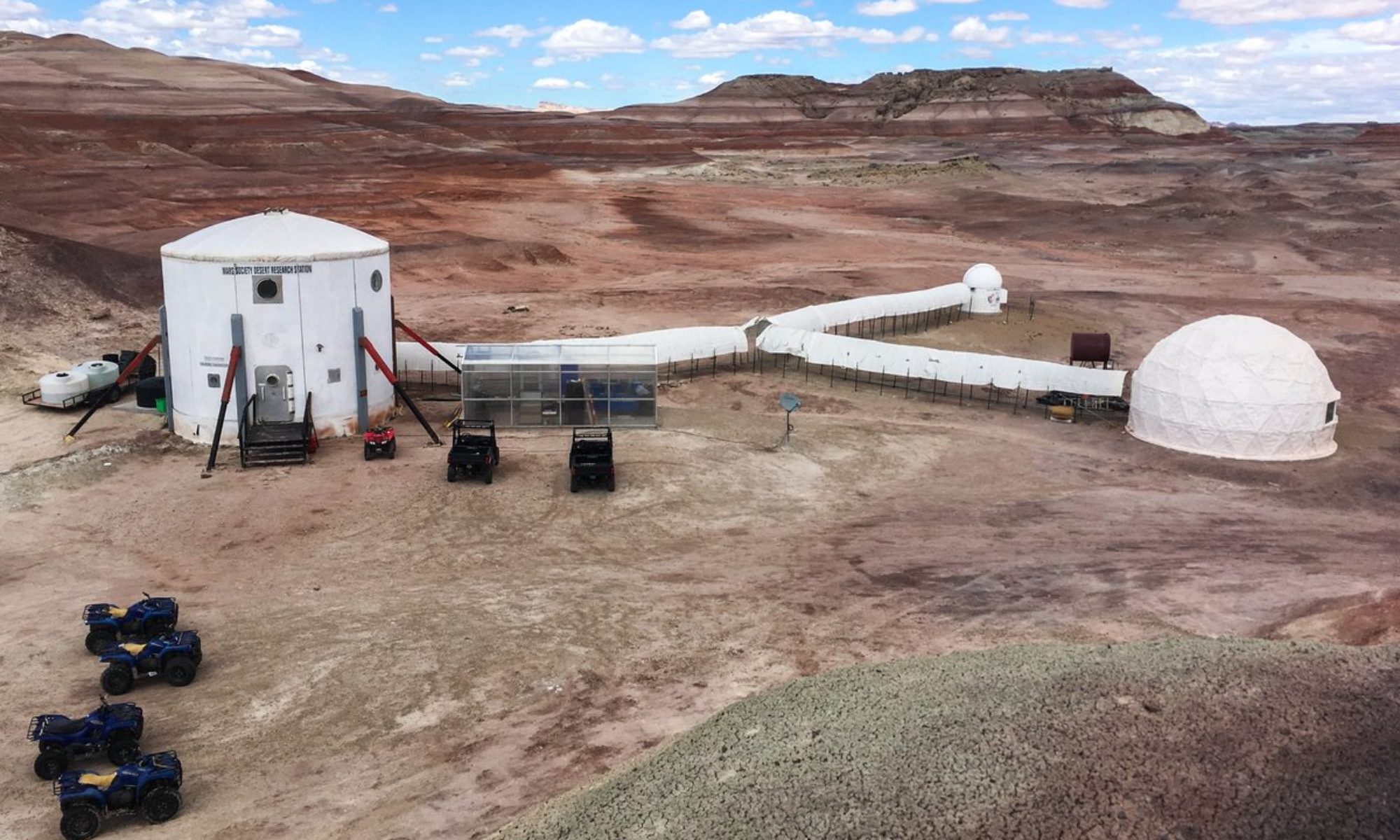
· Trace Lab: The purpose of this research is to better understand the role that emotion and coping strategies have on team dynamics within ICE (Isolated, Confined, Extreme) teams. The findings from this study will aid in the understanding of the role of affect within teams operating in ICE conditions – something that has been highlighted as being important by researchers, Antarctic expeditioners, and astronauts. Experiment conducted in collaboration with Trace Lab, University of Florida.

Related EVAs: None

External point of contact: Andres Kaosaar

Point of contact within the crew: Marie Delaroche

· AMI – Anomalies Monitoring Interface: Software allowing random anomalies to occur within the station to simulate problems that could happen in a real environment and see how we could react. The main goal is to improve the simulation.

Related EVAs: Potentially emergency EVAs in case of depressurization of ammoniac leak. It is worth noting that such emergencies cannot be mistaken for real ones as it is not a problem that can occur within our earthly MDRS.

External point of contact: Quentin Royer, ISAE Supaero student (Crew275)

Point of contact within the crew: Marie Delaroche

· Timepercept: Subjective time perception in confined environments, such as isolation or imprisonment, often leads to a distortion of time experience. The phenomenon is significant in understanding the psychological effects of confinement and has implications for mental health management in isolated or controlled settings like space missions or solitary confinement. Experiment conducted with the University of Krakow.

Related EVAs: None

External point of contact: Mateusz Daniol

Point of contact within the crew: Erin Pougheon

Outreach

· Media: Several articles and interviews in French newspaper and on radio

· Scientific mediation: We, like all Supaero Crews that came before us, try to share our passion for space and science in general by engaging in intervention in middle and high school. This year, we developed with high-schoolers a 3-step project around growing food on Mars.

Related EVAs: One as early as possible to retrieve some martian soil in which to plant radish seeds.

External point of contact: None

Point of contact within the crew: Mathurin Franck