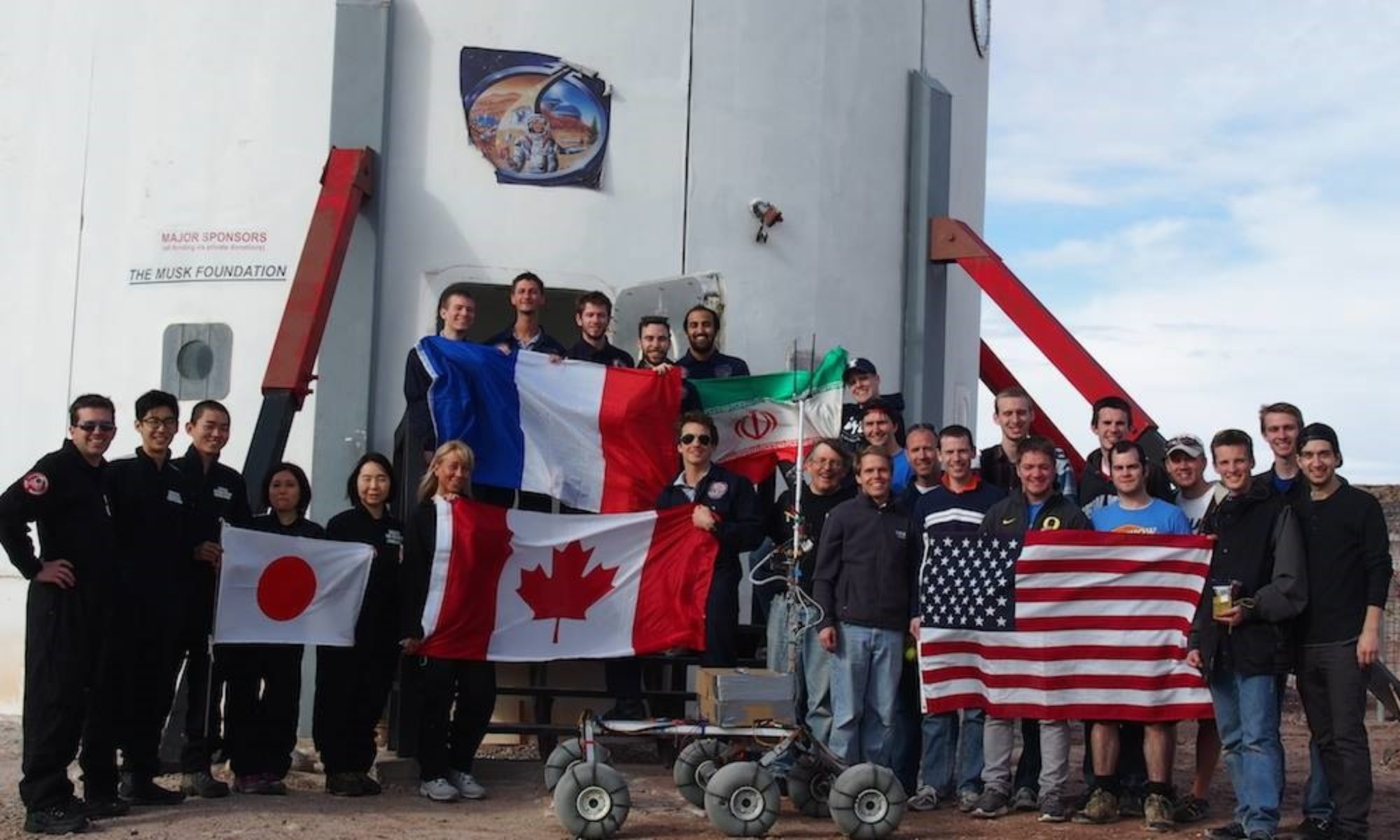

Journalist Report – January 26th

Journalist Report
Crew #: 328
Position: Crew Journalist, Comms Officer, & Astronomer
Report prepared by: Tom Bickmore
Date: 26-01-2026
Sol: 1
Journalist Report Title: The First Full Sol

Hello from the Hab on Sol 1!

We’re now fully in simulation at the Mars Desert Research Station, and today was our first complete day of routines plus our introductory EVA.

A resupply drop came in today, topping off our inventory with the missing items—nice to have everything squared away.

We spent time prepping the suits and radios for the first EVA. Getting the radios positioned and working reliably while fully suited took some coordination, but we sorted it out without major issues. This EVA was our required training outing to the Marble Ritual site, a short, easy walk (or rover drive) from the Hab that’s ideal for first-timers to practice suit mobility and procedures. If the rovers had any trouble, walking back is straightforward. Commander Mariló Torres led the group. GreenHab Officer Rebeca Gonçalves checked soil along the route, scouting locations for tomorrow’s sample collection that are as close as possible to Martian regolith while still suitable for growing.

I, Tom Bickmore the Crew Journalist, took a couple hundred photos, some 360 video, and helped with navigation.

Supporting our mission on comms and GPS monitoring, we had Aaron Tenner, Engineer & Safety Officer, and Jahnavi Dangeti, our Crew Scientist.

Driving the rovers in suits is an adjustment: you can’t easily turn your head to check sideways or behind, so we relied on clear radio communication and extra caution during turns to keep the group together.

Back in the Hab, we assembled our first full cooked meal: spaghetti with tomato powder, chunks, and ground beef. It came out well: tasty and a solid win for our expectations for what we can do with the available supplies. We also found the bread-maker and plan to run a test batch tonight after reports are filed. Daily reports are getting smoother, experiments are starting up, and the crew is working well together.

Picture(s) attached

Journalist Report – January 26th

Journalist Report
Crew #: 328
Position: Crew Journalist, Comms Officer, & Astronomer
Report prepared by: Tom Bickmore
Date: 25-01-2026
Sol: 0
Journalist Report Title: Dodging Asteroids in the Earth-Mars Transport Shuttle

Hello from the Mars Desert Research Station! Today marked the exciting start of our mission as Crew 328, where we’re simulating life on Mars right here in the Utah desert. We kicked things off with health checks to ensure everyone was ready for "launch" – and we all passed with flying colors! Our journey to "the Hab" was an adventure in itself.

The crew shuttle (which looked a lot like an old Chevy Suburban with some bumpy suspension) dodged "rogue asteroids" along the way. Yes, we actually had to swerve around a massive 2-meter tumbleweed that barreled right in front of us, looking just like a real space rock!

Our first task upon arrival: unloading cargo and hauling supplies upstairs with solid teamwork. Then, before simulation kicked in, we suited up in flight suits for a group photo in front of the Hab — a classic shot to inspire future explorers.

We then eagerly explored our new Martian home (and claimed our bunks). The Hab is incredibly clever, with compact living quarters, a science dome, and even a greenhouse for growing food (with some veggies still alive from previous crews, so we’ll get to eat fresh greens!)

Our 5-hour orientation & training covered everything from safety procedures and tours to trying on a spacesuit (I got to be the demo model – it felt like gearing up for a real Mars walk!).

We wrapped up the day by taking inventory of our supplies, including plenty of freeze-dried meats and veggies alongside cereals, cheeses, powdered milk, & baking items. To make meals more fun, each of us "smuggled" in some personal shelf-stable delicacies to supplement the standard rations — variety is key on Mars!

We also made inventory checks on emergency and medical supplies, then filed our first reports. Late into the evening, we dove into geological maps to plan tomorrow’s EVA – we’re hunting for soil samples that mimic Martian regolith to grow space tomatoes and radishes in our greenhouse.

Stay tuned for Sol 1, where the real Mars simulation begins!

[attach 1]
[attach 2]
[attach 3]

Journalist Report – January 27th

Report title: Journalist Report
Crew #: 328
Position: Crew Journalist, Comms Officer, & Astronomer
Report prepared by: Tom Bickmore
Date: 27-01-2026
Sol: 2

Journalist Report Title: Steady Progress

Steady progress here at the Mars Desert Research Station as we build momentum in sim on Sol 2.

We started the day enjoying the bread from last night’s test run—it came out nicely and made for a good addition to breakfast.

Overnight, we had made a few more adjustments to the Hab temperature controls for better sleep, and the whole crew noticed the difference this morning.

GreenHab Officer Rebeca Gonçalves gave an interview to Globo, a Brazilian media outlet, talking about the mission and our GreenHab activities.

We headed out on another training EVA, this time for Crew Scientist Jahnavi Dangeti and Engineer/Safety Officer Aaron Tenner to complete their required practice. I went along to document Jahnavi’s soil collection work for her research.

After a lunch debrief, we did a second EVA: Commander Mariló Torres and I assisted Rebeca in gathering regolith samples from the spots she’d scouted—locations identified as the closest local matches to Martian soil properties while still workable for planting.

We brought back a solid amount of good material for our GreenHab experiments. I also captured some specific footage during the EVA to share with Globo for Rebeca’s piece.

Along the way, we spotted an interesting mix of rocks in the red dirt: blues, greens, pinks, yellows, and plenty of jagged quartz-like chunks with transitions to other types—nice variety to photograph and study.

Projects are picking up speed. The space-flown tomato seeds are now planted in the lab-simulated Martian regolith and today’s regolith we collected will be used for a micro-greens experiment. One hydroponics test now has water flowing, and Aaron has been making on-the-spot modifications to his separate hydroponics setup to better fit local supplies and GreenHab systems.

Outreach is building too: more schools and individuals are signing up for our upcoming Live From Mars event, where kids around the world will talk with us through a simulated interplanetary comms delay (about 10 minutes each way), co-hosted by my students on Earth. It’s encouraging to see the interest grow day by day.

Daily routines are smoothing out, reports are getting easier, and the team is working amazingly well together.

More on Sol 3.

Journalist Report – January 28th

Journalist Report
Crew #: 328
Position: Crew Journalist, Comms Officer, & Astronomer
Report prepared by: Tom Bickmore
Date: 28-01-2026
Sol: 3
Journalist Report Title: Experiments at Home

Hello from the Hab on Sol 3. No EVAs today—just a relatively calm, productive inside day at the Mars Desert Research Station as we keep building momentum.

We woke up to the smell of fresh bread baking (another successful batch from the bread-maker), and I captured an amazing sunrise timelapse over the Martian desert landscape this morning—beautiful start to the day.

We spent time cleaning up the Hab and getting familiar with the cleaning tools and supplies available here. One quirky find: vacuum filters tucked in the back of a cupboard which was labeled "Christmas Grogu" for reasons unknown. (A previous crew’s inside joke?)

The bulk of the day went to personal experiments, but it was rarely solo work. We rotated help based on each person’s strengths, which made everything run smoothly and efficiently.

Engineer/Safety Officer Aaron Tenner got his materials testing experiment running: comparing the structural performance of 3D-printed hydroponics hardware made from different filaments. (I got to drill a bunch of the holes for it.)

Crew Scientist Jahnavi Dangeti made sample bricks from regolith sorted into different grain sizes, using molds 3D printed and assembled by Aaron. (I spent about an hour dancing around with a stack of screens in the science dome, sifting and sorting the collected sample into different sizes.)

GreenHab Officer Rebeca Gonçalves continued advancing her plant experiments, which are starting to fill up the GreenHab alongside Aaron’s hydroponics setups.

On the outreach side, I arranged an additional event and refined more details for our main Live From Mars session. More schools and individuals keep signing up—interest is growing steadily. We have a practice run scheduled for Friday with my co-hosts (some of my best space-loving students), and I’m personally very excited to introduce the crew to my students (and honestly, maybe even more excited to show off my students to the crew).

Commander Mariló Torres kept us going through the day with another great experimental Martian meal. Tasty and well received by the crew!

Daily routines feel more natural now, and the teamwork is stronger than ever.

We are also looking into an EVA to clean the exterior Hab windows for better pictures. With gravity on Mars reduced, ladders are safer, right?

More updates on Sol 4.

Journalist Report – January 29th

Journalist Report
Crew #: 328
Position: Crew Journalist, Comms Officer, & Astronomer
Report prepared by: Tom Bickmore
Date: 29-01-2026
Sol: 4

Journalist Report Title: Sol 4

Hello from the Hab on Sol 4. Another focused inside day at the Mars Desert Research Station—no EVAs, but steady progress on experiments and prep for tomorrow’s big activities.

I started early before sunrise, spotting the Chinese Space Station passing overhead (a nice real-world reminder of orbital activity), then captured a longer sunrise timelapse plus some pre-dawn shots with stars still visible—great light for photos.

We continued working on personal experiments throughout the day.

Crew Scientist Jahnavi Dangeti saw interesting developments in her soil testing: mineral crystals appear to be growing out of the brick samples she formed.
GreenHab Officer Rebeca Gonçalves finished testing her hydroponics setup and planted the radish seeds in it. The radishes are being grown as microgreens across four conditions for comparison: hydroponics, lab-certified regolith sim, locally collected regolith, and organic potting soil. Tomatoes are in the lab-regolith sim. All regolith-based setups include 10% organic potting soil by volume to support growth.
Engineer/Safety Officer Aaron Tenner worked on paperwork for his project, along with outreach tasks and planning.

I posted more of our daily reports and photos for outreach, got the Mars topography model (created and donated by Casey Handmer) running on my laptop after testing, and we’re awaiting confirmation to install it on the main Hab iMac. I also started setting up the Solar Telescope and preparing the Robotic Observatory for use—expanding my hands-on contributions beyond journaling.

Rebeca was assisted by Commander Mariló Torres on some of the GreenHab tending and planting work today.

This evening, with very clear skies, we watched the ISS (or our "Martian Space Station" equivalent) pass overhead—bright, steady, and a great view. I captured a Martian sunset timelapse to close out the day.

We’re gearing up for two key activities tomorrow: a longer EVA to the north, and our first Live-but-delayed session with kids on Earth. This one is a rehearsal with the same ~10-minute comms delay setup, constant video feeds (delayed between parties), and the same co-host students who will run the larger-audience event next time. It’s a chance to test the flow and tech before the full version.

Daily routines are settling in well, and the crew is staying productive.

More on how Sol 5 goes.

Journalist Report – January 30th

Journalist Report
Crew #: 328
Position: Crew Journalist, Comms Officer & Astronomer
Report prepared by: Tom Bickmore
Date: 30-01-2026
Sol: 5

Journalist Report Title: Sol 5

Hello from the Hab on Sol 5. A big day here at the Mars Desert Research Station: Our first live-delayed outreach session and a solid EVA, plus some nice progress inside.

Last night (Sol 4 evening) we had a movie night. It took surprisingly long to find a sci-fi film none of us had seen. We thought we had one, but halfway through two crew members realized they’d watched it years ago. Fun to see how the group reacted to the movie crew’s actions and reactions and to discuss what we’d handle differently in a similar scenario.

Today we ran our first Live-but-delayed outreach event: about a dozen kids from 4 countries joined us for a continuous conversation with the ~10-minute interplanetary comms delay simulated (constant video feeds both ways, delayed between parties). This was a rehearsal with our co-host students to test the full setup before the larger-audience version. We were all impressed by the kids’ questions, the depth of their knowledge, and how well they answered each other. Their variety of knowledge and their enthusiasm were incredible. The delay felt real and impactful: watching Earth respond to our "past" selves, then seeing our own delayed feed return. It made the interaction feel connected rather than isolated. Everyone had a great time.

We also had an EVA: Commander Mariló Torres and I went to the northern limit of our range, an area reported for signs of ancient life (it’s an active dinosaur quarry). No fossils or ancient traces found, but we did spot a very small live "dinosaur" (a lizard). Active dig sites had protective covers in place. The geology was striking. We saw distinct layers of rock with varied erosion patterns. On the drive to and from, we noticed crystalline patterns in the dirt where water gathers, looking a lot like the growths in Jahnavi’s soil experiments and similar to road-salt crystallization during Canadian thaws. Since it’s a desert dirt road with no added salt, these must be natural salts efflorescing from the soil. We plan to look more closely and sample these locations on a future EVA.

Commander Mariló Torres and HSO Aaron Tenner gave us a thorough safety briefing on additional Hab emergency procedures—good refresh and details.

A previously "delayed in orbit" supply drop arrived today with key chemicals and additives for Jahnavi’s soil experiments (to mix into local regolith for bricks and materials). This unblocks the main Science Dome work that was waiting on these items. Very exciting!

In the GreenHab, radish seeds are already germinating in the hydroponics setup. The other experiments (radish microgreens across four conditions, tomatoes in lab-regolith with 10% organic) continue progressing well.

Another day of progress with personal experiments planned for Sol 6!

Journalist Report – January 31st

Journalist Report
Crew #: 328
Position: Crew Journalist, Comms Officer, & Astronomer
Report prepared by: Tom Bickmore
Date: 31-01-2026
Sol: 6
Journalist Report Title: Sol 6

Hello from the Hab on Sol 6.

Full crew collaboration today at the Mars Desert Research Station—everyone rotated through personal projects, helping where strengths aligned best.

We all took turns making small test bricks from local regolith sifted to uniform particle size and mixed with precise amounts of water, gum, and salt. Messy, sticky work, but fun. The mixture looked and felt temptingly chocolatey—we resisted tasting it.

In the GreenHab, Aaron’s materials testing project advanced with further observations. Hydroponic radishes showed continued growth, and radishes in lab-grade regolith produced their first germination. The other setups, including TomatoSphere tomatoes in lab-regolith with 10% organic amendment, progressed steadily.

I configured the main Hab iMac to display the best ever topographical map of Mars (created and donated by Casey Handmer of Terraform Industries). The dataset, which consists of hundreds of millions of files, providing 7-meter per pixel resolution in 3D of the Martian surface is in Linux ext4 format so that it only takes a few TB of space. But that requires further simulation workarounds since macOS and Windows don’t read ext4 natively and Google Earth Pro lacks full M1 support. After a couple hours of fiddly setup, I’m most of the way there. Top priority: keep the iMac stable and running smoothly—no risk to the smart home dashboard, EVA-Link map, or critical systems (like Life Support).

We discovered that everything is available for proper hamburgers tomorrow, with some creativity in our Freeze Dried pantry, including fresh lettuce from the GreenHab. The crew is already excited.

Tonight we continued cultural exchange (with five countries represented) by making pancakes from Krusteaz mix with chocolate chips. Some crew members tried them for the first time—they were a big hit. We have had many other cultural exchanges, including friendly conversations about histories, legends, and traditions, and other dishes from different parts of the world.

Daily routines flow naturally now, teamwork stays strong, and projects keep advancing. More on Sol 7.

Journalist Report – <date – November 4th>

Journalist Report
Crew 321 November 4th, 2025
Alexander Rowe
Sol 1:

The crew gathered for breakfast at 0800. Yishan made a lovely pot of oatmeal for us to share. Bananas, blueberries, strawberries, peanut butter and brown sugar were all lovely supplements to the our dishes. During breakfast and following, we had an overview of what our first EVA (Extra Vehicular Activity) was going to be. Parker volunteered to be our ExO (Executive Officer) on the mission. His job was to keep track of time, keep the crew focused on the tasks and manage rover battery life. Alex volunteered to be the Coms. His tasks were to radio back to the station and update them on our location and times leaving. Dianea volunteered to be our HSO (Health and Safety Officer). She was ready to help with any health or safety issues that might arise on the EVA. Jake volunteered to be our Navigator. He had our map and directed us to where the two spots we would be stopping at. Yishan volunteered to be our team geologist. As our mission was to look for specific geological samples, Yishan’s knowledge was so helpful for us all. After breakfast, crew 321 cleaned the dishes and moved onto getting ready for our EVA.

At 0915 the crew began to change into their EVA uniforms and gather the belongings that they would be using in the field. All crew members decided to take two piece suits. These suits need other members to help put them on, as they have many components that are out of reach. Jen, our Commander, helped all of the members get into their suits. The excitement in the room was palpable, as all members got into their suits, one by one. Once the members were in their suits, many photo opportunities presented themselves. The first grouping of the crew entered the airlock at 1000 and waited for the all clear to come from inside the HAB. Once they exited, the second group followed suit.

Once the team was outdoors, we found our three rovers. We took out the rovers named Curiosity, Perseverance and Spirit. Jake and Alex took Spirit. Parker took Curiosity. Yishan and Dianea took Perseverance. We unhooked the rovers, turned them on and reported their battery life and hours used to our Commander. Spirit took the lead and Jake directed us to our first destination at the intersection of Brahe HWY on Cow Dung Road (518000, 4254750). In tandem, we drove to the first site, passing countless gorgeous mounds of this alien landscape. We came to the sign for Brahe Hwy and parked our rovers. Our first geological samples to collect were gypsum. We all searched for sparkles in the surrounding area. At first, we didn’t know if we had found the correct spot. The sun finally allowed us the opportunity to start finding samples. We quickly found that we were surrounded by pockets of beautiful gypsum, which had floated to the surface of the red-orange sands. We became quickly spread out. After 30 minutes, Parker helped bring us back together and get ready to move onto the second location. We let the HAB know that we were on our way to the second location.

Our second location was the mounds near the balancing rock, south of dry creek wash (518000, 425400). We made it to our second location at around 1115. Our second geological samples to collect were sandstone blueberries. We were to look for these in the berms by the dried riverbed and near the balancing rock. The balancing rock was breathtaking to see. We quickly found ample amounts of blueberries and collected our samples. This area was rife with diverse geology. It was so much fun to look through what was on the surrounding ground. While there, we were approached by an alien life form. We just ignored them and moved on. Parker gave us the go ahead, to head back to the HAB.
We left at 1145, to return.

We arrived back to the HAB at 1200. All crew members docked their rovers, reported their battery life and hours used and gathered for a 360 degree photo. The first group returned to the airlock and waited for pressurization to happen. The second group followed after the first. All members successfully changed out of their suits and cleaned their helmets off. They brought their samples to the upper deck for inspection. All members debriefed as a team on the upper deck. The team was elated about their experience. We problem solved ahead of our next EVA. How to keep our headsets and head coverings more secured was a topic among us all. A few crew members mused about trying the one-piece suit out tomorrow. We will see.

Our fearless Commander made us a delicious lunch of fresh bread and potato cheddar broccoli soup. We all loved and needed the sustenance after such an adventure. After eating and debriefing, the crew had time to complete work in their non-sim lives. Some exhausted from the experience in the field, needed to rest. Some took time to send videos or materials to their students.

After a much needed moment of respite, our team came back together for some experimentation in the Science Dome. Each of us took two of our gypsum samples and noted the weight of them. After this, we put one sample in a pan of continually mixed water and one in an oven. We are leaving them until tomorrow, to note their outcome.

Journalist Report – <date – November 5th>

Journalist Report
Crew 321 November 5, 2025
Alexander Rowe
Sol 2:

Our day started at 0800 this morning with excited chatter and conversation around the day before’s adventures. We had a meal of cereal and dehydrated milk, followed by a briefing of the 2nd day’s EVA. Our EVA had an approved time window of 1000-1230. We were to collect 2 specific geological samples, from two different sites again. We agreed that we would have the same duties on the EVA today, as we had on the previous day. Parker was our ExO, Dianea was our HSO, Yishan was our geologist, Jake was our navigator and Alex was on Coms duty. At 0900, the crew cleaned up from breakfast and started preparing for getting into their suits. At around 0930, we had all assembled down on the main landing of the HAB, to get suited up. Yishan and Jake had decided that they would take the 2-piece suits today and the rest would try the 1-piece suits out. Since the 2-piece suits take more time, we got Yishan and Jake into their suits. Today was different, in that, our commander gave the crew the space to work together to get each other suited up, with no intervening. Our crew worked together gloriously. Yishan and Jake got into their suits with no hiccups. When they were in their suits (and after several photo opportunities), we sent them out into the airlock at 1000. The second crew of suits then started getting prepped. Parker was the first to suit up. This suit has significantly less work to get on, than the 2-piece suits. Parker got in, buckled up and fans on, in less than 5 minutes. Dianea and Alex followed next. The second crew was ready nearly by the time that the first crew was out of the airlock. Waiting in the airlock is a lovely and exciting moment. The anticipation of entering an experience like this is so unique. Once out into the outdoor environment, our crew found the three rovers that we would be using again. Jake and Alex took Spirit. Dianea and Yishan took Perseverance. Parker took Curiosity. Since Jake was the navigator for us, Spirit took the lead. The drive to our first site was a scenic 20 minute venture. Our first site was at the Road to Barranca Butte (519700, 4247300 (UTM NAD27 CONUS)). We successfully made it to the first site at 1030. We radioed to the HAB that we had made it to site #1. The team was to search for basalt samples here. The area was full of interesting samples and the crew was full of chatter for the updates as to what they had found. We all found more than enough samples and collected some interesting samples to explore back at the HAB too. At nearly 1100 Parker gave us an update on the time and we made the move to head to site #2. We all packed into our respective rovers and headed out to site #2 at 1100. Site #2 was Southwest of Kissing Camel Ridge (518200, 4249300 (UTM NAD27 CONUS)). The Kissing Camel Ridge has the name for it’s beautifully anthropomorphic and zoomorphic qualities. The colors in the surrounding area here were breathtaking. Vivid red bursts, followed by bright white lines, next to deep purple veins and auburn splashes all lit up the crews eyes. Our samples to collect at this site were to be an analog version of hematite. We were looking for either chert or petrified wood. This area was rife with these rocks and such a wide land to explore. The river bed proved a lovely place to find samples, as it had rained in the past week. Each crew member filled their pockets with samples and returned to their rovers. The sun was more direct today, which brought on the heat and exhaustion more quickly. By 1130, we had agreed to head back to the rovers. We ended up leaving site #2 and heading back to the HAB for the day. We let the HAB know that we were returning. We made it back to the HAB by 1145 and called to ask if we could use the airlock in the RAM this time. Our commander gave us the approval for the RAM airlock. Our team took a quick 360 video outside the HAB. We loaded ourselves into the RAM for the wait. This was a fun and different experience, as all 5 of us could be in the airlock at the same time. It was a nice way to enter the HAB for the last time in sim. We were cleared for entrance into the HAB by 1155. Once we made it into the HAB, our crew helped each other out of our suits and cleaned them thoroughly. We all were itching with excitement, at the opportunity to look at our samples. After putting all of our suits and accessories away, we were able to head up to the main deck and start looking at our samples. Our wonderful commander had started making us a delicious lunch of Mac and Cheese and fresh bread. All of us enjoyed the meal with minimal talking, as it was delicious. Once finished with cleaning lunch up, we all quickly started perusing our samples. Many “oohs” and “ahhs” were had. The samples from this area are so diverse and a visual buffet. From the clarity of the gypsum, to the vibrant colors in the petrified wood, to the rough edges and lines in our conglomerates, we just all poured over each others’ samples. Yishan was really in her element here, as she gave us all wonderful input on our questions. By 1400 we were all deep into putting together our Mars and Analogue sample packs, that we had set out to create. Our members went back to time on their own, of connecting to their students and taking a respite. We found that our water consumption has been a bit more than anticipated and we problem solved around ways that we could solve the issue. Our crew is looking forward to one last meal before heading back to earth tomorrow morning. See you all then!

Journalist Report – <date – November 6th>

Journalist Report
MDRS Crew 321 (NASA SWB)
Jake Paszko 11/6/2025
Sol 3:

Our first day back on Earth started around 8:00 AM. I woke up missing Mars’s 0.38 percent of Earth’s gravity. My feet hit the floor harder than expected getting out of bed. However, nothing brings you back to Earth like a warm, cheesy breakfast. Parker whipped up some scrambled eggs, hash browns, and bacon spam. It sure hit the spot.

Around 9:30 AM, we made our way to the science dome to check out our gypsum experiments. Commander Jen led our discussion as we observed our rocks and pondered the transformations. Our crew geologist, Yishan, explained the differences in the variety of gypsum. Selenite is the more hydrated form of the gypsum and has a more transparent appearance. Anhydrite is the dehydrated form that is not transparent and has a chalky, grey or white appearance.

Soon after we concluded in the science dome, the crew geared up and completed a briefing. Commander Jen informed us that we will be out looking for biosignatures. Since we are technically back on Earth, we did not have to suit up today. We got to our site around 10:30 AM.

Some of the bioindicators spotted throughout our search included petrified wood, ancient devil’s toe nail mollusks, dinosaur pelvis and fragments. Our search led us up some painted hills so getting down involved some off-trail scrambling but we all made it back in one piece.

Once we returned to MDRS, around 1:45 PM, we rehydrated and refueled for some more afternoon adventures. Alex went out for a solo adventure to explore some sites that caught his eye. Parker and I found a couple larger souvenirs. Jen took some glamour shots of Yishan and Jen and then they headed out to revisit kissing camels.

We are looking forward to an evening that involves hamburgers, milkshakes, and a stop at the local rock shop.

Copyright © The Mars Society. All rights reserved. | Main Site