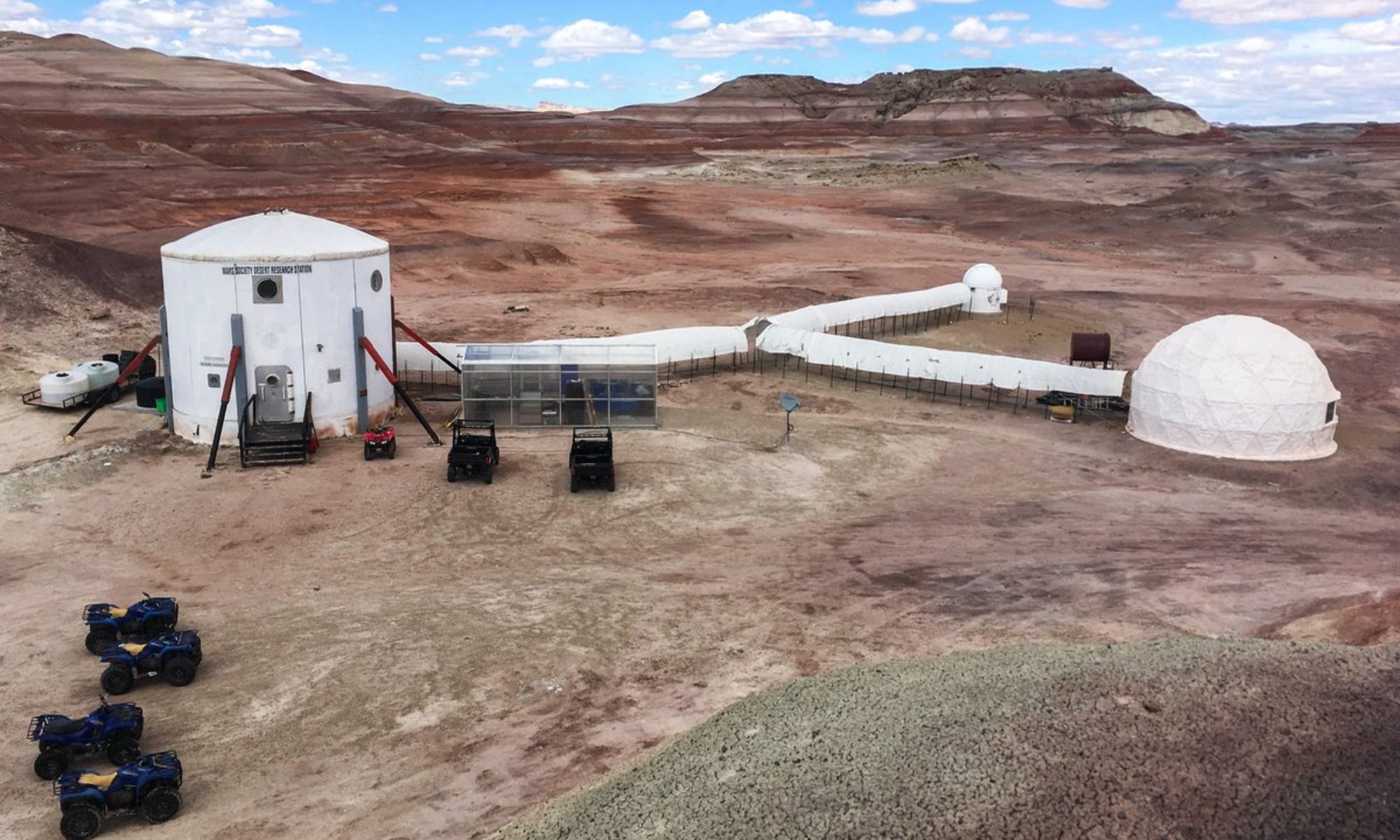

Crew 216 – Team A.R.E.S.
Crew Commander: Marc Levesque (United States)
Executive Officer/Systems Engineer: Mike Lawson (United States) Health and Safety Officer: Andrew Kennedy (United States) Crew Researcher: Rich Whittle (United Kingdom)
Crew Astronomer: Michael Ho (Singapore)
Crew Journalist/Artist-in-Residence: Evgenia Alexandrova (Russia)
MDRS Crew 216 consists of a diverse group of individuals with interests that reflect the crew’s name: Arts Research Education Science. This will be the first experience for all crew members at MDRS, and the international character of the crew will likely be similar to those on future missions to Mars. The crew’s first priority will be to maintain all the MDRS facilities, vehicles, and equipment in a safe and operable condition. For this purpose, each crew member will be assigned primary and secondary tasks for which they will be responsible, based upon their crew position, capabilities, and interests.
Beyond these responsibilities, crew members will undertake projects while living in a Martian analog environment. Below is a detailed summary of planned projects and activities during the mission.
In-situ Fluorescent Mineral Prospecting in a Martian Environment Crew Member: Mike Lawson
Martian colonists will have to exploit local resources to survive and thrive on Mars. UV searches can identify possible sources of rare-earth ores, radioactive ores and other useful minerals, such as industrial gemstones for cutting, polishing and abrasive processes.
Traditional rock sampling, either by chipping rock faces or cone and quartering (alluvial gravel) would net only small samples (kilogram or smaller scale). A large scale survey would take many EVAs. An in-situ UV search of a rock-face or a gravel deposit can rapidly scan many tons of material in a matter of minutes. If a target “lights up,” it can then be sampled for further analysis in the HAB.
Specialized Equipment: A portable 6-watt Analytikea Model UVL-48 ultraviolet light source in shortwave UV mode will be on-hand. This survey can only be done during a period of darkness. The lunar cycle favors us, as the first week of Crew 216 is in a waning crescent moon phase, the second week is in a new moon phase. The UV light source is only six watts in power or less than a typical residential night-light. Consequently, new moonlight darkness is optimal. Some standard reference works on field geology and UV minerals will be brought on the mission.
Preparation: Extensive map and satellite imagery will be studied to identify target sites of interest. Two key terrain types are favored for the UV survey: rock faces in cliffs or canyons and alluvial gravel deposits. The former present an opportunity to rapidly scan multiple layers of rock and identify target-rich epochs in the Martian geologic history. The alluvial deposit survey capitalizes on Martian erosive forces self-selecting out “harder” materials of interest (in Mohs scale context), such as industrial gemstones. Four target areas will be selected based on imagery reconnaissance, two rock faces, and two alluvial deposits. Target priority is for ease of access to minimize travel risks during the EVAs.
Safety Protocols: This survey can only be done during a period of darkness, which adds an added layer of operational risk. Crew members attempting the night-time EVAs will be experienced operatives with extensive military and/or search and rescue experience. This experience includes field operations in periods of darkness. Travel to and from the sites of interest will be illuminated (either by hand lights or vehicle lights, depending on the mode of travel). The routes will be at least partially reconnoitered in daylight hours to ensure a safe route to the sites. Only brief periods of “lights out” scanning will be required at the target sites. The UV scanner will use UV eye protection for short wave UV. Chemical heat packs (similar to those used by athletes) will be on hand in the event of “frosting” issues with the sim-suit helmets, to simulate actual suit heating elements. Excessive “frosting” will be a cause for mission abort and return to the HAB. Extremely low night-time temperatures (under -10 C) will be a cause for mission abort. For this reason, the EVAs will be scheduled in the early evening for launch shortly before nautical twilight. The purpose is two-fold, to execute at the warmest period of darkness and to minimize the total time in absolute darkness.
EVAs: Up to four EVAs are planned for execution in the available 11 Sol window. Since they are planned night-time activity, they will not conflict with other team members’ EVA schedules, and a full support element from the remainder of the crew will be in the HAB. The first two EVAs will visit different target types so that any truncation of the planned EVA schedule will not result in total loss of survey diversity. If UV sensitive materials are found, samples will be gathered and labeled using typical geologic techniques and returned to the HAB for further study and identification in the on-site laboratory.
Report of Results: A paper detailing the results of the UV survey will be written and submitted to the Mars Society after the completion of the mission.
Documentary Film
Crew member: Evgenia Alexandrova
I am planning to make a film around one hour long in a style that I call "poetic documentary." I am not interested in a pure factual coverage of our experience and don’t want it to have a linear narration. The topics I would like to explore are: What is behind our dream for space? What are we trying to learn through learning about space? Our future? Or actually is it about our past and are we looking for understanding where do we come from and where we belong?
The first years of Mars colonization will be hardly easy for humankind: confined space, dehydrated food, heavy spacesuits, no green color in nature, and missing home. There will be not much intimacy, but there may be solitude. Still, we are driven by some dream, instinct, or curiosity to explore beyond. I would like to capture the evolution of the emotional state of the crew members.
At some point, I might concentrate more on some precise team member(s), as the audience becomes more attached to a film when there is a protagonist. This will imply filming every day during working hours but also outside of those: during diners, spare time, and nights. In documentary filming, we can never predict when something interesting is going to happen, so I will have to adjust to the experience. I would need at least four daytime EVA’s to capture the landscape and the work of the team members.
For those who agree to be filmed during an EVA, they will be equipped with a small microphone inside their spacesuit. I would also be extremely interested in a nighttime EVA if MDRS can grant the permission. As the mood of the film intends to evolve towards a dreamy atmosphere, I would absolutely love to film the stars and the station lost in a dark landscape, as well as fellow crew member Mike Lawson testing his tool which can be absolutely stunning by night.
I will also ask for at least one 40-minutes interview with each crew member at a time convenient for them. On the first day of sim, I will request a clear statement if there is any crew member who absolutely doesn’t want to be filmed.
Human Performance & Analog Mission Evaluation of Environmental Stressors via Behavioral Health Scales
Crew member: Rich Whittle
Mars analog astronauts undergo a rigorous selection and training process to ensure crew cohesion and mission success. However, even the healthiest, strongest individuals may face psychological challenges due to various stressors in extreme or abnormal environments. Examples of these stressors include isolation, confinement, close living quarters, the monotony of food, delayed communication with ground control, time pressure, scientific or engineering failures, sleep difficulties, fatigue, etc. In our effort to further human space exploration in a safe and effective way, we must thoroughly understand and protect the psychological and physiological well-being of the crew, before, during, and after the space analog mission.
Research Aims: This project aims to study crew member behavioral traits, including anxiety and depression levels, before, during, and after space analog missions using standard questionnaires before, during, and after the mission. This will allow us to better understand psychological well-being in response to known and unknown environmental stressors. This project further aims to study the correlation between crew anxiety and depression levels and the possibility of a “third quarter phenomena” (TQP), whereby the first quarter of the mission may be characterized by crew excitement or anxiety, the second quarter by boredom and depression, and the third quarter by increased emotional outbursts. An addition to the study will examine basic physiological changes in subjects over the course of a short duration analog mission to explore transient changes.
Analog Missions: We will conduct our experiments in two different analog missions: MDRS – Mars Desert Research Station (Mission 216) and AMADEE-20 (Austrian Space Forum). MDRS is located in the Utah desert with the Mars analog simulation lasting 15 days. The AMADEE-20 Mars analog simulation will be conducted in the Negev Desert in Israel, with a duration of 30 days.
Surveys: Five surveys will be administered, each taken at various points pre/during/post-mission: PANAS (Positive and Negative Affect Schedule), POMS (Profile Of Mood States), Sleep Quality Survey, ICE-Q (Isolated and Confined Environments Questionnaire), and PsychScale.
Survey Timing: One-time pre-mission, two in-mission (approximately days five and 10), and one post-mission. Also included will be a measuring of the heart rate and blood pressure at the same time each morning using Omron Sphygmomanometer.
Supplements Significance: This project has the potential to inform prevention strategies including resilience training for the mental health and overall well-being of analog crew members at the individual and group level.
Enrollment/Recruitment: Crew will be contacted prior to the mission to receive information and confirm if they would agree to participate. All crew members will be eligible to participate, and those that do will be required to sign a consent form detailing the process of the research, any risks, and their consent to participate. This will take place on the first day the crew meets before the mission.
Note: This research is not for clinical findings, but for research only. Findings will not be given to participants for clinical purposes.
Mars Society and MDRS Educational Materials Crew Member: Michael Ho
My project is to spread awareness of The Mars Society objectives and the Mars Desert Research Station by developing a public presentation. This will include the following activities: 1) Filming Crew 216 members’ introductions; 2) Recording the experience of maintaining physical and mental well-being living in a confined space with strangers for 14 days; 3) An introduction to the physical structure and utilities of MDRS; 4) Meals, water & energy resources and waste conservation practices at MDRS; 5) Diurnal and sleep cycles; 6) EVA procedures; 7) Emergency drills; 8) Flying drone footage of MDRS, surrounding desert features, and accompanying EVAs on rovers.; and 9) Taking pictures and observing celestial objects through telescopes in the Musk Observatory. Note: Each crew member will be asked to sign a release if they agree to be filmed for this project.
In-situ Resource Utilization for Medical Applications Crew members: Rich Whittle and Andrew Kennedy
This will be a continuation of a Crew 215 project to collect gypsum samples to produce Plaster of Paris for application in medical interventions stemming from splinting to preliminary dental impressions. This project will require several EVAs pending the outcome of material testing.
MDRS Mapping and Communications Crew member: Marc Levesque
Mapping: The current map at MDRS was developed by Henrik Hargitai et al in 2017 from digital GIS files. These files were obtained from the developer to provide the option of updating the map that could include the removal of unwanted features or the addition of new features to make the map more current. Once the post-mission processing is completed, an updated map will be offered to the MDRS to replace the existing map in the station and digital files provided for operational support.
This project will require EVAs to capture new data points via GPS, which might be accomplished during other planned EVAs or separately depending on the number of features to collect and distances from MDRS. Additionally, the GPS units will be used to collect the tracks of any EVA activity and to mark the location of crew members at regular intervals while conducting their EVAs. The latter will assist the communications person monitoring EVAs to know precisely where each crew member is during their EVA. At the end of the mission, these data sets will be used to develop a map of Crew 216 EVA activities for the mission record.
Communications: The current MDRS radio communication system uses FRS/GMRS handheld radios that are limited to an output of 2 watts, which limits how well EVA teams can communicate with the Hab and each other. A system utilizing VHF frequencies would expand the range of radio communications to enhance the safety of crew members. Such a system would include handheld radios with 5-watt output, a base radio at the Hab with a capacity up to 50 watts, and a tower with the high gain antenna installed next to the Hab. A further enhancement to the system would be the deployment of self-contained field repeaters in the surrounding area to expand the range of communications even further. This project would possibly require two EVAs to confirm possible repeater sites after a terrain analysis was conducted in GIS. If the project is implemented, the Mars Society would need to obtain an FCC license that is available for non-profit or educational organizations.
An additional communications project will be to attempt amateur radio contact with the International Space Station (ISS). Depending of the ISS orbital schedule, Crew 216 will attempt to make a contact with a licensed astronaut on the ISS. This will utilize a mobile radio in the crew commander’s personal vehicle set up in cross-band mode that will allow the contact to be accomplished from inside the Hab via a handheld radio. This project will require two short EVAs to turn on the mobile radio in the vehicle prior to the contact attempt and then turn it off. Crew members Levesque and Lawson are licensed amateur radio operators and will undertake the contact attempt.
Submitted by: Marc Levesque
Crew 216 Commander


You must be logged in to post a comment.