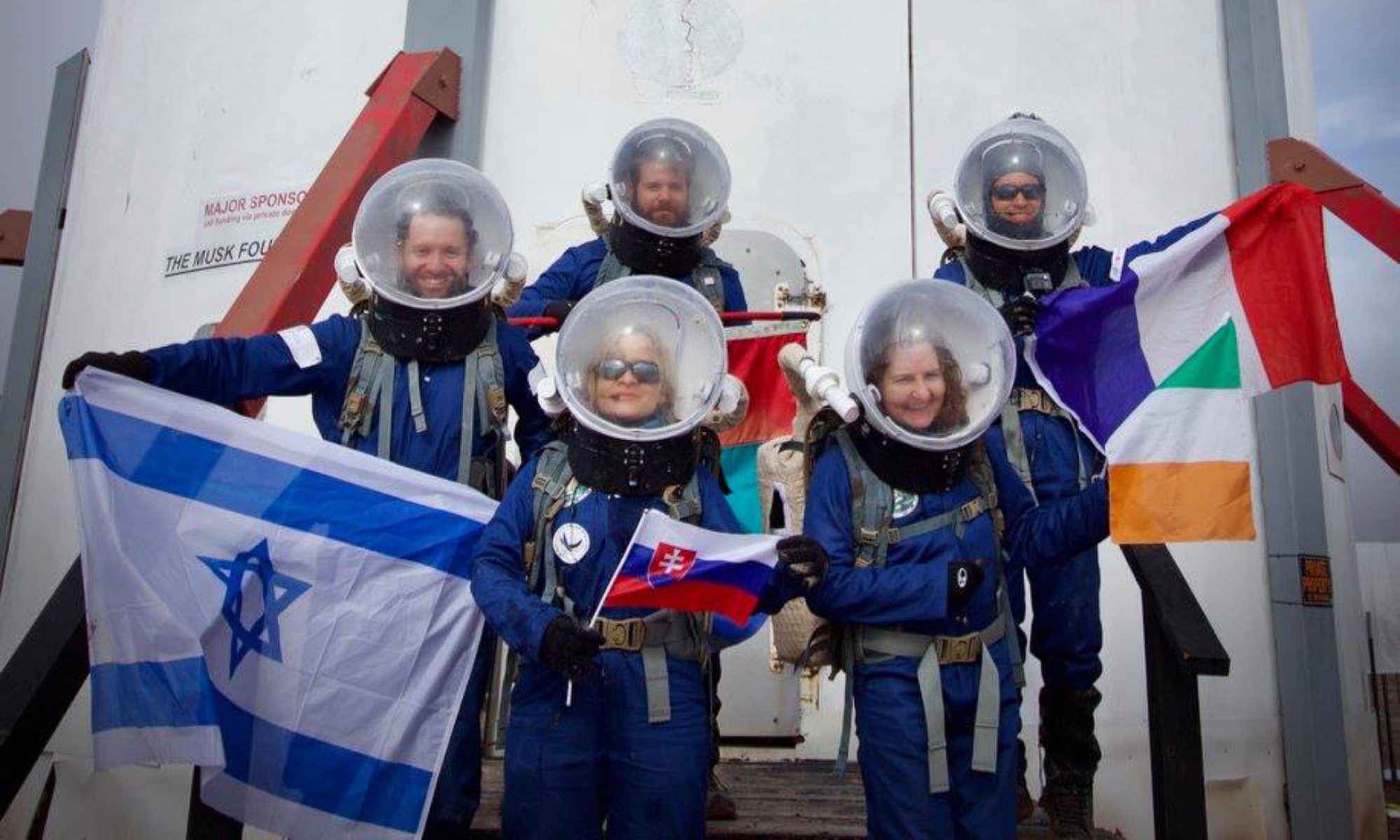

GreenHab Officer: Scott Dorrington
Environmental control: heater on automatic, supplemental lights automatic 10pm to 2am
Average temperatures:
09:17: 73.6 F, 22%
09:59: 77.7 F, 25%
11:05: 83.8 F, 21%
12:04: 92.8 F, 19%
13:03: 97.3 F, 15%
13:51: 100.8 F, 12%
14:03: 89.1 F, 13%
15:27: 100.8 F, 11%
17:39: 76.8 F, 27%
Hours of supplemental light: 4 hours overnight
Daily water usage for crops: 7 gallons
Daily water usage for research and/or other purposes: 0 gallons
Water in Blue Tank (200 gallon capacity): 124 gallons
Time(s) of watering for crops:
Changes to crops: Planted two additional rows of carrots in the carrot box
Narrative:
Today was the crew’s rest day, although the plants still needed tending. I visited the GreenHab in the morning around 9:15 and stayed for a while to check in on the heater. It was on when I entered at 73 F and turned off several minutes later when the temperature read 76 F. Heating system nominal!!! I started the plants with a nice morning misting. Unfortunately, cukes #1 and #3 were looking a little wilty. I suspect they may have gotten some direct hot air from the heater – they were placed on the metal shelves overnight. I made a note not to leave them there when the heater was on. They were placed down on the floor for the day in the shade of the mesh shade cloth (later moved to the wooden pallet with the tomatoes). I also pruned some dead leaves from tomato #4 and inspected the fruits on tomato #9 – they look nice and red and a little squishy to the touch. I think tomorrow might be harvest day for them. I gave the plants their first watering of the day with 3 gallons. Soundtrack of the day was Jackson Browne. Today, I joined the crew in completing the Mars puzzle on our rest day. I set regular alarms to check in hourly on the plants, recording the temperature and giving a mist on each visit. By 1pm, the temperature had reached 100 F, although I did not observe the anomalous heater-turning-on issues the crew observed the previous sol. Looks like there may have been an initial hiccup in the system, but is now working ok. I gave the plants another watering of 3 gallons in the afternoon, and did some rotations of the tomatoes, and moving other plants out of the sun. Alex caught a bee inside the hab, which was also relocated to the GreenHab (I have yet to see it). For the past few sols, I have been eying off the carrot box – only a few carrot heads appear to have germinated, and there is a lot of free space in the box. Luckily, I did bring a packet of carrot seeds with me. I dug two shallow trenches on the left side of the box, away from the existing carrots, and added some seeds – following the instructions to apply 4 seeds per inch during initial planting, and to spread them out later after germination (expected to be 8-12 days). I will make sure to keep the carrot box nice and moist. In the afternoon, temperatures began to cool, and the heater was turning on periodically keeping the temperature above 75 F.
Harvest: None
Support/supplies needed: None
EVA Report – January 28th
EVA # 12
Author: Clare Fletcher
Purpose of EVA: Deploy solar logger before sun gets too high. Solar logger had stopped working on 27-01-24 and was retrieved on EVA #10.
Start time: 0800
End time: 0815
Narrative: Prior to the beginning of EVA #12, Alex reported having a migraine and was unable to join this EVA. Given I (Clare) was awake, I volunteered to help on this EVA to deploy the solar logger. Andrew and I made good time getting ready and left on time. We deployed the solar logger outside the Science Dome and turned it on. After this, we inspected the tunnels quickly as we intend to hold a practice emergency depressurization EVA during the week (EVA request yet to come for that one).
Destination: Outside Science Dome. 518150, 4250950
Coordinates (use UTM WGS 84): 518150, 4250950
Participants: Andrew Wheeler, Clare Fletcher (replacing Alex Tobal)
Road(s) and routes per MDRS Map: Exit Hab via main airlock and walk to outside the Science Dome. Within 50m of the Hab walking distance.
Mode of travel: Walking only.
Commander Report – January 28th
Sol: 7
Summary Title: A day of rest
Author’s name: Andrew Wheeler
Summary: Today was a down day for the 291 crew after spending a hectic and tiring 6 days climbing up the ridges and through the gullies surrounding the MDRS. Personal time to wash and clean clothes and a well deserved (though very short) shower was the order of the day. However it didn’t turn out that way. One crew member reported in with a severe migraine and another with a stomach upset. As for the rest of us, it was a quiet day mindful of our colleagues. Though the day dawned crisp (-5C) and clear, high cirrus cloud ruined any chance for astronomer Rob obtaining clear observations of the sun after missing out for most of last week. With the assistance of Clare during an early morning EVA, I returned the solar logger to its position outside the science dome, having recharged the battery to full. It should be good for a few more days. Whilst out on this EVA, we inspected the outside of the hab tunnels for micrometeorite damage and general state of repair.
In quiet mode, the mobile crew members discovered the Mars jigsaw puzzle and about completing the 999 piecer (it was a 1000 piece puzzle but the top left corner piece has disappeared!) to keep us occupied. In a herculean effort, the task was completed before dark and the back signed in accordance with the tradition. During dinner, an issue with the lower level gas heater was dealt with and reported to mission control.
As crew recover overnight, Sol 8 should see us refreshed for further exploration of the MDRS area and testing of robot equipment.
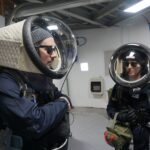
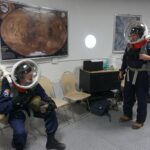
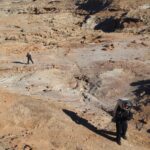
Crew Photos – January 27th
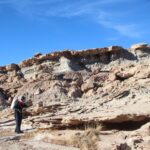
Sol Summary – January 27th
Sol: 6
Summary Title: The search continues
Author’s name: Andrew Wheeler
Mission Status: Nominal
Sol Activity Summary: A repeat of yesterday, Sol 6 dawned bright, clear and cold; perfect weather for EVAs. It also allowed the solar observatory to be utilised for the first time. The morning EVA saw a return to Kissing Camel Ridge in search of access to Hab ridge and the locations of fossil beds, concretions and petrified wood. The return to the parked rovers during this EVA was via a different route that pushed the EVA into the reserve time. A lesson learned. The afternoon EVA chartered new territory into Candor Chasma (via Galileo Road) in the search for fossil beds and spectral targets. A location for fossil beds was identified as well as more green and red mudstone lithologies. Interestingly, purple mudstone beds and salt coated rocks were located and will be potential targets for spectral analysis on later EVAs. Pizza and fresh salad greeted all for the evening meal and very welcome it was.
Look Ahead Plan: A day of rest and consolidation. However, in expectation of clear weather again, the solar observatory will continue to have the idiosyncrasies worked through to allow clear observations of the solar surface. With no EVAs scheduled, the crew will be able to catch up on interpretations and conclusions as well as personal time.
Anomalies in work: An incursion by curious visitors in to the campus In the afternoon.
Weather: Clear crisp morning at -6 Celcius rising to low teens during the day. No precipitation. Humidity continuously dropping from near 60% to below 40%. The wind was faint to gentle during the day.
Crew Physical Status: nominal
EVA: EVA 10 with Clare and Scott to Kissing Camel Ridge en route to Hab Ridge in search of fossil beds, concretions and petrified wood.
EVA 11 to Candor Chasma via Galileo Road reconnoitering for spectral targets, fossil beds and concretions.
Reports to be filed: Sol Summary, Journalist Report, Greenhab Report, Operations Report, EVA report, EVA Request(s), Astronomer report and mid-Mission report.
Support Requested: Nothing to request.
Operations Report – January 27th
SOL: 6
Name of person filing report: Scott Dorrington
Non-nominal systems: None
Notes on non-nominal systems: None
ROVERS EVA #10
Curiosity rover used:
Hours: 264.9
Beginning charge: 100%
Ending charge: 68%
Currently charging:
Perseverance rover used:
Hours: 282.8
Beginning charge: 99%
Ending charge: 62%
Currently charging: No
ROVERS EVA #11
Spirit rover used:
Hours: 243.4
Beginning charge: 100%
Ending charge: 43%
Currently charging: No
Opportunity rover used:
Hours: 157.8
Beginning charge: 100%
Ending charge: 51%
Currently charging: No
General notes on rovers: None
Summary of Hab operations:
WATER USE: 26.1 gallons
Water (static tank): 331.1 gallons
Static tank pipe heater (on or off): on
Static tank heater (On or off): on
Toilet tank emptied: Yes
Summary of internet: Nominal during comms window
Summary of suits and radios:
Suit #8 still stood down. Located some replacement nuts for charging port, but not correct size. Will continue repair tomorrow.
Summary of GreenHab operations: put notes here
WATER USE: 5 gallons
Heater: On automatic
Supplemental light: on at 6pm – to be fixed to turn on at 10pm
Harvest: 6g basil, 5g parsley, 1g sag, 17g arugula
Summary of ScienceDome operations: Alex entered to observe crew of EVA #10 upon their return.
Dual split: Nominal
Summary of RAM operations: (Tools used, work done) put notes here
Summary of any observatory issues: See astronomy report
Summary of health and safety issues: None.
Questions, concerns and requests to Mission Support:
Toilet seat has been replaced. Thank you.
May have follow up questions on the greenhab heater/thermostat in afternoon pending observations.
Crew 291 Mid-mission Research Report 27Jan2024
[title Mid-mission Research Report – January 27th]
[category science-report]
Crew 291 – Expedition Boomerang III
Jan 21st – Feb 3rd, 2024
Crew Members:
Commander: Andrew Wheeler
Health and Safety Officer: Steve Hobbs
Crew Scientist: Clare Fletcher
Crew Engineer and Green Hab Officer: Scott Dorrington
Crew Astronomer and Medical support: Rob Hunt
Crew Journalist: Alex Tobal
Crew Projects:
Title: Geological mapping and sensor deploy
Investigators: Andrew Wheeler, Clare Fletcher, Steve Hobbs and Scott Dorrington,
with full-crew participation.
Objectives:The mission objectives are to revisit geologically interesting locations, deploy sensors to characterize mineralogy, locate them in the topography for navigation purposes and characterize the sites for preservation.
Current Status: Two sensors were meant to be deployed and were scheduled for EVA 3. One, a solar logger previously deployed during the FMARS15 mission in July/August 2023, was successfully positioned outside the science dome in view of the panoramic window. The second sensor, an electronic Stevenson Screen with multiple environmental sensors, was unable to be initiated due to circuitry burnout in the secondary battery pack and an, so far untraced, electrical fault in the primary battery pack, has not been deployed at this time.
A robotic rover has been deployed on five occassions to test wheel traction at various slope angles at locations near to and remote from the hab. On two occasions a portable spectrometer was deployed to collect data from various lithologies. There are expected to be more EVAs in support of this project.
The geological boundaries that influence the geomorphology and topography surrounding the MDRS have been visited on six occassions in search of unmapped outcrops of the target rocks and minerals – gypsum, carbonate concretions, fossil beds and horizons containing petrified wood. Previously mapped locations have been revisited and plotted into a GIS for reference by follow on crews. Constraints imposed by the cold weather on the rovers have prevented expeditions to the more remote locations. There are more EVAs planned to support this project.
As part of the geological EVAs, map reading and compass bearings are taken to prominent features that can be viewed from multiple directions. The ability to accurately triangulate position to prominent features is designed to build confidence in non compass navigation as a failsafe/backup to GPS/satellite navigation. More EVAs in support of this project are planned.
EVAs: 11 EVAs have been carried out. EVAs 1 and 2 were training exercises for the whole crew. Three EVAs have been conducted in and around the hab. Three EVAs have been conducted to the south and southeast and three EVAs have been conducted to the north and northeast.
Title: Monitoring Solar activity
Author: Rob Hunt
Objectives: The MDRS solar observatory will be utilized for the daily monitoring of
solar activity.
Current Status: Total cloud cover during the day has prevented the operation of the solar observatory until Sol 6 and this day was spent working through the idiosyncracies.
EVAs: None.
Title: Investigations for establishment of MARS-Oz in Australia.
Author: Alexander Tobal
Objectives: This project is focused on collecting observations of how analogue
astronauts operate under simulated conditions and how the MDRS hab setout
influences operations and if improvements can be incorporated into the MARS-Oz
design.
Current Status: Observations of the activities of the analogue astronauts as they carry out their activities inside and outside the habhave been collated and summarised in a living document and is ongoing.
EVAs: None
Journalist Report – January 27th
Mining and Dining
Milk rationing is now in effect. In practice, this meant experimentation with some pretty egregious alternatives – i.e., Scott and Clare eating strawberry frosted flakes with ‘Orange Delight’ cordial… and Rob using diluted buttermilk pancake mix in lieu of actual milk.
We also experimented with dehydrated potato slices in the hopes of creating a super-chip (crisp). There’s potential there. Potential that wasn’t realised today, but potential. By the end of the day we also got a couple of pizzas up and running, which rounded off things in a special way.
You’ve probably noticed that I talk a lot about food. I suppose this is meaningful in a way that might not initially be apparent – i.e., that food will be incredibly important to crew morale over long-term expeditions to Mars, just as it has been to us. There’s something to be said for the joy of recreating a staple meal (or creating a new one) in a restrictive environment where many other luxuries might be unavailable, and especially in growing your own. It brings people together, provides an outlet for creativity and experimentation, and serves as a daily (for some, hourly) motivator.
We conducted two EVAs today, both of which involved a drive out to mineral sites for reconnaissance purposes. Scott also (successfully) used both opportunities to experiment with a theodolite app to help measure angles between geographical features, as well as conventional analogue measurements.
EVA 1 travelled south to Kissing Camels Ridge (another name that never gets old) and found some great samples (as well as ‘weird things in the dakota’… Clare’s words, no further explanation given). From there the team also got a great view of Skyline Ridge.
EVA 2 travelled further north-east to Candor Chasma and found some good samples of their own, as well as some other curiosities: a fossil bed (fossilised worm burrows and more ‘Devil’s Toenails’), lots of cow dung, plus a watering hole (possibly two?) with surrounding hoof-prints. They also found unexpected salt deposits.
Back at the station, Rob got to spend six hours in the station’s observatory studying the sun.
We also had a UFO incursion – i.e., a car drove directly through the station and then encountered our EVA team on the road. Luckily they came in peace.
Highlights of the day: Pizza, EVA 2 returning early, surprise salt, accidentally fossil discovery.
Lowlights of the day: Pre-diabetic improvised breakfasts, EVA 1 returning late and losing a marker pen to Mars, dodgy Greenhab thermometers, UFO incursions are escalating.
– Alexander Tobal, Crew 291.
GreenHab Report – January 27th
GreenHab Officer: Scott Dorrington
Environmental control: heater on automatic, supplemental lights automatic on 6pm (will adjust tonight to turn on at 10pm and off at 2am).
Average temperatures:
08:41: 92.3 F, 12%
09:17: 89.8 F, 19%
09:27: 90.0 F, 20%
12:26: 115.7 F, 10% Fan on
13:15: 99.3 F, 10%
14:16: 99 F, 10%
14:26: 105.6 F, 10%
15:04: 96.4 F, 10% Fan off
17:12: 77.2 F, 27%
17:28: 78.3 F, 30%
Hours of supplemental light: 4 hours overnight
Daily water usage for crops: 5 gallons
Daily water usage for research and/or other purposes: 0 gallons
Water in Blue Tank (200 gallon capacity): 131 gallons
Time(s) of watering for crops: 9:20am water (2 gal), 12:56 water (3 gal) + mist, 14:16 mist, 17:30 mist
Changes to crops: None
Narrative:
Last night was the first night with the GreenHab heater back in commission. I checked in on the plants around 8:40 to find the temperature a nice warm 92 F. I think the plants enjoyed the warmth – there was no sign of wilting leaves on the tomatoes. I checked in again at 9:30 to give the plants their first watering of the day. I was off most of the day on EVAs, so requested assistance from the other crew members to monitor the temperatures in the GreenHab. I returned from the first EVA at 12:30 and found temperatures a bit warm at 115 F. I turned the fan on for 10 minutes, which cooled it back down to 100 F. I gave the plants their second watering of 3 gallons, and a good misting. I rearranged the tomatoes to keep them out of the afternoon sun. While out on my afternoon EVA, the crewmates monitored the temperatures again. They noted some anomalous activity with the heater in the GreenHab. In the afternoon, the fan was turned on in order to mitigate the heat. From yesterday’s observations, keeping the fan on low was effective in maintaining a near constant temperature in the midday heat. On a regular visit from the crew, they found that the fan had dropped the temperature to 99 F, however the heater had turned on. This was puzzling and certainly not ideal to have both heater and fan running simultaneously. The crew called for advice from Mission Support, who advised to turn off the fan, which would also turn off the heater. This was done, and it worked. The crew radioed to update me while on EVA. Without knowing the full details, my initial advice was to keep monitoring the temperature and if it did get too hot, to turn the fan on and monitor. This would not be ideal, but would be a temporary measure to make sure the plants did not overheat – until I could return and re-assess the situation. Mission control inspected the GreenHab and moved the thermometer into a cardboard box that shielded it from the sun – in order to give better readings. Following my return from EVA, I visited the GreenHab to investigate. The temperatures were beginning to cool down to around 75 F, and we observed the thermostat turn on the heater until temperatures raise to 78 F before turning off. We were relieved to see this nominal behaviour. It seems the heater and thermostat work as expected overnight to keep temperatures above 75 F, but might have some issues during the hot parts of the day. I aim to carefully monitor temperatures tomorrow to investigate further. In the evening, we harvested some herbs to add to Steve’s pizza. Following dinner, we were advised from mission support to adjusted the supplemental lights to start at 10pm and turn off at 2am.
Harvest: 6g basil, 5g parsley, 1g sag, 17g arugula
Support/supplies needed: None
EVA Report – January 27th
EVA # 10
Author: Clare Fletcher
Purpose of EVA: Going to Kissing Camel Ridge West to attempt to reach Hab Ridge from Kissing Camel Ridge West, to identify concretions and possible fossils, as signs of life on Mars. We could not do this in the timeframe on EVA #7, so are going to make another attempt.
Start time: 1000
End time: 1238 (meant to return at 1230)
Narrative: We had two possible routes to get from Kissing Camel Ridge up to Hab Ridge – one on the South side and one on the North side. Mission support suggested we take the North route, and we thought it looked less steep, so decided that was the optimal route to take. We made it up on to Hab Ridge and managed to find a bed of Oyster Shell fossils! We also took bearings to various peaks from our location. According to previous research we should also have found petrified wood at this site, and after some searching of our noted GPS points and of the ground, we found some petrified wood too. We ventured further afield to take bearings from a different location to the peaks we have been looking at. As we began our return, Scott took a few more bearings and I found some odd-looking formations in the rocks of the Dakota Formation. This was our downfall – we were running out of time and needed to get back to the rovers. However, as we began our downclimb I noticed I’d left my notebook somewhere and went back to get it and my valuable field notes. Once found we re-started our downclimb but had some navigational issues with our path down as we took a different side of the gully to our way up. Once safely down we took a quick walk to the rovers and got home as quickly as we could, collecting a solar logger that was out of charge on the way back. We got into the airlock at 1233 (just after our EVA end time), and after our 5 minutes in the airlock, we were 8 minutes late back. This was a valuable learning experience for us in how to manage time and equipment in the field and we are aiming for no repeats of our lateness.
Destination: Kissing Camel Ridge West. Walking within 700m of the rover. Parking rover at 518271, 4249560, walking to 517664, 4249650.
Coordinates (use UTM WGS 84): Parking rover at 518271, 4249560, walking to 517664, 4249650.
Participants: Clare Fletcher, Scott Dorrington
Road(s) and routes per MDRS Map: Exit Hab via main airlock. Drive down driveway to Cow Dung Rd 0110. Drive South on Cow Dung Rd 0110 to Kissing Camel Ridge. Walk up and along Kissing Camel Ridge to Hab Ridge.
Mode of travel: Driving and walking.
You must be logged in to post a comment.