
Journalist Report – April 18th
Crew 297 – Janus 1 Journalist – David Laude
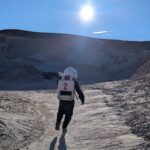
Janus 1’s first double EVA on Sol 4, taken on another beautiful Martian day by two teams of two. One team manned by both Matts worked on burying the nuclear reactor in regolith, while at the same time Pawel and Dave got practice with the robot system provided by Nicholas Conlon of CU Boulder.
The two Matts took turns digging until after 54 minutes of toil they had a hole big enough to hold the entire mock reactor. A few issues came up along the way including Matt’s (does it matter which one?) communications head piece that slid of his head until repositioned. That’s part of the learning in sim experience. Afterwards, they removed the reactor and covered up the hole. We will hear more about the reactor in future reports.
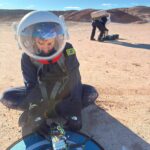
Meanwhile Pawel and Dave set up the mobile robot, named "Case", after a robot from sci-fi movie "Interstellar". The process was long, due to our not having done it before, but it worked the first time. Pawel did the driving from a laptop while Dave walked along with his new friend Case, while watching for obstacles. Case can be programmed from the laptop to drive a particular course, but sometimes Pawel had to manually drive it from his laptop computer.
The main goal of the study with Case is to understand how future astronauts, in current real-world robotic applications, where users rely heavily on telemetry, map data, and intuition in order to infer how competent a robot will be in a given environment. Telemetry can consist of a variety of data, however in our experiments, telemetry will include the robot’s position, heading, velocity, battery level, and other state information. Map data consists of a displayed map with iconography indicating features such as positions of the robot, waypoints, hazards, and other relevant information. This information, while valuable, can be confusing for non-expert users whose mental model of the robot’s competence is incomplete or inaccurate, tedious to follow and monitor, and can lead to poor human decision-making. Instead, this research focuses on developing more human-centered approaches to convey robot competency.
In an unusually productive day, Sean and Matt S. also gave the rest of the crew an introduction to their software based "Toolset for Shared and Long-term Document Management and IT Operations". More on this in a later journalist report.
Today’s person of interest is Executive Officer Matthew Storch. He has B.S. and M.S. degrees in electrical engineering from Stevens Institute of Technology and a Ph.D. in computer science from UIUC. He has worked as a software engineer and has held various engineering management positions for 35 years He is currently acting VP Engineering and CTO of a small (30 person) company that is building a specialized physical infrastructure management product (target audience is large corporations and government institutions). Outside of work, Matthew has a long-standing passion for adventure, technical achievement and unusual experiences that has led him to becoming an airplane pilot, a gyroplane pilot, sailboat & powerboat operator, and a submersible pilot.
GreenHab Report – April 17th
Crew 297 GreenHab Report 17-04-2024
GreenHab Officer: Sean Marquez
Environmental control:
– Heater on (set to 55F)
– Fan on
Average temperatures: 91F
Hours of supplemental light: N/A
Daily water usage for crops: 5.25 gal
Daily water usage for research and/or other purposes: 0.25 gal
Water in Blue Tank: 191 gal
Time(s) of watering for crops: 11:34, 12:33, 15:18
Changes to crops: Carrots, radishes, and red cabbages were looking wilted. Two of the (Riya & Garbanzo) kale plants were looking less wilted compared to the prior two days.
Narrative: Crops that were wilting today were likely due to EPS fluctuations, causing inconsistent air flow from the fan system in the GreenHab throughout the day. While watering the plants around 15:18, the GreenHab temperature had reached 110F. In an attempt to supplement the lack of air flow and reduce heat build up in the GreenHab, the door was opened around 16:00 to allow for the tunnel system to act as a temporary air conduit, at least ’til around sunset when the door was closed.
Harvest:
– 288g squash
– 2g cherry tomato
Support/supplies needed:
– (more of a nice to have, but) a means to query and download the GreenHab atmosphere temperature data from HomeAssistant as to be able to perform time-series analysis, automation of calculating average temperatures, and/or for comparison with the FPrime data collection system.
Operations Report – April 17th
Crew 297 Operations Report 17-04-2024
SOL: 3
Name of person filing report: Matt Lynch (Engineer)
Non-nominal systems: Suit 2 (stuck valve), Suit 9 (broken visor), Suit 4 (missing metal tie on rear of helmet collar)
Notes on non-nominal systems: The issues with Suit 2 and 9 were already noted before our mission. The issue with Suit 4 was found today, spare parts are being looked for and if they are not found a zip tie can be used as a temporary fix.
ROVERS
Spirit rover used:
Hours: 251.1
Beginning charge: 100%
Ending charge: 38%
Currently charging: No
Curiosity rover used:
Hours: 180
Beginning charge: 100%
Ending charge: 56%
Currently charging: No
General notes on rovers: NA
Summary of Hab operations:
WATER USE: 20.4 gallons
Water (static tank): 380 gallons
Static tank pipe heater (on or off): off
Static tank heater (On or off): off
Toilet tank emptied: no
Summary of internet: Looking up recipes, downloading entertainment, downloading navigation applications, report formatting methods, catching up on Earthly news
Summary of suits and radios:
Radios 1,2,5, and 6 were used.
EVA Suits 4,7, and 11 were used.
Summary of GreenHab operations:
WATER USE: 5.25 gallons
Heater: Yes
Supplemental light: N/A
Harvest: 288 g of suspected squash and 2 g cherry tomato
Summary of ScienceDome operations: NA
Summary of RAM operations: (Tools used, work done): NA
Summary of any observatory issues: NA
Sol Summary – April 17th
Crew 297 Sol Summary Report 17-04-2024
Sol: 03
Summary Title: Red Planet Rocks!
Author’s name: Pawel Sawicki
Mission Status: Nominal
Sol Activity Summary: The crew started the day at 0800, welcomed by the smell of the delectable crepes prepared by Sean and Matt S. With the mood already in good spirits after breakfast, the EVA team could not flounder, as they hastily were able to locate the NPS and spent the rest of the time analyzing the rocks of the Red Planet. After a fortunate EVA, the crew was treated to a mouthwatering take on fromage et legumes soup prepared by Matt L. While the soup was prepared, the crew learned how to play the cooperative card game Hanabi. In the afternoon, Sean and Pawel troubleshooted thermal problems within the GreenHab along with harvesting a ripe cherry tomato. Dinner concluded a day of scrumptious meals, with a soy peanut couscous containing vegetables and chicken, prepared by chefs Matt L. and Sean.
Look Ahead Plan:
Tomorrow we will perform a single EVA in the morning. This EVA will be the first for Case, our robotic crewmate, who will traverse and record imagery as we monitor closely. The EVA will also test out digging possibilities for the [inert] NPS.
Anomalies in work:
Suit 5 (ventilation electrical connection): Investigated and likely fixed. To be further examined/tested in the coming days.
GreenHab automated fan: The GreenHab fan powered on today when the GH temp reached 94F, but then turned off. It then powered cycled continuously but never reached its expected rpm.
Suit 4 (collar cable ring missing): In work
Weather:
Morning (data from 0900): calm winds (2 mph), chilly (53F), and clear skies (0% cloud coverage)
Noon: moderate winds (15 mph), warm (70F), and clear skies (0% cloud coverage)
Afternoon (1800): moderate winds (17 mph), warm (76F), and clear skies (0% cloud coverage)
Crew Physical Status: Crew health is nominal.
EVA: EVA was nominal today. The crew found the hidden NPS fairly quickly (~15 minutes) and spent the rest of the time performing gamma-ray spectrometer readings of regions along Cow Dung Road south of MDRS including Robert’s Rock Garden.
Reports to be filed:
Sol Summary
Journalist Report
GreenHab Report
Operations Report
EVA report (1 EVA)
EVA request (1 EVA)
Support Requested: We request that the [inert] NPS be placed by Mission Support at a location of their choosing (though reachable by rover and within a maximum of 15 minutes of walking) in either Candor Chasma, Eos Chasma, Valles Marineris, or Aurorae Chaos for a search and recovery EVA on 19-04-2024. The NPS will be placed in the rear airlock tomorrow night, 18-04-2024 by 1600. Once the inert NPS is hidden, precise GPS coordinates and a photo are requested to be taken to not lose track of the location. These GPS coordinates are then asked to be sent to Pawel.
Crew Photos – April 17th
Journalist Report – April 17th
Crew 297 – Janus 1 Journalist – David Laude
Our fourth EVA on Sol 3, taken on this beautiful Martian day by three of the crew, found the hidden nuclear reactor mockup (a 20-gallon capacity cylindrical metal container). Crew members of yesterday’s third EVA provided a simulated landing site for the nuclear power system. Sarah, the EVA Crew Leader, Pawel and Dave were given an approximate landing site via GPS coordinates, which was within 1000 feet from the actual location. The terrain here was like a maze of short hills, any of which could hide the reactor. Fortunately, we were headed in the correct direction from the start and Dave found the reactor within 15 minutes. Afterwards, the EVA crew was tasked to find a location where it could dig to bury it. In this Martian terrain it is common to immediately be stymied by loose chunks of sandstone. The team drove further south on Cow Dung Road and then parked the rovers. Digging near the road quickly revealed sand stone slabs. Dave, having been in this area before, suggested an area 60 meters further west from the road where Pawel found loose regolith with his shovel. He quickly dug down a half meter in one location and then another. This area is likely where it will be buried and later retrieved. Burial is required to help reduce radiation exposure to humans with an active installation.
Sarah had this to say about today’s highly successful EVA, "Today was the first EVA with the Gamma Ray Spectrometer. We measured the natural amounts of radioactive potassium, uranium, and thorium in the regolith 1000 m south of the Hab, as well as conglomerates at Robert’s Rock Garden, and sandstone and regolith at a location that from orbit looks redder that some of the surrounding rocks. Ratios of these different elements can tell us about predicted mineralogy, changes in lithology, and even if Redox conditions has been pervasive in this area."
EVA Crew Leader Sarah is currently a Geology Ph.D. candidate at the University of Kansas, focusing her research on analog materials for Mars and Ocean Worlds using Raman spectroscopy. She worked on developing a chemical calibration for chlorite minerals using Raman Spectroscopy, which also has implications for Mars research. Sarah also interned at NASA’s Jet Propulsion Laboratory in the Origins and Habitability Lab in the summers of 2021 and 2022. Sarah was an active member on the ChemCam Instrument Team on the Mars Curiosity Rover and spent three summers at Los Alamos National Laboratory. Sarah is currently a Geology Ph.D. candidate at the University of Kansas, focusing her research on analog materials for Mars and Ocean Worlds using Raman spectroscopy. During her graduate studies, Sarah also interned at NASA’s Jet Propulsion Laboratory in the Origins and Habitability Lab. In 2018, Sarah graduated from Kansas State University, with three bachelor’s degrees in Chemistry, Geology, and Geography. Throughout her undergraduate years, Sarah spent three summers at Los Alamos National Laboratory.
EVA Report – April 17th
Crew 297 EVA 4 Report 17-4-2024
EVA #4
Author: Sarah Lamm
Purpose of EVA: To locate the NPS from yesterday and to observe a geological formation that from orbit is redder than the surrounding location
Start Time: 9:36 AM
End Time: 1:00 PM
Narrative: We arrived at the first stop to locate the NPS device for Matt L’s research project. It was found quickly. From there we moved to the south and stopped at the location yesterday to test how easy it would be to dig in the regolith and to get initial Gamma-Ray Spectrometer readings of the regolith. We continued south to the region that looked redder from orbit, to take more observations of the regolith and the rocks. Lastly, we headed north toward the Hab and stopped at Robert’s Rock Garden to observe those rocks in comparison to those we had already seen.
Destination: Find the NPS, location to dig and gamma ray on regolith, redder area regolith & rocks, Robert’s Rock Garden (Stop #4)
Coordinates: 12S 518166N, 425092E (Stop #1); 12S 518065 4250003 (Stop #2); 12S 518819 4248714 (Stop #3); 12S 518278 4249467 (Stop #4)
Participants: Pawel Sawicki (Commander), Dave Laude (Journalist), Sarah Lamm (Geologist)
Road(s) and routes per MDRS Map: Cow Dung Road
Mode of travel: Spirit, Opportunity; Walking
EVA Report – April 20th
Crew 297 EVA 8 Report 20-4-2024
EVA # 8
Author: Matthew Storch
Purpose of EVA: We first did another seek for the NPS Project, by traveling to the coordinates specified by Mission Support, and searching a 300 m radius for the NPS. We then evaluated the robot, excavated a site for placement of the NPS, and explored the surrounding region for geological purposes.
Start Time: 9:08 AM
End Time: 12:55 PM
Narrative: Crew obtained the NPS search coordinates and proceeded to the search area, which was near the Candor Chasma. We stopped just off Cow Dung road and proceeded on foot along the Gateway to Candor, to conduct the search. The crew split into 2 teams that straddled a ravine. Matt Lynch quickly spotted the NPS and we retrieved it and returned to the rovers. We then proceeded north along Cow Dung Road to Galileo Road and headed east on Galileo until we reached the turnaround limit on battery power. The turnaround point was not deemed suitable for the other mission objectives, so we started to return along Galileo road, stopping twice to evaluate possible sites to cover the remaining mission objectives. Once a suitable location was found, Pawel and Matt S set up the robot, while Matt L scouted for suitable nearby excavation sites and Sarah conducted geological studies of the area. The robot had problems connecting to its network and there was not much we could do in the field to address the problem, so we had to abandon that objective for today. All four EVA crew members then joined the excavation effort, using a variety of tools and working in shifts. In the end we were able to excavate deep enough to properly bury the NPS, but finished just in time to return from the EVA with a suitable time margin. Excavation was much more difficult than in the first location, with the regolith removal rate being about one half of what it was in the first excavation, despite having 4 crew members to work this excavation vs. 2 for the previous one.
Destination: Candor Chasma area
Coordinates: 519608E 4251496N
Participants: Pawel Sawicki (Commander), Matthew Storch (XO), Sarah Lamm (Geologist), Matthew Lynch (Engineer)
Road(s) and routes per MDRS Map: Cow Dung Road, Galileo Road
Mode of travel: Curiosity, Opportunity, and walking
GreenHab Report – April 19th
Crew 297 GreenHab Report 19-04-2024
GreenHab Officer: Sean Marquez
Environmental control:
– Heater on (set to 55F)
– Fan on (set to 92F; not accounting for power outages)
Average temperatures: 79F
Hours of supplemental light: N/A
Daily water usage for crops: 1 gal
Daily water usage for research and/or other purposes: 0 gal
Water in Blue Tank: 187 gal
Time(s) of watering for crops: 12:30
Changes to crops: N/A
Narrative: Fan power went out again shortly after entering the GreenHab around 12:20. Same procedure was implemented as previously whereby the GreenHab door was purposefully left open at 12:20 to allow air flow from the tunnel system to mitigate heat build-up, then closed at 17:25 when the GreenHab atmosphere temperature had dropped to ~85F and the outdoor temperature had dropped to ~79F. More brown leaves and/or yellow stems from cherry tomatoes were composted.
Harvest:
– 11g cherry tomato
– 1g rosemary
Support/supplies needed: Access to MDRSCampus network and HomeAssistant credentials would be convenient for being able to download temperature data from personal laptop, as opposed to having to use the lower deck computer.


You must be logged in to post a comment.