Mars Desert Research Station
Mission Summary
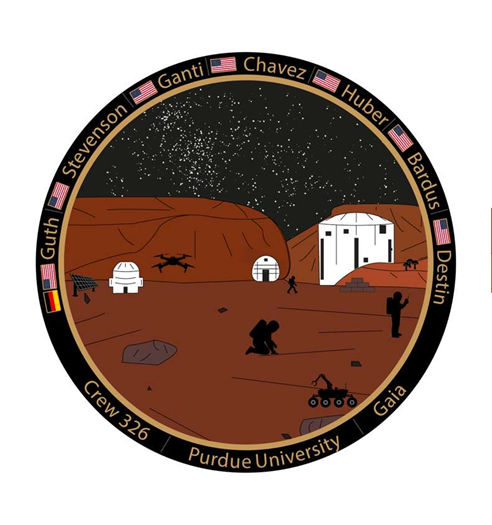
Crew 326 – Gaia
Dec 28th, 2025 – Jan 10th, 2026
Crew Members:
Commander Keegan Chavez
Crew Scientist: Benjamin Huber
Crew Engineer: Idris Stevenson
Health and Safety Officer: Katharina Guth
Green Hab Officer: Vindhya Ganti
Crew Journalist: Daria Bardus
Crew Biologist: Armand Destin
Mission Narrative:
The first few days in sim went as expected. The first EVA for every crew member is mainly to get experience with the EVA suits, radio communications and general operating procedures. Multiple crew members had to be reminded that taking your gloves off on Mars would not end well, but it was better to learn the lesson early. The next two days saw the EVA intensity increase with longer EVA and more demanding hikes, the crew getting a better idea of how long EVA prep time would take and the pace they could work at on EVA. The overall picture of the mission was starting to take shape, and just in time for a New Year’s Eve celebration. Cake, champagne, and party favors were shared as the crew had a special comms window to watch the ball drop. They were all now looking forward to the new year and the rest of the mission.
Sol 4 saw the start of some tumultuous days for the crew. The initial procedures outlined to test the RF signal strength were deemed too dangerous for crew operations as they interfered with the EVA team’s ability to communicate with CAPCOM. Tests for this project had to be postponed until procedures could be updated. The next two days saw poor weather conditions that cancelled a few EVAs and pushed research back, while one EVA for the rover had to be cut short due to poor terrain conditions. These days had a few silver linings: defining a proper procedure for RF mapping on EVAs, the first GreenHab harvest of the mission, crew showers, and the start of a series of Terraforming Mars games. The crew had seen many delays at this point but were resolved to maintain high spirits and find ways to make progress towards mission objectives regardless.
Sol 7 was seen as a turning point for the mission. While weather delayed the EVA for the day, the full EVA was able to be completed with all scientific objectives completed. The crew even had time to summit Phobos Peak for some excellent scenery and photos. The crew left for EVA 9 on Sol 8, but the weather worsened as they approached the operating region and the EVA had to be recalled, there were already plans made to return to the same region so data could still be collected. At this point, the orange drink mix had become a staple of our diet, and our crew engineer found a way to turn it into an orange chicken sauce that was easily the best meal of the mission.
From there, it was a standard couple of days to close out the mission. The crew could prepare for EVAs in less than 30 minutes, and we had become accustomed to extended EVA times. The crew could even handle up to three projects at once on an EVA, allowing us to catch up on any data collection that had been missing due to previous days’ weather delays. Highlights of the last few days included a movie night with an assortment of candies and fried foods on Sol 10 and the commander completing his 5-0 unbeaten streak of Terraforming Mars on Sol 11. With the completion of EVA 13, the crew had finished data collection for all research projects and had clearly shown improvements in the daily routine of EVA prepping, report writing, and maintaining a physically and mentally fit self.
EVA Summary
EVA 01:
Crew Scientist, Crew Engineering, Crew Journalist, and Crew Biologist took rovers to Marble Ritual site with the objective of practicing EVA prepping, rover operations, radio communications, and general EVA procedure. Objective was accomplished.
EVA 02
Crew Commander, Health and Safety Officer, and GreenHab Officer took rovers to Marble Ritual site with the objective of practicing EVA prepping, rover operations, radio communications, and general EVA procedure. Objective was accomplished.
EVA 03
Crew Scientist, Crew Journalist, and Crew Biologist went on foot to Hab Ridge with the objective of acquiring a sample for the crew scientist’s brick making project. The crew did not make it as far as initially expected on foot but were still able to acquire a sample and return within the mission time. Further EVA times were adjusted based on this. Objective was accomplished.
EVA 04
Health and Safety Officer, Crew Engineer, and Green Hab Officer took rovers to Kissing Camel Ridge with the objectives of placing an environment sensor and taking images of the ridges. All objectives were accomplished.
EVA 05
Health and Safety Officer, Crew Biologist, and Crew Engineer left on foot towards Skyline Ridge with the objectives of placing an environmental sensor, taking images of the ridge, and collecting RF signal power data. Procedures for RF mapping were deemed too dangerous to EVA operations and data collection was postponed. Other objectives were accomplished.
EVA 06
Health and Safety Officer, GreenHab Officer, and Crew Journalist stayed at the Hab with the objective of testing new RF mapping procedures and testing the rover functionality. Poor terrain from recent weather caused the rover team to be unable to perform testing. Other objectives were accomplished.
EVA 07
Crew Commander, GreenHab Officer, and Crew Journalist stayed at the Hab with the objective of testing the rover functionality. Objective was accomplished.
EVA 08
Crew Scientist, Health and Safety Officer, Crew Engineer, and Crew Biologist took rovers to Phobos Peak with the objectives of gathering a sample for brick making and gathering RF signal power data. All objectives were accomplished.
EVA 09
Crew Commander, GreenHab Officer, and Crew Journalist took rovers to White Rock Canyon with the objective of testing the rover functionality. Weather conditions forced the crew to return before data could be collected.
EVA 10
Crew Scientist, Health and Safety Officer, and Crew Biologist took rovers to Candor Chasma with the objective of gathering a sample for brick making and gathering RF signal power data. All objectives were accomplished.
EVA 11
Health and Safety Officer, GreenHab Officer, and Crew Journalist took rovers to Kissing Camel with the objectives of retrieving the environmental sensor, testing the rover functionality and gathering RF signal power data. All objectives were accomplished.
EVA 12
Crew Commander, Crew Scientist, and Crew Engineer left on foot to the Amazonis Planitia with the objective of retrieving the environmental sensor. Objective was accomplished.
EVA 13
Health and Safety Officer, Crew Engineer, Crew Journalist, and Crew Biologist took rovers to White Rock Canyon with the objectives of testing the rover functionality, gathering RF signal power data, and retrieving the two Hab environmental sensors upon return. All objectives were accomplished.
Research Milestones and Outcomes
1.
Title: Autonomous Mars Rover for Geological Sample Collection
Author(s): Vindhya Ganti
Objectives: Train an image-based navigation system on local landmarks to allow a rover to navigate autonomously
Milestones:
- Images for training gathered on EVA 04 and EVA 05
- Imaging software successfully discerns location on Sol 6
Outcome: Imaging software has been proven in lab testing, it is ready to be integrated onto rover platform
2.
Title: Dust Storm Detection
Author(s): Idris Stevenson
Objectives: Install environmental sensors to give crews early warnings on incoming dust storms and other hazardous weather
Milestones:
- Placed sensors on EVA 04, EVA 05, and EVA 07
- Retrieve sensors on EVA 11, EVA 12, and EVA 13
Outcome: Sensors were able to acquire data over a time span of 6-7 days and through a variety of weather and environmental conditions, data has been retrieved from on board memory and is ready to be analyzed
3.
Title: Utilization of In-Situ Materials for Construction
Author(s): Benjamin Huber
Objectives: Gather materials from the surface of Mars to make bricks for construction and testing the strength of those bricks
Milestones:
- Sample 01 collected on EVA 03
- Brick made from sample 01 on Sol 03 and Sol 05
- Sample 02 collected on EVA 08
- Brick made from sample 02 on Sol 08
- Sample 03 collected on EVA 10
Outcome: Multiple samples were collected from a variety of geological sites, and bricks were made from 2 of the 3 samples, all bricks made were stress tested, 1 final brick is planned to be made and tested upon return home before conclusion can be drawn.
4.
Title: Terrain-Dependent RF Signal Propagation Mapping
Author(s): Katharina Guth
Objectives: Begin to create an RF signal strength map of the area surrounding the Hab
Milestones:
- Finalized procedure on EVA 06
- Mapped data from area around Hab on Sol 06
- Gather RF mapping data on EVA 08, EVA 10, EVA 11, EVA 13
Outcome: Gathered significant data in multiple regions of MDRS, successful map a portion of data, planning to map the rest of the data and finalize conclusions post mission
5.
Title: Crew-Centric Interface for Performance Optimization at MDRS
Author(s): Armand Destin
Objectives: Develop a platform to allow teams to perform risk assessment in an efficient and effective manner
Milestone:
- Collected data on crew decision making risk assessment on EVA 03, EVA 05, EVA 08, EVA 10, and EVA 13
Outcome: A platform will be developed using data collected on mission, pending IRB approval and subsequent consent forms
6.
Title: Autonomous Mars Rover for Geological Sample Collection
Author(s): Daria Bardus
Milestones:
- Demonstrated basic rover functionality in Hab on Sol 03
- First successful sample collected using rover on EVA 07
- Success sample collections using rover on EVA 11 and EVA 13
Outcomes: Rover was able to successfully acquire terrain samples in multiple terrains, improvements for remote sample collection will be detailed for future crews
Overall Mission Outcomes:
All crew members gathered significant data for the respective research projects to consider their projects a success. Many crew members plan to finish data analysis post mission and submit papers for review to numerous journals covering research in extreme environments.
The crew become very accustomed to the daily routine of living in and maintaining an isolated station. EVA prepping and daily report writing became more efficient, even as crews continued to stay on top of chores and research. Crew were able maintain a healthy balance of work and relaxation throughout the mission, keeping overall wear and stress to a minimum.
Even with many delays due to weather, lack of resources and equipment, and unfamiliarity with the location, the crew was able to find creative ways to continue making progress towards all mission objectives. Overall, the mission was a success for Crew 326 – Gaia.
You must be logged in to post a comment.